Near Mountain Pass in San Bernardino County, California — The American West (Pacific Coastal)
Ranching and Mining
Photographed by Craig Baker, April 23, 2023
1. Ranching and Mining Marker
Topics. This historical marker is listed in this topic list: Settlements & Settlers. A significant historical year for this entry is 1883.
Location. 35° 26.149′ N, 115° 42.086′ W. Marker is near Mountain Pass, California, in San Bernardino County. It is on Interstate 15 26 miles south of Primm, on the right when traveling south. Located at Valley Wells Rest Area on the south-bound side of Interstate 15. Touch for map. Marker is in this post office area: Nipton CA 92364, United States of America. Touch for directions.

Regionally, this marker is in Greater Los Angeles, in the Mojave Desert,
this page online
Other nearby markers. At least 8 other markers are within 12 miles of this marker, measured as the crow flies: Who Has Lived Here? (here, next to this marker); Railroads Revolutionize Transportation (here, next to this marker); Movement in the Desert (here, next to this marker); Modern Highways (a few steps from this marker); Western Expansion (a few steps from this marker); Valley Wells (within shouting distance of this marker); Footprints in Time (approx. 0.2 miles away); Teutonia Peak Trail (approx. 11.8 miles away). Touch for a list and map of all markers in Mountain Pass.
Photographed by Denise Boose, May 18, 2015
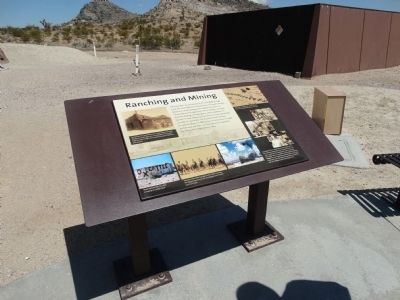
2. Ranching and Mining Marker
Photographed by Denise Boose, May 18, 2015
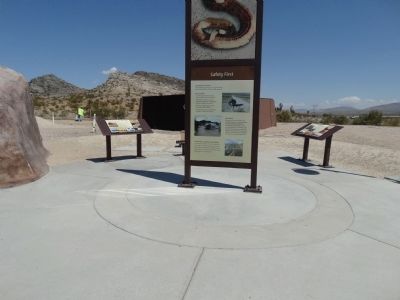
3. Ranching and Mining Marker on the left
Photographed by Denise Boose, May 18, 2015
4. Ranching and Mining Marker
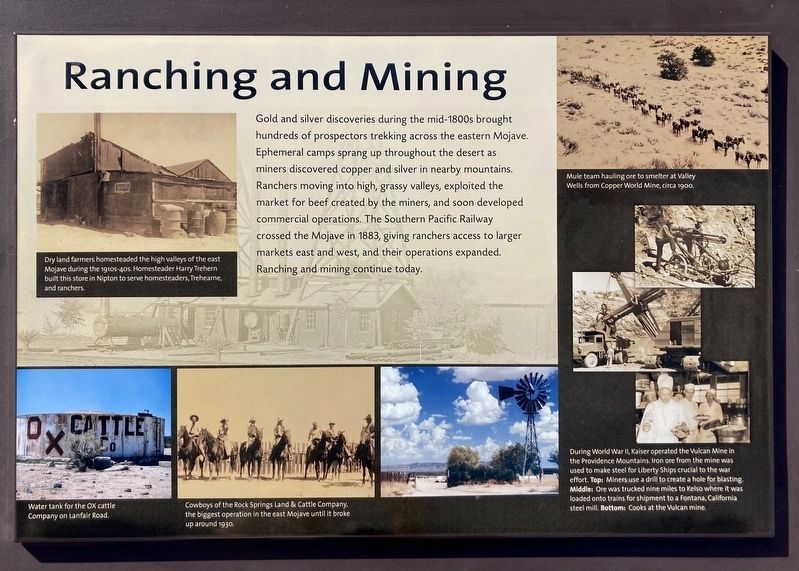
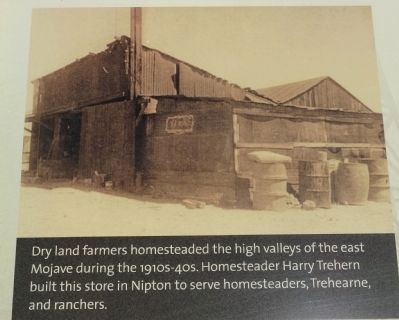
Dry land farmers homesteaded the high valleys of the east Mojave during the 1910s-40s. Homesteader Harry Trehern built this store in Nipton to serve homesteaders, Trehearne, and ranchers.
Photographed by Denise Boose, May 18, 2015
5. Ranching and Mining Marker
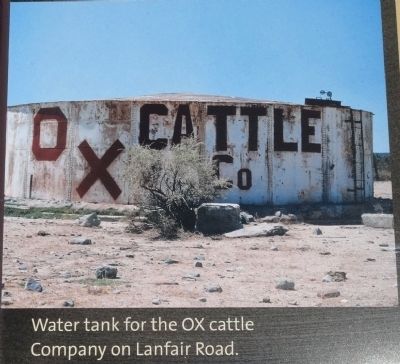
Water tank for the Ox cattle Company on Lanfair Road.
Photographed by Denise Boose, May 18, 2015
6. Ranching and Mining Marker
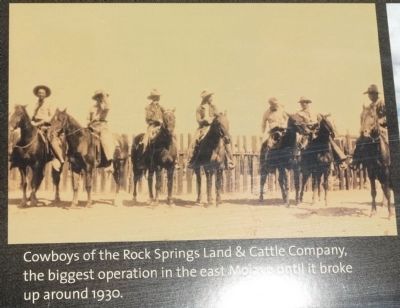
Cowboys of the Rock Springs Land & Cattle Company, the biggest operation in the east Mojave until it broke up around 1930.
Photographed by Denise Boose, May 18, 2015
7. Ranching and Mining Marker
Photographed by Denise Boose, May 18, 2015
8. Ranching and Mining Marker
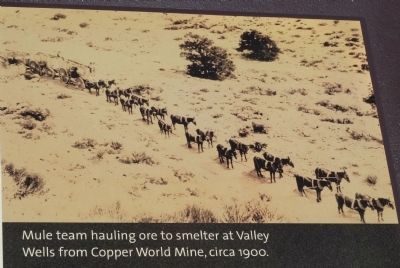
Mule team hauling ore to smelter at Valley Wells from Copper World Mine, circa 1900.
Photographed by Denise Boose, May 18, 2015
9. Ranching and Mining Marker
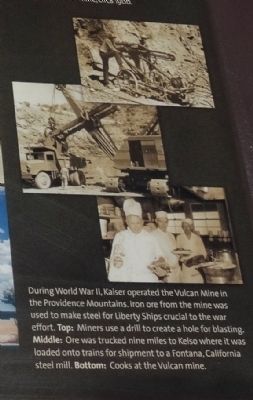
During World War II, Kaiser operated theh Vulcan Mine in the Providence Mountains. Iron ore from the mine was used to make stell for Liberty Ships crucial to the war effort. Top: Miners used a drill to create a hole for blasting. Middle: Ore was trucked nine miles to Kelso where it was loaded onto trains for shipment to a Fontana, California steel mill. Bottom: Cooks at the Vulcan Mine.
Credits. This page was last revised on October 16, 2024. It was originally submitted on May 31, 2015, by Denise Boose of Tehachapi, California. This page has been viewed 471 times since then and 21 times this year. Photos: 1. submitted on April 25, 2023, by Craig Baker of Sylmar, California. 2, 3. submitted on May 31, 2015, by Denise Boose of Tehachapi, California. 4, 5, 6, 7, 8, 9. submitted on June 1, 2015, by Denise Boose of Tehachapi, California. • Andrew Ruppenstein was the editor who published this page.
