Near Eisenach in Wartburgkreis, Thuringia, Germany — Central Europe
Südturm • South Tower • La Tour Sud
Photographed by William Fischer, Jr., September 27, 2013
1. Südturm • South Tower • La Tour Sud Marker

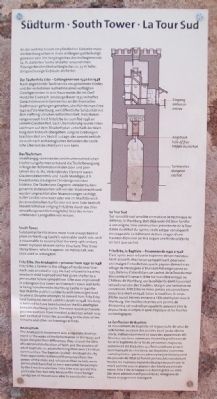
South Tower
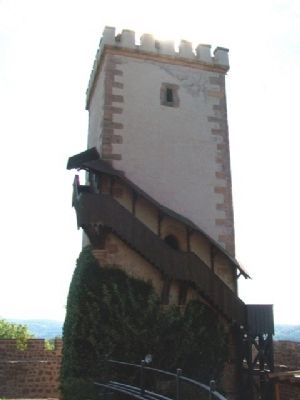
Substantial fortications must have always been in place on Wartburg Castle’s vulnerable south side, so it is reasonable to assume that the early 14th century tower replaced an even earlier structure. This three-storey tower, which is approx. 20 metres tall, was once used as a dungeon.
Fritz Erbe, the Anabaptist – prisoner from 1540 to 1548
Fritz Erbe, a farmer in the village of Herda near Eisenach, was arrested in 1533. He had refused to have his newborn child baptized and had given shelter to a persecuted fellow sympathizer. Erbe was imprisoned in a dungeon in a tower on Eisenach’s town wall before being transferred to Wartburg Castle in 1540 for fear that the public’s solidarity with him might lead to unrest. Despite attempts to convert him, Fritz Erbe held fast to his beliefs until his death in 1548. His body is believed to have been buried on the Elisabethplan beneath Wartburg Castle. The most recent archaeological excavations have revealed a skeleton which may well be that of Fritz Erbe, according to the date of the remains and other archaeological finds.
Anabaptism
The Anabaptist movement was a separate development in the wake of the Reformation in the 1520s and 1530s. Despite their differences they shared the idea of a personal declaration of faith and the practice of adult baptism, i.e. adults forming their own Christian communities. The Baptists (called »Anabaptists« by their opponents) distanced themselves from the power of the state and, whatever their beliefs, were persecuted, banished or even executed, for example by the Ernestine electors. Fritz Erbe was spared this particular fate but only because the more benign Landgrave of Hessen was able to exercise his veto.
An der wehrtechnisch empfindlichen Südseite muss die Wartburg schon in ihren Anfängen gut
this page online
Der Täufer Fritz Erbe – Gefangener von 1540 bis 1548
Nach abgelehnter Taufe seines neugeborenen Kindes und der verbotenen Aufnahme einer verfolgten Gleichgesinnten in sein Haus wurde der im Dorf Herda bei Eisenach ansässige Bauer 1533 verhaftet. Zunächst in einem Turmverlies an der Eisenacher Stadtmauer gefangen gehalten, überführte man Erbe 1540 auf die Wartburg, weil öffentliche Solidarität mit dem Häftling Unruhen befürchten ließ. Trotz Bekehrungsversuch hielt Fritz Erbe bis zum Tod 1548 an seinem Glauben fest. Laut Überlieferung wurde Erbes Leichnam auf dem Elisabethplan unterhalb der Wartburg dem Erdreich übergeben. Jüngste Grabungen brachten dort ein Skelett zutage, das sowohl zeitlich als auch nach archäologischen Befunden der sterbliche Überrest des Märtyrers sein kann.
Das Täufertum
Unabhängig voneinander und in unterschiedlichen Erscheinungsformen entstand die Täuferbewegung in Folge der Reformation in der 20er und 30er Jahren des
Photographed by William Fischer, Jr., September 27, 2013
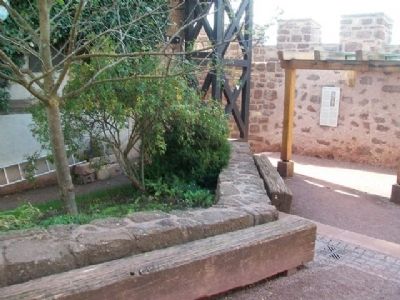
2. Südturm • South Tower • La Tour Sud Marker
Sur son côté sud sensible en matière de technique de défense, le Wartburg doit déjà avoir été bien fortifié à son origine. Une construction précédente de la Tour datée du début du 14ème siècle est par conséquent envisageable. Le bâtiment de trois étages d'une hauteur d'environ 20 m a acquis une triste célébrité en tant que cachot.
Fritz Erbe, le Baptiste-Prisonnier de 1540 à 1548 C'est après avoir refusé le baptême de son nouveau-né et accueilli chez lui un sympathisant poursuivi, ceci malgré l'interdiction, que le paysan domicilié au village de Herda près d'Eisenach fut emprisonné en 1533. Détenu d'abord dans
Photographed by William Fischer, Jr., September 27, 2013
3. Südturm • South Tower • La Tour Sud
La Confession de Baptiste
Le mouvement de Baptiste vit le jour suite de celui de la Réforme, au cours des années 20 et 30 du 16ème siècle, indépendamment et sous des apparences différentes. Les liens communs étaient la profession de foi et le baptême de la foi de personnes majeures, autrement dit d'adultes, qui formaient une propre communauté de chrétiens. Les Baptistes (nommés anabaptistes par leurs adversaires) se distançaient du pouvoir de l'Etat et furent persécutés nonobstant toutes les nuances, expulsés du pays ou punis par la mort comme sous le pouvoir des Electeurs ernestiniens. Fritz
Photographed by William Fischer, Jr.
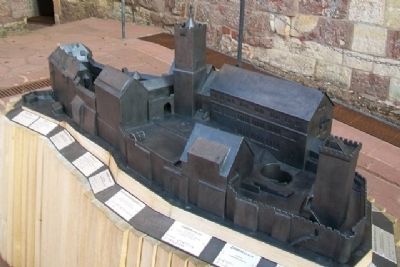
4. Model of Wartburg Castle for Blind-Low Vision Visitors
Topics. This historical marker is listed in these topic lists: Forts and Castles • Religion & Religious Structures. A significant historical year for this entry is 1540.
Location. 50° 57.931′ N, 10° 18.356′ E. Marker is near Eisenach, Thüringen (Thuringia), in Wartburgkreis. It is on Auf der Wartburg. Marker is at Wartburg Castle. Touch for map. Marker is at or near this postal address: Auf Der Wartburg 1, Eisenach TH 99817, Germany. Touch for directions.

Regionally, this marker is in Central Germany. Globally, it is in Europe, the European Union, Atlantic Europe, Central Europe, the Schengen Area, Western Europe, and the Western World. Historically, it finds itself in what was once the Holy Roman Empire, the former East Germany, and on the Inner German Border.
Other nearby markers. At least one other marker is within walking distance of this marker: Knight's Bath • Ritterbad • Le bain des chevaliers (within shouting distance of this marker).
Also see . . .
1. Wartburg Castle at Sacred Destinations. (Submitted on June 1, 2015, by William Fischer, Jr. of Reynoldsburg, Ohio.)
2. Fritz Erbe Bio at Global Anabaptist Mennonite Encyclopedia Online. (Submitted on June 1, 2015, by William Fischer, Jr. of Reynoldsburg, Ohio.)
Credits. This page was last revised on October 1, 2026. It was originally submitted on June 1, 2015, by William Fischer, Jr. of Reynoldsburg, Ohio. This page has been viewed 742 times since then and 103 times this year. Photos: 1, 2, 3, 4. submitted on June 1, 2015, by William Fischer, Jr. of Reynoldsburg, Ohio.
