
Karaseki in Göreme in Nevsehir, Turkiye — West Asia or Southeast Europe
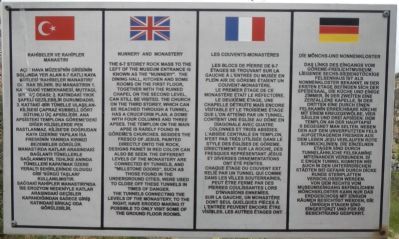
Nunnery and Monastery
Rahibeler ve Rahipler Manastiri
| — | Les Couvents-Monastères / Die Mönchs-und Nonnenkloster | — |
Photographed by Barry Swackhamer, April 23, 2015
1. Nunnery and Monastery Marker
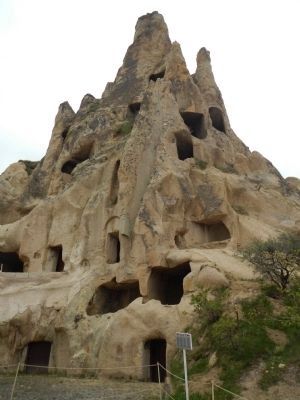
The 6-7 storey rock mass to the left of the museum entrance is known as the “nunnery”. The dining hall, kitchen and some rooms on the first floor, together with the ruined chapel on the second level, can still be visited. The church on the third storey, which can be reached through a tunnel, has a cruciform plan, a dome with four columns and three apse is rarely found in Göreme’s churches. Besides the fresco of Jesus, painted directly onto the rock, designs painet (sic) in red color can also be seen. The different levels of the monastery are connected by tunnels, and “millstone doors”, such as those found in the underground cities, were used to close off these tunnels in times of danger. The tunnels connecting the levels of the monastery, to the right, have eroded making it possible to only visit some of ground floor rooms.
Turkish:
Açık hava müzesi'nin girisinin solunda yer alan 6-7 katli kaya kütlesi 'rahi̇beler manastırı’ olarak bilinir. Bu manastırın 1. katıdaki yemekhanesi. mutfağı, birkaç odası; 2. katındaki̇ yıkık şapeli gezilebilir durumdadır. 3. kattaki -blr tünelle ulaşılankiliseli çapraz kubbeli, dört sütunlu üç apsislidir. Ana apsisteki templona Göreme’deki diğer kiliselerde pek rastlanmaz.
this page online
French: Click on the marker image to enlarge it and read the French text.
German: Click on the maker image to enlarge it and read the German text.
Topics. This historical marker is listed in this topic list: Religion & Religious Structures.
Location. 38° 38.367′ N, 34° 50.715′ E. Marker is in Göreme, Nevsehir. It is in Karaseki. It can be reached from Müze Cadde, on the right when traveling south. Touch for map. Marker is in this post office area: Göreme, Nevsehir 50180, Turkiye. Touch for directions.

Regionally, this marker is in Turkish Asia Minor — Anatolia. Globally, it is in Asia, West Asia, Mesopotamia, and in a coastal Mediterranean country. Historically, it finds itself in what was once the Byzantine Empire, the Ottoman Empire, the Roman Empire, and on the Silk Road.
Other nearby markers. At least 8 other markers are within walking distance of this marker: Elmali (Apple) Church (within shouting distance of this marker); Chapel of St. Catherine (within shouting distance of this marker); Chapel of St. Basil (within shouting distance
Photographed by Barry Swackhamer, April 23, 2015
2. Nunnery and Monastery Marker
More about this marker. This marker is located at the Göreme Open Air Museum (Göreme Açık Hava Müzesi).
Also see . . . Churches of Göreme. In the 4th century small anchorite communities began to form in the region, acting on instruction of Saint Basil of Caesarea. They carved cells in the soft rock. During the iconoclastic period (725-842) the decoration of the many sanctuaries in the region was held to a minimum, usually symbols such as the depiction of the cross. After this period, new churches were dug into the rocks and they were richly decorated with colourful frescoes. When the Cappadocian Greeks were expelled from Turkey in 1923 in the Population exchange between Greece
Photographed by Barry Swackhamer, April 23, 2015
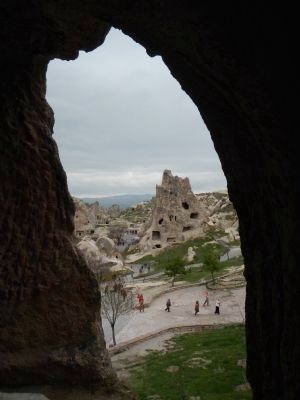
3. The Nunnery from St. Onuphrius' Church
Credits. This page was last revised on February 13, 2023. It was originally submitted on June 3, 2015, by Barry Swackhamer of Brentwood, California. This page has been viewed 558 times since then and 24 times this year. Photos: 1. submitted on June 3, 2015, by Barry Swackhamer of Brentwood, California. 2, 3. submitted on June 5, 2015, by Barry Swackhamer of Brentwood, California. • Andrew Ruppenstein was the editor who published this page.
