Hudson Bay in Vancouver in Clark County, Washington — The American West (Northwest)
From Military to Municipal Airfield
Photographed by Kevin W., June 12, 2008
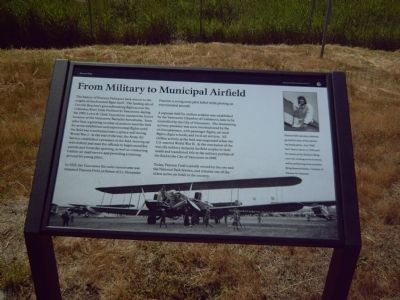
1. From Military to Municipal Airfield Marker
In 1925, the Vancouver Barracks Aerodrome was renamed Pearson Field, in honor of Lt. Alexander Pearson, a young army pilot killed while piloting an experimental aircraft.
A separate field for civilian aviation was established by the Vancouver Chamber of Commerce,
this page online
Today Pearson Field is jointly owned by the city and the National Park Service, and remains one of the oldest active air fields in the country.
Erected by Vancouver National Historic Reserve.
Topics. This historical marker is listed in these topic lists: Air & Space • Military. A significant historical year for this entry is 1905.
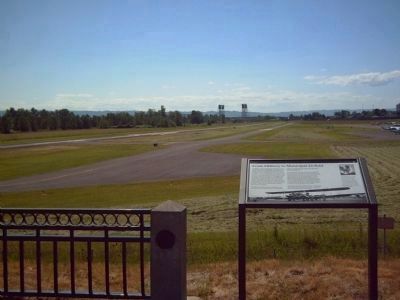
Location. 45° 37.227′ N, 122° 38.984′ W. Marker is in Vancouver, Washington, in Clark County. It is in Hudson Bay. It is on S. V Street near Columbia House Boulevard. Touch for map. Marker is in this post office area: Vancouver WA
Photographed by Kevin W.
2. From Military to Municipal Airfield Marker

Regionally, this marker is in Greater Portland Area and in Southwest Washington State. It is also on the American Pacific Coast, in the Pacific Northwest, and in the Lewis & Clark Corridor. Globally, it is in North America, on the Pacific Rim, in the Western Hemisphere, in the Western World, and in the Anglosphere.
Other nearby markers. At least 8 other markers are within walking distance of this marker: U. S. Grant Memorial (approx. 0.3 miles away); Ilchee (approx. 0.4 miles away); Pearson Airfield (approx. 0.4 miles away); Carlton Foster Bond (approx. 0.4 miles away); Early Aviation History in Vancouver (approx. 0.4 miles away); The Soviet Transpolar Flight of 1937 (approx. 0.4 miles away); The Chkalov Transpolar Flight (approx. 0.4 miles away); The 321st Observation Squadron (1923-1941) (approx. 0.4 miles away). Touch for a list and map of all markers in Vancouver.
More about this marker. The background photograph on the marker has the caption, "This Curtiss B-2
Photographed by Kevin W., June 12, 2008
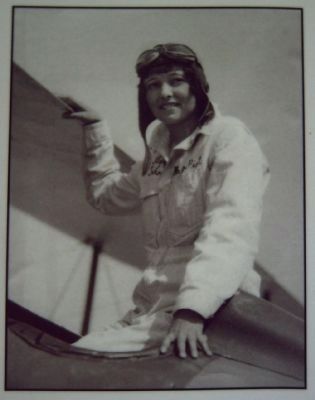
3. Upper right photograph on the "From Military to Municipal Airfield" Marker
Pearson Field was also a training ground for some of the nation's top femaile pilots. Ann "Half Pint" Bohrer (above in 1929) paid for lessons at Tex Rankin's flying school by working as his secretary and by performing in his acrobatic flying demonstrations. Courtesy of Pearson Air Museum.
Photographed by Kevin W., June 12, 2008
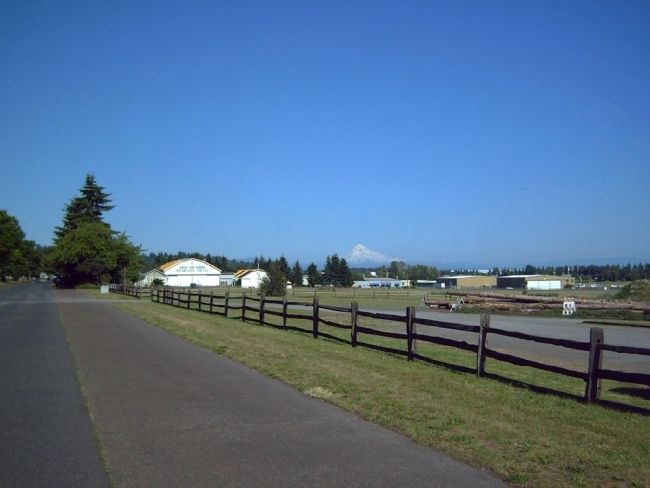
4. Mount Hood seen over the Pearson Field hangers.
Credits. This page was last revised on February 7, 2023. It was originally submitted on June 19, 2008, by Kevin W. of Stafford, Virginia. This page has been viewed 1,617 times since then and 25 times this year. Photos: 1, 2, 3, 4. submitted on June 19, 2008, by Kevin W. of Stafford, Virginia.
