Rogersville in Lauderdale County, Alabama — The American South (East South Central)
Rogersville Presbyterian Church in the U.S.A.
Photographed by Sandra Hughes, October 19, 2013
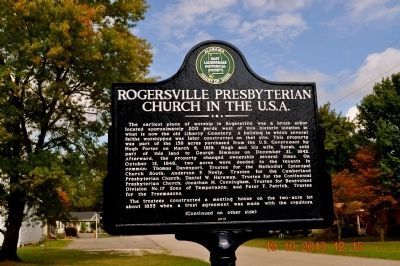
1. Rogersville Presbyterian Church in the U.S.A. Marker (side 1)
The earliest place of worship in Rogersville was a brush arbor located approximately 200 yards west of this historic location in what is now the old Liberty Cemetery. A building in which several faiths worshipped was later constructed on that site. This property was part of the 158 acres purchased from the U.S. Government by Hugh Porter on March 6, 1819. Hugh and his wife, Sarah, sold part of this land to George Simmons on December 21, 1842. Afterward, the property changed ownership several times. On October 12, 1848, two acres were deeded to the tenants in common: Thomas Davenport, Trustee for the Methodist Episcopal Presbyterian Church; Daniel W. Haraway, Trustee for the Continental Presbyterian Church; Jonathan M. Cunningham, Trustee for Benevolent Division No. 17 Sons of Temperance; and Peter F. Patrick, Trustee for the Freemasons.
The trustees constructed a meeting house on the two-acre lot about 1855 when trust agreement was made with the creditors.
this page online
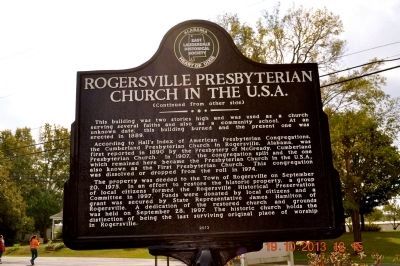
According to Hall's Index of American Presbyterian Congregations, the Cumberland Presbyterian Church in Rogersville, Alabama, was first reported in 1890 by the Presbytery of McGready, Cumberland Presbyterian Church. In 1907, the congregation split and the one which remained here became the Presbyterian Church in the U.S.A., also known as the First Presbyterian Church. This congregation was dissolved or dropped from the roll in 1974.
The property was deeded to the Town of Rogersville on September 20, 1975. In an effort to restore the historic property, a group of local citizens formed the Rogersville Historical Preservation Committee in 1997. Funds were donated by local citizens and a grant was secure by State Representative James Hamilton of Rogersville. A dedication of the restored church and grounds was held on September 28, 1997. The historic church holds the distinction of being the last surviving original place of worship in Rogersville.
Erected 2013 by East Lauderdale Historical Society.
Topics.
Photographed by Sandra Hughes, October 19, 2013
2. Rogersville Presbyterian Church in the U.S.A. Marker (side 2)
Location. 34° 49.613′ N, 87° 17.762′ W. Marker is in Rogersville, Alabama, in Lauderdale County. It is at the intersection of Lee Street (County Route 66) and Dement Street, on the right when traveling west on Lee Street. Touch for map. Marker is in this post office area: Rogersville AL 35652, United States of America. Touch for directions.

Regionally, this marker is in North Alabama and in the Shoals. It is also in the American South, specifically in the Deep South, in Appalachia, and specifically in Southern Appalachia. Globally, it is in North America, a Gulf of Mexico state, the Western Hemisphere, the Western World, and the Anglosphere. Historically, it finds itself in what was once the territory of the Mississippian Culture, one of the Confederate States of America, and the Antebellum South.
Other nearby markers. At least 8 other markers are within 2 miles of this marker, measured as the crow flies: Heritage Park (about 600 feet away, measured in a direct line); Lamb’s Ferry Road
Photographed by Sandra Hughes, October 19, 2013
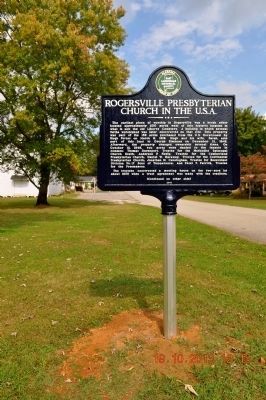
3. Rogersville Presbyterian Church in the U.S.A. Marker
Photographed by Sandra Hughes, October 19, 2013
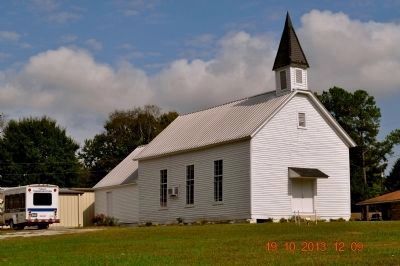
4. Rogersville Presbyterian Church in the U.S.A.
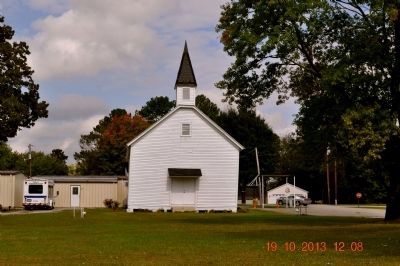
Photographed by Sandra Hughes, October 19, 2013
5. Rogersville Presbyterian Church in the U.S.A.
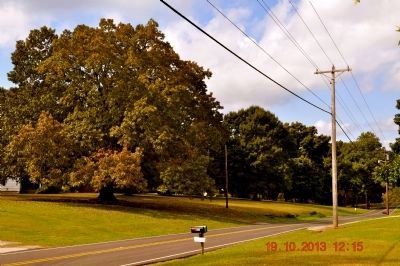
Photographed by Sandra Hughes, October 19, 2013
6. Rogersville Presbyterian Church in the U.S.A. Marker
If you follow this road about 1/2 mile to top of hill on left is the old Liberty cemetery.
Credits. This page was last revised on June 16, 2016. It was originally submitted on October 21, 2013, by Sandra Hughes Tidwell of Killen, Alabama, USA. This page has been viewed 1,421 times since then and 49 times this year. Last updated on June 12, 2015, by J. Makali Bruton of Washington, District of Columbia. Photos: 1, 2, 3, 4, 5, 6. submitted on October 21, 2013, by Sandra Hughes Tidwell of Killen, Alabama, USA. • Bill Pfingsten was the editor who published this page.
