Near Bamberg in Bamberg County, South Carolina — The American South (South Atlantic)
Pinewood Plantation
Photographed by Anna Inbody, May 26, 2011
1. Pinewood Plantation Marker
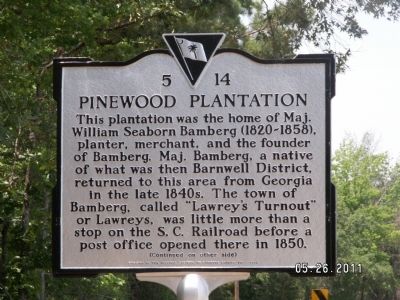
This plantation was the home of Maj. William Seaborn Bamberg (1820-1858), planter, merchant, and the founder of Bamberg. Maj. Bamberg, a native of what was then Barnwell District, returned to this area from Georgia in the late 1840s. The town of Bamberg, called “Lawrey’s Turnout” or Lawreys, was little more than a stop on the S.C. Railroad before a post office opened there in 1850.
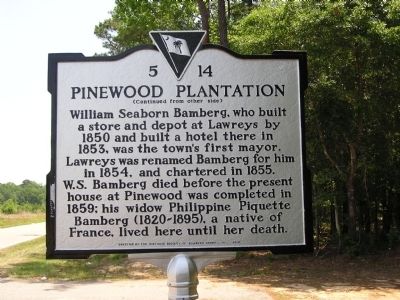
William Seaborn Bamberg, who built a store and depot at Lawreys by 1850 and built a hotel there in 1853, was the town’s first mayor. Lawreys was renamed Bamberg for him in 1854, and chartered in 1855. W.S. Bamberg died before the present house at Pinewood was completed in 1859; his widow Philippine Picquet Bamberg (1820-1895), a native of France, lived here until her death.
Erected 2010 by South Carolina Department of Archives and History; sponsored by The Historic Society of Bamberg County, Inc. (Marker Number 5-14.)
Topics. This historical marker is listed in this topic list: Notable Places. A significant historical year for this entry is 1850.
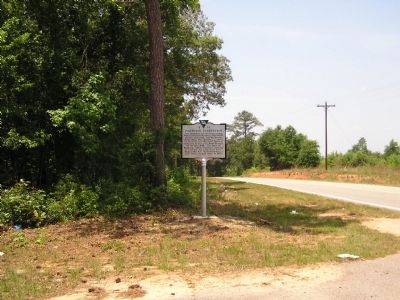
Location. 33° 17.12′ N, 81° 5.652′ W. Marker is near Bamberg, South Carolina, in Bamberg County.
this page online

Regionally, this marker is in the Lowcountry. It is also in the American South and specifically in the Deep South. Globally, it is in North America, the Western Hemisphere, the Western World, and the Anglosphere. Historically, it finds itself in what was once the territory of the Mississippian Culture, one of the original Thirteen Colonies, one of the Confederate States of America, and the Antebellum South.
Other nearby markers. At least 8 other markers are within 4 miles of this marker, measured as the crow flies: Voorhees College (approx. 2.7 miles away); Bamberg County Veterans Park (approx. 3½ miles away); Veterans Memorial (approx. 3½ miles away); Bamberg County Courthouse (approx. 3.6 miles away); Bamberg County Confederate Monument (approx. 3.6 miles away); Bamberg (approx. 3.6 miles away); Carlisle Military School (approx. 3.6 miles away); AT&T Building (approx. 3.7 miles away). Touch for a list and map
Photographed by Anna Inbody, May 26, 2011
2. Pinewood Plantation Marker Reverse
Regarding Pinewood Plantation. The name of the wife of William Seaborn Bamberg is Philippine Picquet (1820-1895). She was born in Alsace, France and is the daughter of Antoine (1798-1866) and Agatha Picquet. The family lived in Augusta, GA.
Additional commentary.
1. William Seaborn Bamberg
Bamberg, the County Seat of Bamberg County, is named for Major William Seaborn Bamberg who came to this community in the 1840s. His grandfather, John George Bamberg, a native of Germany, settled near River’s Bridge following the Revolutionary War. Major William Seaborn Bamberg became one of the most influential businessmen in this section of the state. Through his foresight, leadership, and ingenuity, he had the town incorporated when it was no more than a country crossroad. The original charter, according to records, was dated December 19, 1855. In earlier years the settlement had been known as Lowery’s Turnout.
Five men owned, in 1852, the site of the present city, according to a deed filed that year in the Barnwell courthouse. They were G. W. Bamberg, W. S. Bamberg, I. R. Simmons, Owen R. Faust, and Howell Easterling.
Photographed by Anna Inbody, May 26, 2011
3. Pinewood Plantation Marker
Although only a crossroads at the time, the town was chartered on December 19, 1855, and in 1860, Bamberg had about 250 residents.
After the end of the Civil War, the establishment of a business community in Bamberg was due to the efforts of General Bamberg, Colonel T. J. Countys, and H. J. Brabham. Later, arrived Thomas and Dr. J. B. Black, the O'Neals, Hartzogs, Johnsons, Rileys, Hayses, Hootons, Wrights, Eveses, Rices, and Crums. H. J. Brabham caused the bridges to be built across the Edisto River in 1882, at the site of the present Highway 301 bridge.
In order to win the county seat, the Bamberg city fathers promised to build a courthouse, which they did with the issuance of $10,000 in bonds and the use of state penitentiary labor. It was erected in 1897.
— Submitted September 21, 2011, by Anna Inbody of Columbia, South Carolina.
Credits. This page was last revised on May 31, 2026. It was originally submitted on September 21, 2011, by Anna Inbody of Columbia, South Carolina. This page has been viewed 2,974 times since then and 62 times this year. Last updated on June 17, 2015, by Roger Picquet of San Luis Obispo, California. Photos: 1, 2, 3. submitted on September 21, 2011, by Anna Inbody of Columbia, South Carolina. • Bill Pfingsten was the editor who published this page.
