Near Hohenwald in Lewis County, Tennessee — The American South (East South Central)
Grinder House
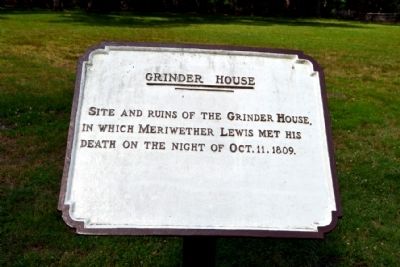
Photographed by Duane Hall, June 4, 2015
1. Grinder House Marker
Topics and series. This historical marker is listed in this topic list: Notable Places. In addition, it is included in the Natchez Trace series list. A significant historical year for this entry is 1809.
Location. 35° 30.563′ N, 87° 27.59′ W. Marker is near Hohenwald, Tennessee, in Lewis County. It can be reached from Natchez Trace Parkway (at milepost 385.9), 0.2 miles north of Summertown Highway (Tennessee Route 20), on the left when traveling north. Marker is located near the Grinder House at the Meriwether Lewis Site on the Natchez Trace. Touch for map. Marker is in this post office area: Hohenwald TN 38462, United States of America. Touch for directions.

Regionally, this marker is in Middle Tennessee and in the Highland Rim. It is also in the American South and specifically in the Upper South. Globally, it is in North America, the Western Hemisphere, the Western World, and the Anglosphere. Historically, it finds itself in what was once the territory of the Mississippian Culture, one of the Confederate
this page online
Other nearby markers. At least 8 other markers are within 5 miles of this marker, measured as the crow flies: The Natchez Trace – Early American Trail (within shouting distance of this marker); Natchez Trace (about 300 feet away, measured in a direct line); Lewis' Last Journey (about 600 feet away); Meriwether Lewis: Life Compass (about 700 feet away); Meriwether Lewis (about 800 feet away); Metal Ford (approx. 3.3 miles away); Steele's Iron Works (approx. 3.3 miles away); Phosphate Mine (approx. 4.4 miles away). Touch for a list and map of all markers in Hohenwald.
Also see . . . Natchez Trace. Official National Park Service website. (Submitted on June 23, 2015.)
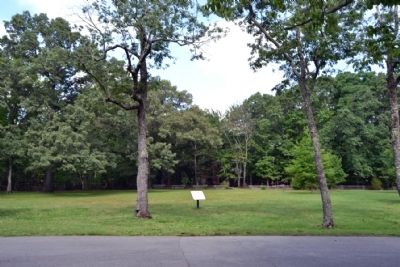
Photographed by Duane Hall, June 4, 2015
2. Grinder House Marker
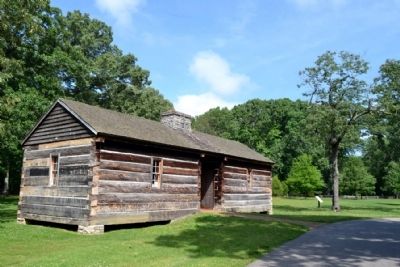
Photographed by Duane Hall, June 4, 2015
3. 1930's Reproduction of Grinder House
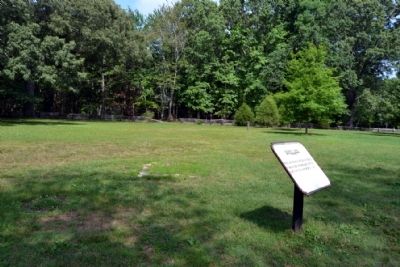
Photographed by Duane Hall, June 4, 2015
4. Marker near Stone Remains of Grinder House
Photographed by Duane Hall, June 4, 2015
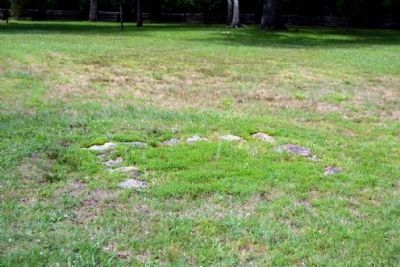
5. Stone Remains of Grinder House,
Possibly Chimney
Possibly Chimney
Credits. This page was last revised on June 16, 2016. It was originally submitted on June 23, 2015, by Duane Hall of Abilene, Texas. This page has been viewed 1,367 times since then and 39 times this year. Photos: 1, 2, 3, 4, 5. submitted on June 23, 2015, by Duane Hall of Abilene, Texas.
