Near Filippi in Kavala, Macedonia and Thrace, Greece — Ελλάδα (Southeastern Europe, Balkan Peninsula)
The Octagon at Philippi
Photographed by Dale K. Benington, June 16, 2015
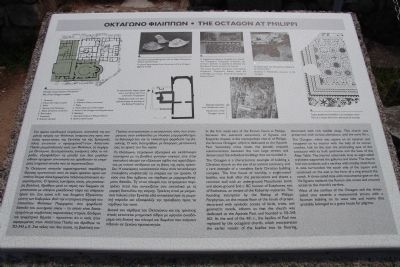
1. The Octagon at Philippi Marker
In the first insula east of the Roman Forum at Philippi. between the eastward extensions of Egnatia and Emporiki streets, is the metropolitan church of Philippi, the famous Octagon, which is dedicated to the Apostle Paul. Secondary cross roads, the parodoi, ensured communication between the two large streets and demarcated the individual buildings that surrounded it.
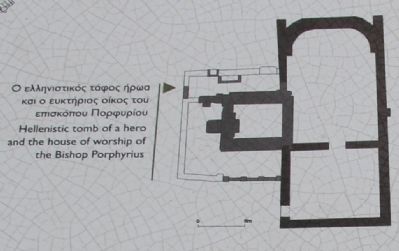
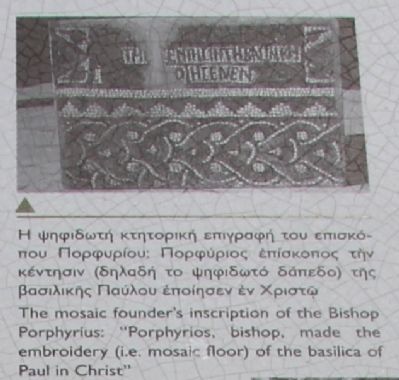
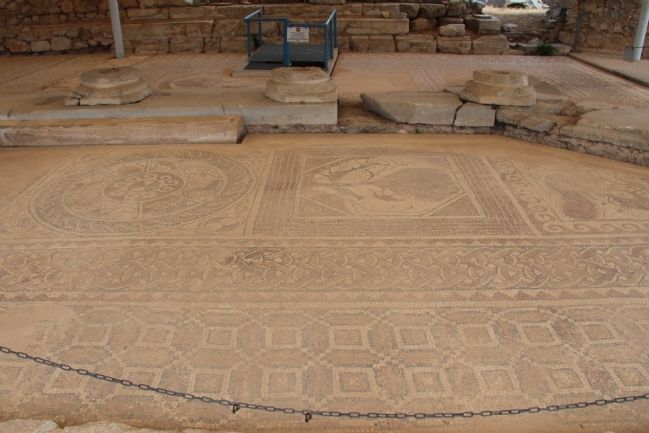
The Octagon is a characteristic example of building a Christian church on the site of an ancient sanctuary, and a rare example of a complete Early Christian building complex. The first house of worship, a single-naved basilica, was built after the persecutions and shares a common wall with an underground Macedonian tomb and above-ground 2nd century BC heroon of Euephenes, son of Exekestos, an initiate of the Kabeirian mysteries. The founding inscription by the Bishop of Philippi, Porphyrios, on the mosaic floor of the house of prayer, decorated with symbolic scenes of birds, trees, and geometric motifs, informs us that the church was dedicated to the Apostle Paul, and founded in 313-343 AD. At the end of the 4th century, the basilica of Paul
this page online
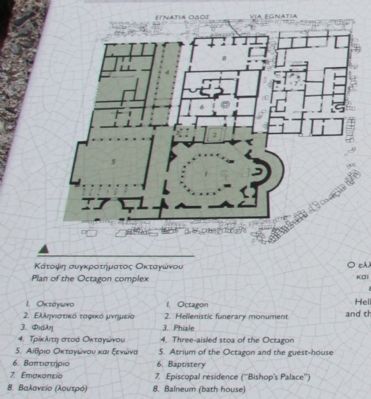
The Octagon, which was square on its exterior and octagonal on its interior with the help of its corner conches, had on the east the protruding apse of the sanctuary with its built synthronon and the base of the Altar Table. The interior colonnade atop an eight-sided stylobate supported the galleries and dome. The church had two ambones and a narthex with marble inlaid floor. A stoa surrounded the south side of the square and continued on the east in the form of a ring around the conch. A three-aisled stoa with monumental gate on the Via Egnatia replaced the Roman side street and ensured access to the church's narthex.
West of the narthex of the Octagon and the three-aisled stoa extends a monumental atrium with a fountain building on its west side and rooms that probably belonged to a guest house for pilgrims.
Topics. This historical marker is listed in this topic list: Religion & Religious Structures.
Location. 41° 0.7′ N,
Photographed by Dale K. Benington, June 16, 2015
2. The Octagon at Philippi Marker
Close-up view, that is displayed on the marker, of an illustration, showing how the floor plan of the Octagon structure appeared.

Regionally, it is in Europe, the European Union, the Schengen Area, a coastal Mediterranean country, and the Western World. Historically, it finds itself in what was once the Byzantine Empire, the Ottoman Empire, and specifically the Roman Empire.
Other nearby markers. At least 8 other markers are within 14 kilometers of this marker, measured as the crow flies: Annexes to Octagon at Philippi (within shouting distance of this marker); Christian Philippi (within shouting distance of this marker); Basilica (about 120 meters away, measured in a direct line); Ancient Theater (approx. 0.3 kilometers away); Philippi (approx. 0.3 kilometers
Photographed by Dale K. Benington, June 16, 2015
3. The Octagon at Philippi Marker
Close-up view, that is displayed on the marker, of an illustration, featuring where the Hellenistic tomb of a hero appeared, on the floor plan of the Octagon structure.
Photographed by Dale K. Benington, June 16, 2015
4. The Octagon at Philippi
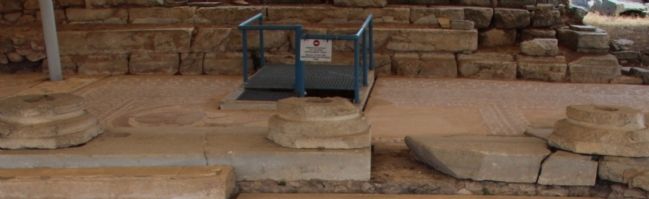
The metal railing in the picture I believe is there to protect the site of the Hellenistic tomb of a hero, that was originally incorporated into the structure of the Octagon.
Photographed by Dale K. Benington, June 16, 2015
5. The Octagon at Philippi Marker
Close-up view, that is displayed on the marker, of a photograph, showing the mosaic founder's inscription, made in the mosaic floor embroidery of the Octagon.
Photographed by Dale K. Benington, June 16, 2015
6. The Octagon at Philippi Marker
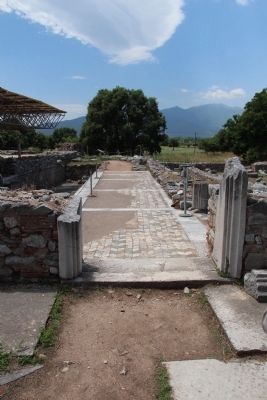
View of a passage in the, in the ruins of the Octagon complex, that leads to both the marker (seen just beneath the tree at the far end of the walkway) and an entrance to the Octagon.
Photographed by Dale K. Benington, June 16, 2015
7. The Octagon at Philippi Marker
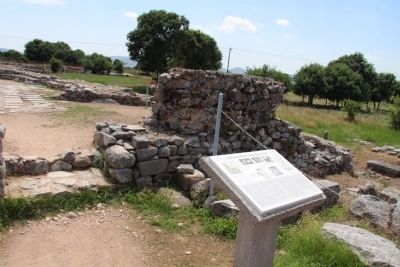
View of the marker (at the end of the passage), in the ruins of the Octagon complex, at an entrance to the Octagon.
Photographed by Dale K. Benington, June 16, 2015
8. The Octagon at Philippi Marker
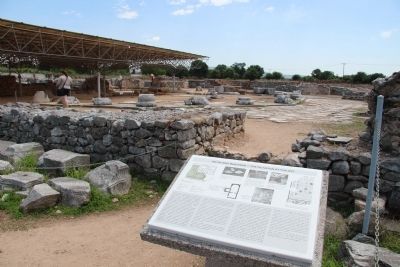
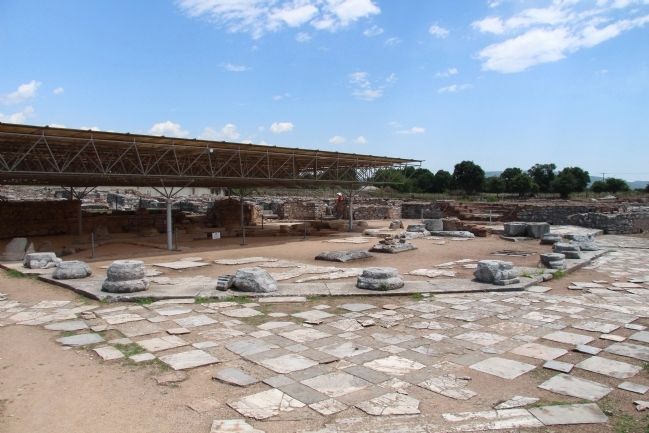
View of the marker in the foreground, and looking through the complex entrance passage and over the ruins, in the background one can see the ruins of the Octagon.
Photographed by Dale K. Benington, June 16, 2015
9. The Octagon at Philippi Marker
View of the Octagon ruins.
Photographed by Dale K. Benington, June 16, 2015
10. The Octagon at Philippi
View of the mosaic floor that is in the Octagon, with what I believe is a view of the metal railing structure protecting the Hellenistic tomb that the Octagon incorporated into its structure when it was originally built.
Credits. This page was last revised on March 22, 2022. It was originally submitted on June 29, 2015, by Dale K. Benington of Toledo, Ohio. This page has been viewed 5,765 times since then and 458 times this year. Photos: 1, 2, 3, 4, 5, 6, 7, 8, 9, 10. submitted on June 29, 2015, by Dale K. Benington of Toledo, Ohio.
