Lower Merion Township near Bryn Mawr in Montgomery County, Pennsylvania — The American Northeast (Mid-Atlantic)
Woodrow Wilson
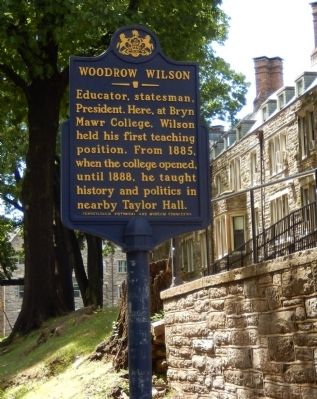
Photographed by Don Morfe, June 28, 2015
1. Woodrow Wilson Marker - now removed.
Erected 1958 by Pennsylvania Historical & Museum Commission.
Topics and series. This historical marker is listed in these topic lists: Education • Government & Politics. In addition, it is included in the Former U.S. Presidents: #28 Woodrow Wilson, and the Pennsylvania Historical and Museum Commission (PHMC) series lists. A significant historical year for this entry is 1885.
Location. Marker has been permanently removed. It was located near 40° 1.692′ N, 75° 18.745′ W. Marker was near Bryn Mawr, Pennsylvania, in Montgomery County. It was in Lower Merion Township. It was on New Gulph Road. The marker is at the entrance to the college near Caversham Road. Touch for map. Marker was at or near this postal address: 800 New Gulph Rd, Bryn Mawr PA 19010, United States of America.
We have been informed that this marker is no longer there and will not be replaced. This page is an archival view of what was.
Regionally,
this page online

Other nearby markers. At least 8 other markers are within 2 miles of this location, measured as the crow flies: Bryn Mawr Summer School for Women Workers in Industry (approx. 0.3 miles away); Harriton (approx. 0.4 miles away); The Baldwin School (approx. 0.4 miles away); Harriton Farm (approx. one mile away); Bartley Hall - 1956 (approx. 1.4 miles away); Bartley Hall - 2002 (approx. 1½ miles away); Sullivan Hall - 1954 (approx. 1½ miles away); Vasey Hall - 1930 (approx. 1.6 miles away). Touch for a list and map of all markers in Bryn Mawr.
Also see . . . Woodrow Wilson ’79 Amid the “Demure Damsels”. Princeton Alumni Weekly website entry (Submitted on March 10, 2025, by Larry Gertner of New York, New York.)
Additional commentary.
1.
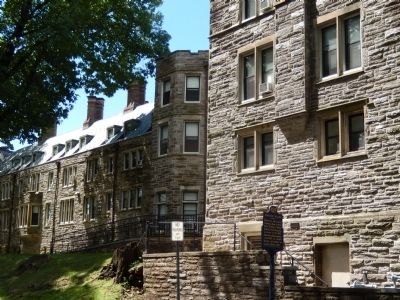
Photographed by Don Morfe, June 28, 2015
2. Woodrow Wilson Marker
The Pennsylvania Historical and Museum Commission, responsible for Pennsylvania's historical markers, began a Diversity, Equity, Inclusion and Access (DEIA) review of its markers. At the request of Bryn Mawr College's president, the Commission decided to remove this marker because the college no longer wished to be associated with President Wilson’s views on race and gender at the time. The marker itself had no controversial language or insinuations.
— Submitted October 29, 2021, by Mark Hilton of Montgomery, Alabama.
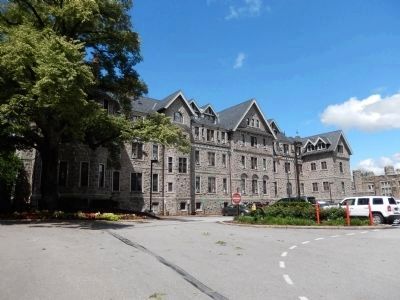
Photographed by Don Morfe, June 28, 2015
3. Bryn Mawr College Campus
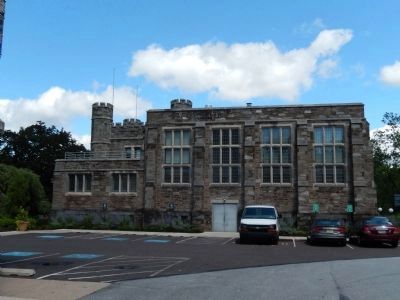
Photographed by Don Morfe, June 28, 2015
4. Bryn Mawr College Campus
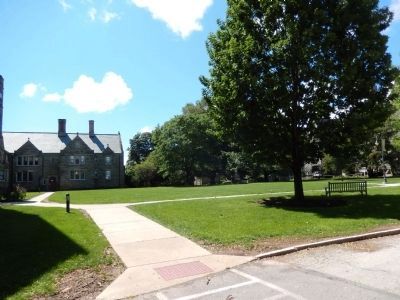
Photographed by Don Morfe, June 28, 2015
5. Bryn Mawr College Campus
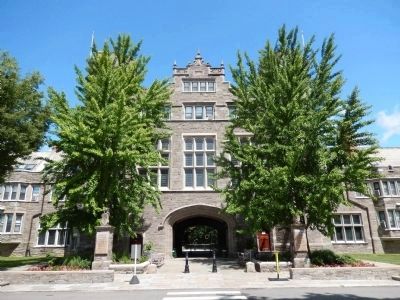
Photographed by Don Morfe, June 28, 2015
6. Bryn Mawr College Campus
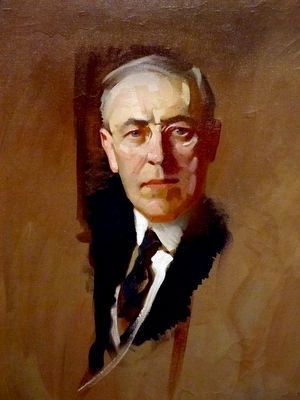
Photographed by Allen C. Browne, February 16, 2015
7. Woodrow Wilson painting.
This c. 1919 painting of Woodrow Wilson by John Christen Johansen hangs in the National Portrait Gallery in Washington, DC.
“Elected to the White House after winning wide acclaim as the reforming governor of New Jersey, Woodrow Wilson left an impressive legacy of change that sought to curb abusive business practices and improve conditions for workers. But Wilson was not as successful in winning approval for his international idealism during World War I. Determined to make this conflict ‘the war to end all wars,’ he sought at its end to create a world order that put peace ahead of national self-interest. America's European allies, however, undermined these hopes, insisting on a postwar peace settlement that contained the seeds of another war. A far worse disappointment for Wilson himself was his failure to persuade his own country to join the League of Nations, an organization he had conceived as the best hope for avoiding future wars. Having suffered a stroke while campaigning for American entry into the league, he left office in 1921, broken in both health and spirit.”
“Elected to the White House after winning wide acclaim as the reforming governor of New Jersey, Woodrow Wilson left an impressive legacy of change that sought to curb abusive business practices and improve conditions for workers. But Wilson was not as successful in winning approval for his international idealism during World War I. Determined to make this conflict ‘the war to end all wars,’ he sought at its end to create a world order that put peace ahead of national self-interest. America's European allies, however, undermined these hopes, insisting on a postwar peace settlement that contained the seeds of another war. A far worse disappointment for Wilson himself was his failure to persuade his own country to join the League of Nations, an organization he had conceived as the best hope for avoiding future wars. Having suffered a stroke while campaigning for American entry into the league, he left office in 1921, broken in both health and spirit.”
Credits. This page was last revised on March 10, 2025. It was originally submitted on July 1, 2015, by Don Morfe of Baltimore, Maryland. This page has been viewed 891 times since then and 33 times this year. Photos: 1, 2, 3, 4, 5, 6. submitted on July 1, 2015, by Don Morfe of Baltimore, Maryland. 7. submitted on October 1, 2015, by Allen C. Browne of Silver Spring, Maryland. • Bill Pfingsten was the editor who published this page.
