Hudson Bay in Vancouver in Clark County, Washington — The American West (Northwest)
Officers Row
Photographed by Kevin W., June 9, 2008
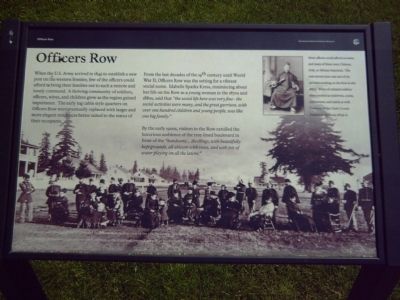
1. Officers Row Marker
From the last decades of the 19th century until World War II, Officers Row was the setting for a vibrant social scene. Isabelle Sparks Kress, reminiscing about her life on the Row as a young woman in the 1870s and 1880s, said that ”the social life here was very fine – the social activities were many, and the great garrison, with over one hundred children and young people, was like one big family.”
By the early 1900s, visitors to the Row extolled the luxurious ambience of the tree-lined boulevard in front of the ”handsome… dwellings, with beautifully kept grounds, all abloom with roses, and with jets of water playing on all the lawns.”
Erected by Vancouver
this page online
Topics. This historical marker is listed in these topic lists: Exploration • Military • Settlements & Settlers • War, US Revolutionary. A significant historical year for this entry is 1849.
Location. 45° 37.719′ N, 122° 39.768′ W. Marker is in Vancouver, Washington, in Clark County. It is in Hudson Bay. It is at the intersection of E. Evergreen Way and Fort Vancouver Way, on the left when traveling east on E. Evergreen Way. Touch for map. Marker is in this post office area: Vancouver WA 98661, United States of America. Touch for directions.

Regionally, this marker is in Greater Portland Area and in Southwest Washington State. It is also on the American Pacific Coast, in the Pacific Northwest, and in the Lewis & Clark Corridor. Globally, it is in North America, on the Pacific Rim, in the Western Hemisphere, in the Western World, and in the Anglosphere.
Other nearby markers. At least 8 other markers are within walking distance of this marker: Cannon Replica Project (within shouting distance of this marker); Congressional Medal of Honor Monument (within shouting distance of this marker);
Photographed by Kevin W., June 9, 2008
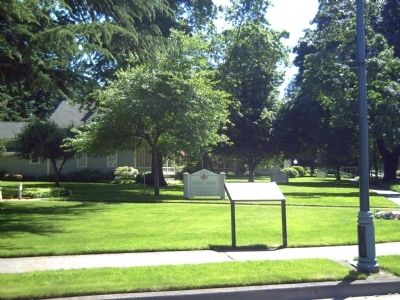
2. Officers Row and Marker
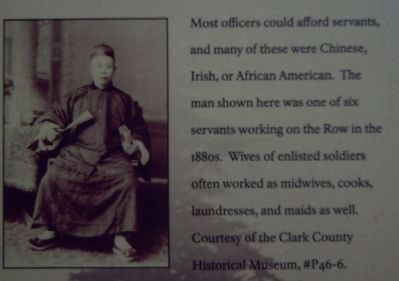
More about this marker. The picture in the upper right is of a Chinese servant who worked for an officer living on Officers Row. It is captioned, "Most officers could afford servants, and many of these were Chinese, Irish, or African American. The man shown here was one of six servants working on the Row in the 1880s. Wives of enlisted soldiers often worked as midwives, cooks, laundresses, and maids as well." It was provide for the marker courtesy of the Clark County Historical Museum, #P46-6.
The main picture is of, "The officers and families of the 21st Infantry on Officers Row in 1879, view to the east. Brigadier General O. O. Howard is seated with his youngest son and wife in the front and center." It was provided for the marker courtesy
Photographed by Kevin W., June 9, 2008
3. Closeup of picture from upper right corner of the Officers Row Marker
Along Officers Row, in front of every house, is at least one marker outlining the history of Fort Vancouver. Their pictures and text are included in the HMdb database on this marker's page, The Grant House Marker page, the Marshall House, and two other markers titled "Officers Row" along E. Evergreen Boulevard. This marker is on the western end of E. Evergreen Boulevard. The ground markers seen on this page extend from this marker to the Grant House and its adjacent "Officers Row" marker.
Additional commentary.
1. Officers Row Historic District
Officers Row consists of 21 houses located in a long row facing the Fort Vancouver Parade Grounds. The small area, which includes Officers Row, the old Fort Vancouver, and the old Barracks Parade Grounds was once the hub of northwest history.
The houses were designed for either company or field grade officers. High ceilings, large foyers, long sweeping staircases, bay windows, numerous fireplaces, and many rooms are characteristics of most of the houses. The Grant House, built in 1846, is the oldest house and one of the foremost historical structures in the Old Oregon
Photographed by Kevin W., June 9, 2008
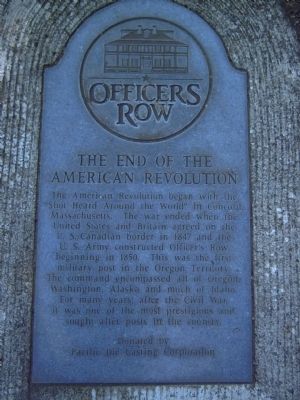
4. The End of the American Revolution
The American Revolution began with the "Shot Heard Around the World" in Concord, Massachusetts. The war ended when the United States and Britain agreed on the U.S./Canadian border in 1847 and the U.S. Army constructed Officer's Roa beginning in 1850. This was the first military post in the Oregon Territory. The command encompassed all of Oregon, Washington, Alaska and much of Idaho. For many years, after the Civil War, it was one of the most prestigious and sought after posts in the country.
Donated by Pacific Die Casting Corporation.
Donated by Pacific Die Casting Corporation.
Listed on the Clark County Heritage Register in 1985.
Listed on the National Register of Historic Places in 1974.
— Submitted June 25, 2008, by Kevin W. of Stafford, Virginia.
Photographed by Kevin W., June 9, 2008
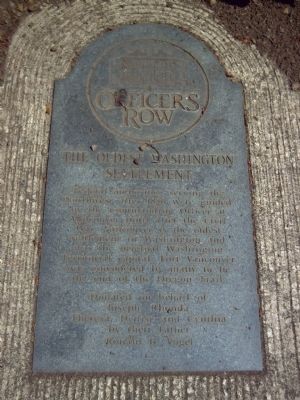
5. The Oldest Washington Settlement
Federal authorities serving the Northwest after 1850 were guided by the Commanding Officer at Vancouver until after the Civil War. Vancouver is the oldest settlement in Washington and was the original Washington Territorial capital. Fort Vancouver was considered by many to be the end of the Oregon Trail.
Donated on behalf of Joseph, Rhonda, Therese, Denise, and Cynthia by their Father Ronald B. Vogel.
Donated on behalf of Joseph, Rhonda, Therese, Denise, and Cynthia by their Father Ronald B. Vogel.
Photographed by Kevin W., June 9, 2008
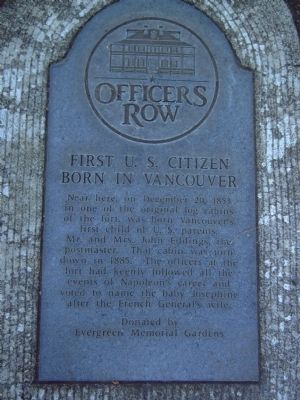
6. First U. S. Citizen Born in Vancouver
Near here, on December 20, 1853 in one of the original log cabins of the fort, was born Vancouver's first child of U. S. parents, Mr. and Mrs. John Eddings, the postmaster. That cabin was torn down in 1885. The officers at the fort had keenly followed all the events of Napoleon's career and voted to name the baby Josephine after the French General's wife.
Donated by Evergreen Memorial Gardens.
Donated by Evergreen Memorial Gardens.
Photographed by Kevin W., June 9, 2008
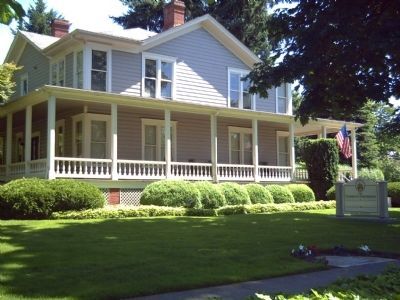
7. A house along Officers Row
Rehabilitated in the mid-1980s and considered "21 white elephants nose to tail," Officers Row is now considered one of the city's signature assets.
Credits. This page was last revised on February 7, 2023. It was originally submitted on June 24, 2008, by Kevin W. of Stafford, Virginia. This page has been viewed 2,658 times since then and 60 times this year. Photos: 1, 2, 3. submitted on June 24, 2008, by Kevin W. of Stafford, Virginia. 4, 5, 6. submitted on June 29, 2008, by Kevin W. of Stafford, Virginia. 7. submitted on June 25, 2008, by Kevin W. of Stafford, Virginia.
