Near Opelika in Lee County, Alabama — The American South (East South Central)
Shady Grove Christian Church
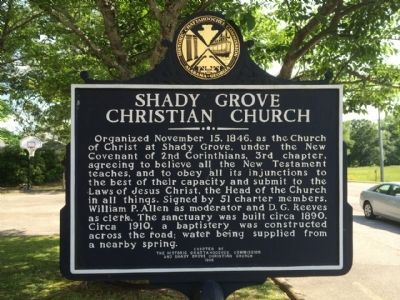
Photographed by Mark Hilton, May 8, 2014
1. Shady Grove Christian Church Marker
Erected 1996 by the Historic Chattahoochee Commission and Shady Grove Christian Church.
Topics. This historical marker is listed in this topic list: Religion & Religious Structures. A significant historical date for this entry is November 15, 2006.
Location. 32° 41.612′ N, 85° 17.651′ W. Marker is near Opelika, Alabama, in Lee County. It is on Lee Road (County Road 177) 0.1 miles north of West Point Parkway (U.S. 29), on the right when traveling north. Touch for map. Marker is at or near this postal address: 2194 Lee Road 177, Opelika AL 36804, United States of America. Touch for directions.

Regionally,
this page online
Other nearby markers. At least 8 other markers are within 6 miles of this marker, measured as the crow flies: Bean's Mill (approx. 1½ miles away); Pat Garrett and Billy the Kid / Pat Garrett, "The Man Who Shot Billy the Kid" (approx. 3.7 miles away); Union Grove Baptist Church (approx. 5.3 miles away); J.W. Darden High School (approx. 5½ miles away); Former Site of J. W. Darden High School (approx. 5½ miles away); Bethesda Missionary Baptist Church (approx. 5½ miles away); Top Rock Millstone (approx. 5.6 miles away); Salem Shotwell Covered Bridge (approx. 5.6 miles away). Touch for a list and map of all markers in Opelika.
Additional commentary.
1. The Reformation of Shady Grove
In the early in the 1840s Prier Reeves
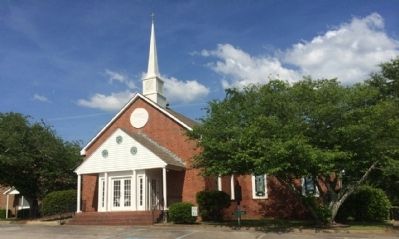
Photographed by Mark Hilton, May 8, 2014
2. Shady Grove Christian Church
The Shady Grove Baptist Church, one of the nine which divided ever the matter, voted that both groups should continue to use the same building. There was considerable opposition on the part of the Baptists to this procedure but the difficulties were peaceably settled. The record states:
The church agreed to divide on the following terms viz those who wish to retain the United Baptist name and doctrine practice & discipline not sacrificing the fellowship of the church was to do so & their internal wrights with the sovereignty of the denomination was not to be meddled with & that they shall hold possession of the Church records & shall have the first Sabbath and day before in each month in the house as days of worship on the other part those who wish to assume no name but what the new testament give (Christians) fellow out the doctrine faith and practice of the same have equal wrights unmolested to two days in each month in the house to which each member shall have equal wrights to have their names registered in the book of church records according to their choice.Thus, the "Reformers" in this congregation went through the same experience that Stone and Campbell had previously had in separating from their churches. The church formed by the "Christians" was called the Church of Christ at Shady Grove, and dates its history from 1848. Note To Editor only visible by Contributor and editor
— Submitted March 20, 2025, by Tiffany Hilyer of Opelika, Alabama.
Credits. This page was last revised on March 31, 2025. It was originally submitted on May 8, 2014, by Mark Hilton of Montgomery, Alabama. This page has been viewed 1,232 times since then and 71 times this year. Last updated on July 12, 2015, by J. Makali Bruton of Washington, District of Columbia. Photos: 1, 2. submitted on May 8, 2014, by Mark Hilton of Montgomery, Alabama.
