Coplay in Lehigh County, Pennsylvania — The American Northeast (Mid-Atlantic)
Coplay Made Cement: Cement Made Coplay
Saylor Cement Museum
| — | 1894-1904 | — |
Photographed by Don Morfe, July 5, 2015
1. Coplay Made Cement: Cement Made Coplay Marker
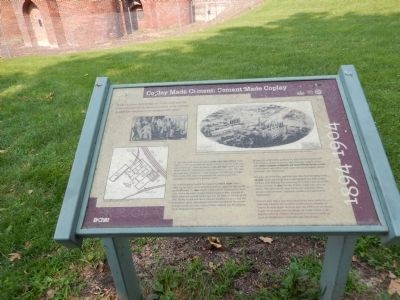
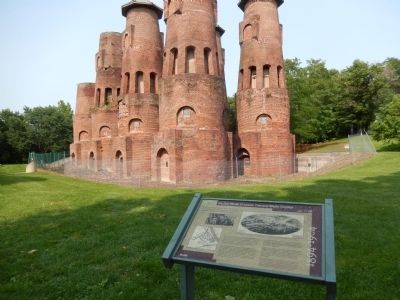
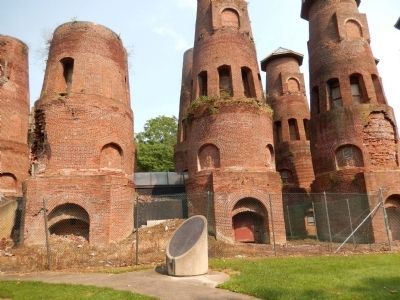
The inventive genius behind the industry was David Saylor (1827-1884). In 1871 Saylor received the first American patent for high-quality Portland cement. By 1894 Saylor’s Coplay Cement Company built these kilns. During the plant’s heyday, workers loaded endless numbers of bricks made from ground cement rock into the doors at the tops of the kilns. On the second level down, laborers shoveled in coal as fuel. Kiln temperatures above 2000 degrees Fahrenheit transferred the cement rock into chunks of clinker. Carts of clinker clattered into the growing mill to be ground into cement.
By 1900, the Lehigh Valley produced ¾ of all Portland cement used in this country.
this page online
The great size of the kilns could not save them from becoming swiftly obsolete. Across the Lehigh River to Northampton, the Atlas Cement Company built America’s first rotary kiln, an invention that saved both money and labor. In 1904, the fires these Coplay kilns went out forever. Their ruins survive today because of cooperative efforts among local government, community members, and preservation organizations.
“I saw a great dust flying out of the mills and the men who carried the ground cement away in bags, to load the wagons were covered with dust.”
(Inscription below the image in the upper right)
Blockhouses, a brick factory, grinding mills and other long-gone factory structures live on in this photograph of the cement plant taken about 1900. Today only the kilns remain.
Topics. This historical marker is listed in this topic list: Industry & Commerce. A significant historical year for this entry is 1900.
Location. Marker has been reported missing. It
Photographed by Don Morfe, July 5, 2015
2. Coplay Made Cement: Cement Made Coplay Marker

Regionally, this marker was in Southeast Pennsylvania and in Lehigh Valley. It was also in the American Northeast and in the Mid-Atlantic. Globally, it was in North America, the Western Hemisphere, the Western World, and the Anglosphere. Historically, it found itself in what was once the Haudenosaunee (Iroquois) Confederacy and also one of the original Thirteen Colonies.
Other nearby markers. At least 8 other markers are within walking distance of this location: Last of Their Kind (here, next to this marker); Saving the Kilns (a few steps from this marker); a different marker also named Coplay Made Cement: Cement Made Coplay (a few steps from this marker); Saylor Cement Kiln West 1 Preservation Project (within shouting distance of this marker); Saylor Park-Welcome (within shouting distance of this marker); Discovery of Portland Cement
Photographed by Don Morfe, July 5, 2015
3. Coplay Cement Kilns
Photographed by Don Morfe, July 5, 2015
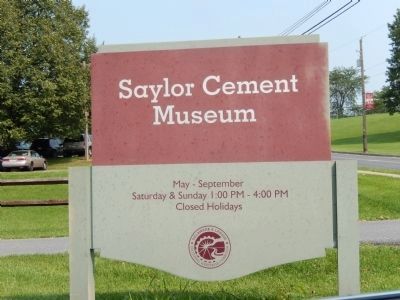
4. Sign at the entrance to the Saylor Cement Museum
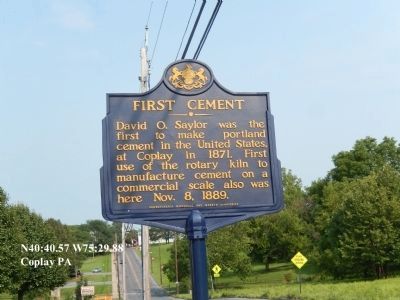
Photographed by Don Morfe, July 5, 2015
5. First Cement Marker
Credits. This page was last revised on March 9, 2025. It was originally submitted on July 14, 2015, by Don Morfe of Baltimore, Maryland. This page has been viewed 929 times since then and 58 times this year. Photos: 1, 2, 3, 4, 5. submitted on July 14, 2015, by Don Morfe of Baltimore, Maryland. • Bill Pfingsten was the editor who published this page.
