Reims in Marne, Alsace, Lorraine, Champagne-Ardenne, France — Western Europe
Cathédral Notre-Dame
| — | World Heritage Site | — |
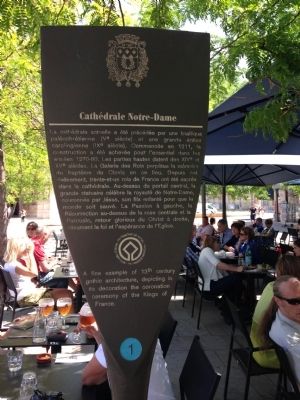
Photographed by Kevin W., June 29, 2015
1. Cathédral Notre-Dame Marker

English translation:
The current cathedral was preceded by an earlier Christian basilica (fifth century) and a large Carolingian church (ninth century). Begun in 1211, construction was completed mainly within the years 1270 - 1280. The higher parts date from the fourteenth and fifteenth century. The Gallery of Kings depicts the baptism of Clovis here. Since that event, thirty-one kings of France were crowned in the cathedral. Above the central portal, the great sculpture celebrates the royalty of Our Lady, crowned by Jesus,
this page online
Erected by la ville de Reims. (Marker Number 1.)
Topics and series. This historical marker is listed in these topic lists: Government & Politics • Religion & Religious Structures. In addition, it is included in the UNESCO World Heritage Sites series list. A significant historical year for this entry is 1211.
Location. This marker has been replaced by another marker nearby. It was located near 49° 15.212′ N, 4° 1.988′ E. Marker was in Reims, Grand Est (Alsace, Lorraine, Champagne-Ardenne), in Marne. It was on Rue Guillaume de Machault just east of Rue Rockefeller, on the left when traveling east. Touch for map. Marker was at or near this postal address: 3 Rue Guillaume de Machault, Reims, Grand Est 51100, France. Touch for directions.

Regionally, it was in the North Atlantic Region, Europe, the European Union, Atlantic Europe, the Schengen Area, Western Europe, a coastal Mediterranean country, and the Western World. Historically, it found itself in what was once a French colony, the Roman Empire, and specifically the Holy Roman Empire.
Other nearby markers. At least 8 other markers are within walking distance of
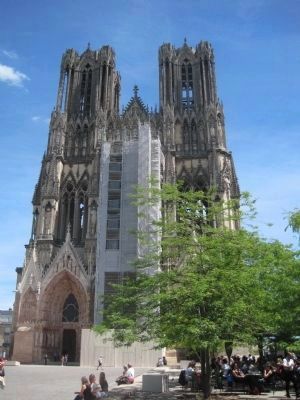
Photographed by Kevin W., June 29, 2015
2. Cathédral Notre-Dame and Marker
Marker is in the lower right, in the seating area under the trees.
Other markers no longer nearby. Palais du Tau (was within shouting distance of this marker but has been replaced with another marker now near it); Médiathèque Jean Falala (was about 90 meters away, measured in a direct line but has been replaced with another marker now near it).
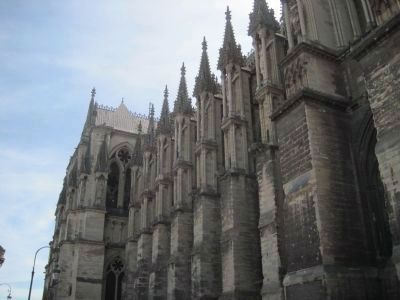
Photographed by Kevin W., June 29, 2015
3. Cathédral Notre-Dame
North façade.
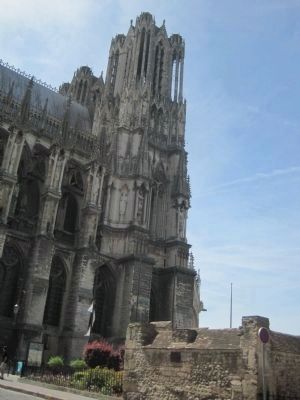
Photographed by Kevin W., June 29, 2015
4. Cathédral Notre-Dame
North façade and the nearby Maison du Trésorier du Chapitre de la Cathédral.
Photographed by Kevin W., June 29, 2015
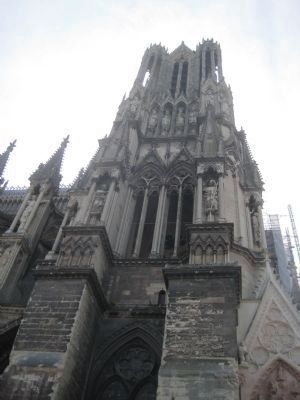
5. Cathédral Notre-Dame
North façade of the left entrance tower
Photographed by Kevin W., June 29, 2015
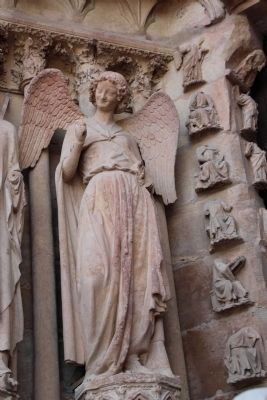
6. L'Ange au Sourire de Reims (the Smiling Angel of Reims)
Photographed by Kevin W., June 29, 2015
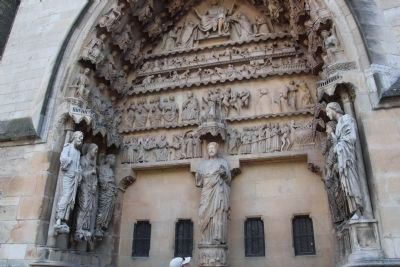
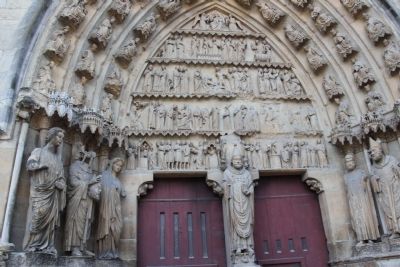
7. Cathédral Notre-Dame
Detailed statuary near an entrance on the north façade depicting the Resurrection at the Last Judgment. The central statue, called "the Beautiful God", is Jesus holding the globe of the universe.
Photographed by Kevin W., June 29, 2015
8. Cathédral Notre-Dame Marker
Detailed statuary on the north entrance recounts the life of Saint Remi and Saint Nicaise.
Photographed by Kevin W., June 29, 2015
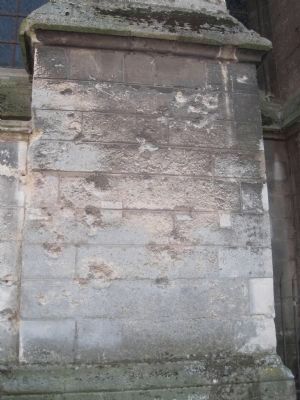
9. Cathédral Notre-Dame shell damage
Damage done to the Cathédral during World War I can still be seen today.
Photographed by Kevin W., June 29, 2015
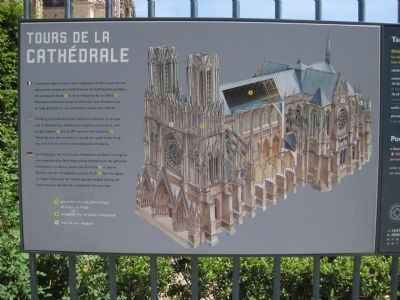
10. Tours de la Cathédral
L'ascension dans les tours de la cathédral de Reims permet une découverte insolite d'un chef-d'œuvre de l'architecture gothique, de sa statuaire haute (1) et de sa charpente du XXe siècle (2). Dominant la ville des sacres, le circuite de visite chemine tout au long de la toiture, aux ornements récemment redorés.
Climbing up inside the towers of Reims cathedral is a unique way of discovering a masterpiece of gothic architecture, with its high statuary (1) and its 20th century roof structure (2). Towering over the coronation city, the tour path winds along the roof, with its recently renovated gold ornaments.
German translation not transcribed.
(1) galerie des rois / the gallery of kings / die Galerie der Könige
(2) charpente / the roof timbers / Dachgebälk
Photographed by Kevin W., June 29, 2015
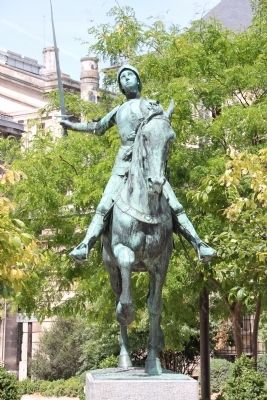
11. Statue of Jeanne d'Arc at the Cathédral Notre-Dame
Drawing by J.J. Marquart, 1846
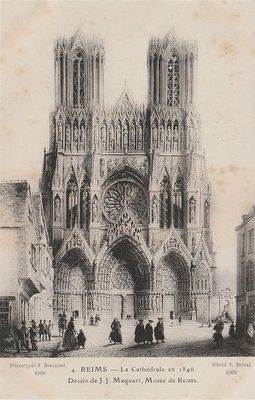
12. Reims - La Cathédral en 1846
1846 drawing of the Cathédrale on a postcard published in 1909.

Photographed by E. Lemielle, 1919
13. Souvenez-vous! 1914. Rien d'Allemand!!! Des Allemands
Remember! 1914. Nothing German! Nothing from the Germans.
The poster depicts the burning of the cathedral, which was considered a war crime. The Library of Congress (this image courtesy of) couches the explanation of the burning in relatively neutral terms: The city of Rheims was shelled with explosives and incendiaries by the Germans during ten days in September of 1914 with the cathedral as the main target. Outraged, particularly by the attack on the cathedral, the government at Bordeaux sent an official protest. At the time of the shelling the cathedral was serving as a hospital with a red cross hanging from its tower. The Germans, however, believed it was also used as an observation tower by the French, hence the heavy and unrelenting bombing. The Germans had eyewitnesses who corroborated this story, but the French consistently denied it. The tracery, towers, and nave of the cathedral were heavily damaged, but the walls were still intact.
The poster depicts the burning of the cathedral, which was considered a war crime. The Library of Congress (this image courtesy of) couches the explanation of the burning in relatively neutral terms: The city of Rheims was shelled with explosives and incendiaries by the Germans during ten days in September of 1914 with the cathedral as the main target. Outraged, particularly by the attack on the cathedral, the government at Bordeaux sent an official protest. At the time of the shelling the cathedral was serving as a hospital with a red cross hanging from its tower. The Germans, however, believed it was also used as an observation tower by the French, hence the heavy and unrelenting bombing. The Germans had eyewitnesses who corroborated this story, but the French consistently denied it. The tracery, towers, and nave of the cathedral were heavily damaged, but the walls were still intact.
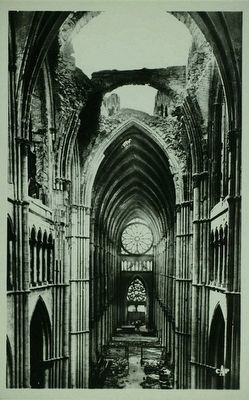
Photographed by Editions Reims-Cathédral, circa 1915
14. Cathedral interior post-bombardment
Credits. This page was last revised on August 13, 2026. It was originally submitted on July 24, 2015, by Kevin W. of Stafford, Virginia. This page has been viewed 613 times since then and 27 times this year. Photos: 1, 2, 3, 4, 5, 6, 7, 8, 9, 10, 11. submitted on July 24, 2015, by Kevin W. of Stafford, Virginia. 12, 13, 14. submitted on July 29, 2015. • Andrew Ruppenstein was the editor who published this page.
