Oswego in Oswego County, New York — The American Northeast (Mid-Atlantic)
Bicentennial Peace Garden
Oswego
Photographed by Dale K. Benington, July 22, 2015
1. Bicentennial Peace Garden Marker
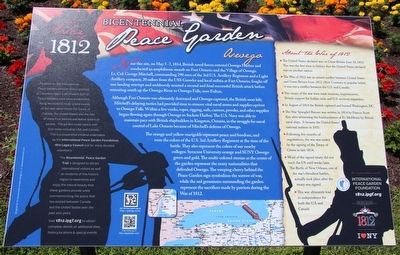
Although Fort Ontario was ultimately destroyed and Oswego captured, the British soon left; Mitchell's delaying tactics had provided time to remove vital naval stores and supplies upriver to Oswego Falls. Within a few weeks, ropes rigging, sails, cannon, powder, and other supplies began flowing again through Oswego to Sackets Harbor. The U.S. Navy was able to maintain pace with British shipbuilders in Kingston, Ontario, in the struggle for naval control of Lake Ontario because of Mitchell's defense of Oswego.
The orange and yellow marigolds represent peace and freedom, and were the colors of the U.S. 3rd
this page online
Modeled on the International Peace garden concept that originated in Canada in 1990, a permanent trail of Peace Gardens have been established along the historic route where events of the War determined the future of Canada, the United States and the fate of many First Nations and Native American people. The garden route covers over 600 miles including USA and Canada. This is a cooperative undertaken by the International Peace Garden Foundation, 1812 Legacy Council and its' many devoted volunteers.
The Bicentennial Peace Garden Trail is designated to attract international visitors as well as residents of this historic region to experience and enjoy the natural
Photographed by Dale K. Benington, July 22, 2015
2. Bicentennial Peace Garden Marker
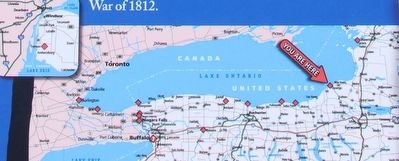
Close-up view, that is displayed on the marker, of a map, showing the locations of additional "Bicentennial Peace Gardens" across the Lake Erie and Lake Ontario basins, in both the United States and Canada.
Visit 1812.ipgf.org to obtain complete details on additional sites, history, locations & special events.
• The United States declared war on Great Britain June 18, 1812. This was the first time in history that the United States declared war on another nation.
• The War of 1812 was an armed conflict between United States and Great Britain from 1812-1814. Contrary to popular belief, it was not a conflict between the U.S. and Canada.
• The causes of the war were trade tensions, impressments, British support for Indian raids and U.S. territory expansion.
• In August of 1814 the British captured and burned Washington, D.C.
• The Star Spangled Banner was written in 1814 by Francis Scott Key after witnessing the bombardment of Fort McHenry by British naval ships. It became the United States' national anthem in 1931.
• Following five months of negotiations, the war was ended by the signing of the Treaty of Ghent in late 1814.
• Word of the signed treaty
Photographed by Dale K. Benington, July 22, 2015
3. Bicentennial Peace Garden Marker
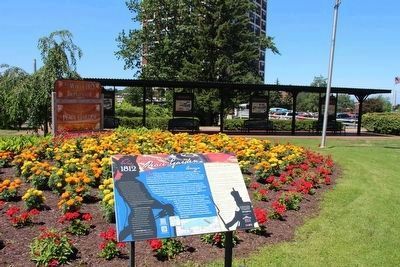
View of the marker, the garden landscaping behind the marker, and of the series of Seaway Trail marker panels that are on display behind the marker, along the O & W Railroad Pedestrian Promenade & Bikeway.
• This war ultimately lead to independence for both the United States and Canada.
Erected by International Peace Garden Foundation, 1812 Legacy Council.
Topics. This historical marker is listed in these topic lists: Peace • War of 1812. A significant historical month for this entry is May 1680.
Location. 43° 27.321′ N, 76° 30.401′ W. Marker is in Oswego, New York, in Oswego County. It is on East 1st Street (New York State Route 481) north of East Mohawk Street. This marker is located in the downtown area, on the high ground overlooking the East side of the Oswego River, across the street from the old armory building (157 East 1st Street), along the O & W Railroad Pedestrian Promenade & Bikeway. Touch for map. Marker is in this post office area: Oswego NY 13126, United States of America. Touch for directions.

Regionally, this marker is in Upstate New York, specifically in Central New York, and in the Syracuse Metropolitan Area. It is also in the American Northeast
Photographed by Dale K. Benington, July 22, 2015
4. Bicentennial Peace Garden Marker
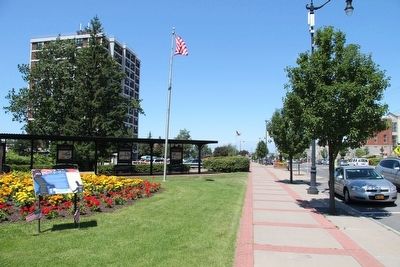
View of the marker looking north along East 1st Street.
Other nearby markers. At least 8 other markers are within walking distance of this marker: War of 1812 Bicentennial/Peace Garden (a few steps from this marker); River Industries (a few steps from this marker); People of the River (a few steps from this marker); Age of Iron Horses (a few steps from this marker); Seaway Trail (a few steps from this marker); The Fur Trade (a few steps from this marker); Early Shipping (a few steps from this marker); The Oswego Canal (within shouting distance of this marker). Touch for a list and map of all markers in Oswego.
Credits. This page was last revised on June 19, 2018. It was originally submitted on July 26, 2015, by Dale K. Benington of Toledo, Ohio. This page has been viewed 712 times since then and 32 times this year. Photos: 1, 2, 3, 4. submitted on July 27, 2015, by Dale K. Benington of Toledo, Ohio.
