Belfield in Stark County, North Dakota — The American Midwest (Upper Plains)
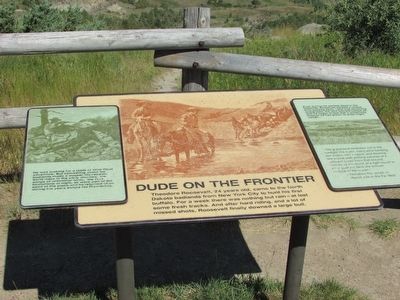
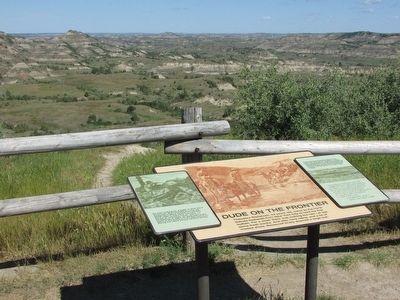
Dude on the Frontier
Photographed by Bill Coughlin, July 20, 2015
1. Dude on the Frontier Marker
Theodore Roosevelt, 24 years old, came to the North Dakota badlands from New York City to hunt his first buffalo. For a week there was nothing but rain – at last some fresh tracks. And after hard riding, and a lot of missed shots, Roosevelt finally downed a large bull.
< Left Sidebar : >
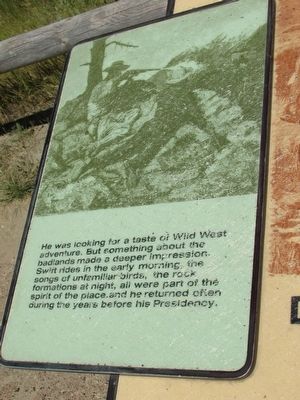
He was looking for a taste of Wild West adventure. But something about the badlands made a deeper impression. Swift rides in the early morning, the songs of unfamiliar birds, the rock formations at night, all were part of the spirit of the place and he returned often during the years before his Presidency.
< Left Sidebar : >
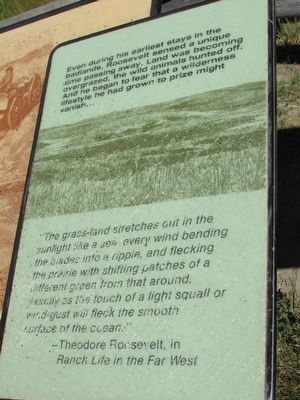
Even during his earliest stays in the badlands, Roosevelt sensed a unique time passing away. Land was becoming overgrazed, the wild animals hunted off. And be began to fear that a wilderness lifestyle he had grown to prize might vanish . . .
“The grass-land stretches out in the sunlight like a sea, every wind bending the blades into a ripple, and flecking the prairie with shifting patches of a different green from that around, exactly as the touch of a light squall or wind-gust will fleck the smooth surface of the ocean.”
Ranch Life in the Far West
Erected by National
this page online
Topics and series. This historical marker is listed in these topic lists: Animals • Settlements & Settlers. In addition, it is included in the Former U.S. Presidents: #26 Theodore Roosevelt series list.
Location. 46° 53.726′ N, 103° 22.972′ W. Marker is in Belfield, North Dakota, in Stark County. It can be reached from Interstate I-94, on the right when traveling west. Marker is located behind the Painted Canyon Visitor Center in Theodore Roosevelt National Park. Touch for map. Marker is in this post office area: Belfield ND 58622, United States of America. Touch for directions.

Regionally, this marker is on the Missouri Plateau. It is also in the American Lewis & Clark Corridor, on the prairies, and on the Northern Plains. Globally, it is in North America, the Western Hemisphere, the Western World, and the Anglosphere. Historically, it finds itself in what was once Rupert’s Land and also the Louisiana Purchase.
Other nearby markers. At least 8 other markers are within 7 miles of this marker, measured as the crow flies: Invasion Confronted (within shouting
Photographed by Bill Coughlin, July 20, 2015
2. Left Side Marker
More about this marker. A picture of Theodore Roosevelt on horseback with another mounted man and a wagon being pulled by a team of horses appear on the marker.
Photographed by Bill Coughlin, July 20, 2015
3. Dude on the Frontier Marker
Photographed by Bill Coughlin, July 20, 2015
4. Dude on the Frontier Marker
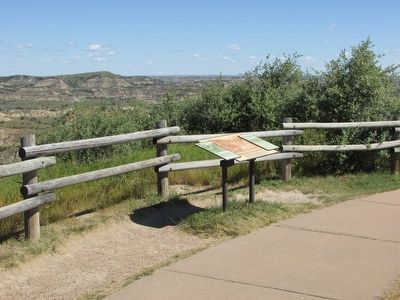
Photographed by Bill Coughlin, July 20, 2015
5. Marker at the Painted Canyon
Photographed by Allen C. Browne, August 9, 2015
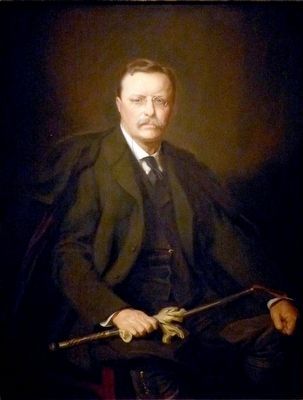
6. Theodore Roosevelt
This 1967 portrait of Theodore Roosevelt by Adrian Lamb after Philip de Lászlo's 1908 original hangs in the National Portrait Gallery in Washington DC.
“No one ever craved the presidency more than Theodore Roosevelt or used its powers more joyously. In early 1901, however, his rise toward that office was suddenly checked. Having gained national prominence as a civil service reformer, Spanish-American War hero, and reform-minded governor of New York, he was now relegated to being William McKinley's vice president. But McKinley's assassination several months later changed everything, and Roosevelt was soon rushing headlong into one of American history's most productive presidencies. By the time he left office in 1909, his accomplishments ranged from implementing landmark efforts to conserve the nation's disappearing natural heritage, to instituting some of the first significant curbs on the excesses of big business, to building the Panama Canal.
When Hungarian-born English artist Philip de Lászlo painted the original version of this portrait, he encouraged Roosevelt to have visitors chat with him during the sittings, apparently thinking that it made for a more animated likeness.” — National Portrait Gallery
“No one ever craved the presidency more than Theodore Roosevelt or used its powers more joyously. In early 1901, however, his rise toward that office was suddenly checked. Having gained national prominence as a civil service reformer, Spanish-American War hero, and reform-minded governor of New York, he was now relegated to being William McKinley's vice president. But McKinley's assassination several months later changed everything, and Roosevelt was soon rushing headlong into one of American history's most productive presidencies. By the time he left office in 1909, his accomplishments ranged from implementing landmark efforts to conserve the nation's disappearing natural heritage, to instituting some of the first significant curbs on the excesses of big business, to building the Panama Canal.
When Hungarian-born English artist Philip de Lászlo painted the original version of this portrait, he encouraged Roosevelt to have visitors chat with him during the sittings, apparently thinking that it made for a more animated likeness.” — National Portrait Gallery
Credits. This page was last revised on November 29, 2019. It was originally submitted on August 15, 2015, by Bill Coughlin of Woodland Park, New Jersey. This page has been viewed 543 times since then and 30 times this year. Photos: 1, 2, 3, 4, 5. submitted on August 15, 2015, by Bill Coughlin of Woodland Park, New Jersey. 6. submitted on October 24, 2015, by Allen C. Browne of Silver Spring, Maryland.
