Gettysburg in Adams County, Pennsylvania — The American Northeast (Mid-Atlantic)
Dwight D. Eisenhower
1890-1969
Photographed by Bill Donovan, August 22, 2015
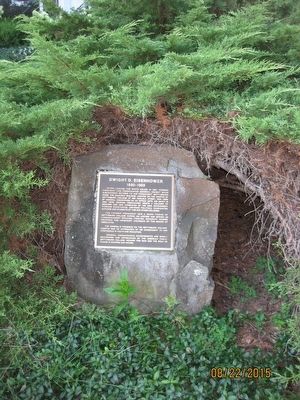
1. Dwight D. Eisenhower Marker
The former president was a good friend of Gettysburg College during his lifetime and served as commencement speaker, trustee, honorary degree recipient and honorary chairman of the Board of Associates.
The General's presence on the Gettysburg College campus was an affirmation of his commitment to and confidence in youth and education.
General Eisenhower's achievements are widely recognized and appreciated by the American public. Gettysburg college honors this man and the role he played in shaping our nation.
Topics and series. This historical marker is listed in these topic lists: Education • Government & Politics.
this page online
Location. 39° 50.12′ N, 77° 13.886′ W. Marker is in Gettysburg, Pennsylvania, in Adams County. It can be reached from the intersection of Carlisle Street and West Stevens Street. Marker is on walkway leading to Gettysburg College admissions building at 300 Carlisle Street. Touch for map. Marker is at or near this postal address: 300 Carlisle Street, Gettysburg PA 17325, United States of America. Touch for directions.

Regionally, this marker is in South-Central Pennsylvania. It is also in the American Northeast, in the Mid-Atlantic, in Appalachia, and specifically in Northern Appalachia. Globally, it is in North America, the Western Hemisphere, the Western World, and the Anglosphere. Historically, it finds itself in what was once the Haudenosaunee (Iroquois) Confederacy and also one of the original Thirteen Colonies.
Other nearby markers. At least 8 other markers are within walking distance of this marker: The Office of a President (a few steps from this marker); President Abraham Lincoln Signing the Emancipation Proclamation
Photographed by Bill Donovan, August 22, 2015
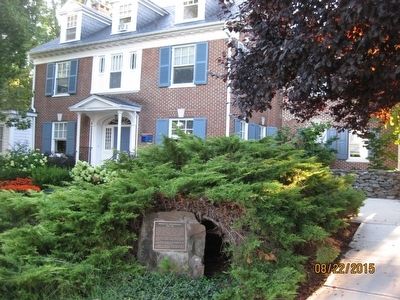
2. Shows location of marker on pathway to admissions building.
Photographed by Allen C. Browne, August 9, 2015
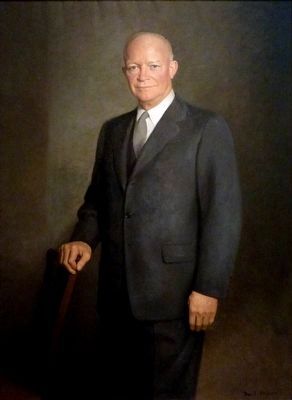
3. Dwight D. Eisenhower
This 1955 portrait of Dwight D. Eisenhower by Thomas E. Stephens hangs in the National Portrait Gallery in Washington, DC.
“In American politics, a successful military career has often led to the presidency, and so it proved with Dwight D. Eisenhower, who gained fame during World War II as supreme commander in Europe. Eisenhower was courted by both political parties, and he became the Republican nominee in 1952, chosen over the more conservative Robert Taft. Eisenhower defeated Illinois governor Adlai Stevenson in a campaign that attacked the Democrat's foreign policy savvy and toughness. With Eisenhower's personal appeal — the slogan was ‘I Like Ike’ — and military background, the Republican ticket was elected and then reelected in 1956. In office, Eisenhower ended the Korean War, maintained an uneasy balance with the Soviet bloc, and domestically presided over a period of general prosperity. A moderate conservative, he was cautious on issues of civil liberties and civil rights but left office warning of the growth of a ‘military industrial complex’ that threatened both government and American values. Once criticized as too passive a president, Eisenhower now draws widespread praise for his quiet, effective leadership during the 1950s.” — National Portrait Gallery
“In American politics, a successful military career has often led to the presidency, and so it proved with Dwight D. Eisenhower, who gained fame during World War II as supreme commander in Europe. Eisenhower was courted by both political parties, and he became the Republican nominee in 1952, chosen over the more conservative Robert Taft. Eisenhower defeated Illinois governor Adlai Stevenson in a campaign that attacked the Democrat's foreign policy savvy and toughness. With Eisenhower's personal appeal — the slogan was ‘I Like Ike’ — and military background, the Republican ticket was elected and then reelected in 1956. In office, Eisenhower ended the Korean War, maintained an uneasy balance with the Soviet bloc, and domestically presided over a period of general prosperity. A moderate conservative, he was cautious on issues of civil liberties and civil rights but left office warning of the growth of a ‘military industrial complex’ that threatened both government and American values. Once criticized as too passive a president, Eisenhower now draws widespread praise for his quiet, effective leadership during the 1950s.” — National Portrait Gallery
Credits. This page was last revised on June 16, 2016. It was originally submitted on August 31, 2015, by Bill Donovan of Maplewood, New Jersey. This page has been viewed 837 times since then and 37 times this year. Photos: 1, 2. submitted on August 31, 2015, by Bill Donovan of Maplewood, New Jersey. 3. submitted on September 1, 2015, by Allen C. Browne of Silver Spring, Maryland. • Bill Pfingsten was the editor who published this page.
