Medora in Billings County, North Dakota — The American Midwest (Upper Plains)
Medora Education
Photographed by Bill Coughlin, July 20, 2015
1. Medora Education Marker
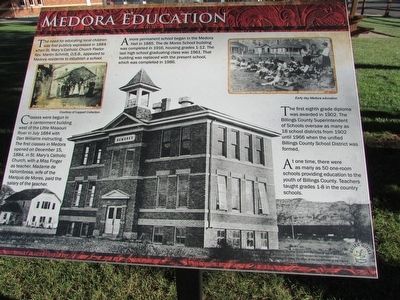
The need for educating local children was first publicly expressed in 1884 when St. Mary’s Catholic Church Pastor Rev. Martin Schmitt, O.S.B., appealed to Medora residents to establish a school.
Classes were begun in a cantonment building west of the Little Missouri River in July 1884 with Dan Williams instructing. The first classes in Medora opened on December 15, 1884, in St. Mary’s Catholic Church, with a Miss Finger as teacher. Madame de Vallombrosa, wife of the Marquis de Mores, paid the salary of the teacher.
A more permanent school began in the Medora Hall in 1885. The de Mores School building was completed in 1916, housing grades 1-12. The last high school graduating class was 1961. That building was replaced with the present school, which was completed in 1986.
The first eighth grade diploma was awarded in 1902. The Billings County Superintendent of Schools oversaw as many as 18 school districts from 1902 until 1966 when the unified Billings County School District was formed.
At one time, there were as many as 50 one-room schools providing education to the youth of Billings County. Teachers taught grades 1-8 in the
this page online
(Marker Number 18.)
Topics. This historical marker is listed in this topic list: Education. A significant historical date for this entry is December 15, 1884.
Location. 46° 54.82′ N, 103° 31.457′ W. Marker is in Medora, North Dakota, in Billings County. It is at the intersection of Broadway and 3rd Street, on the right when traveling east on Broadway. Touch for map. Marker is in this post office area: Medora ND 58645, United States of America. Touch for directions.

Regionally, this marker is on North Dakota’s Missouri Plateau. It is also in the American Lewis & Clark Corridor, on the prairies, and on the Northern Plains. Globally, it is in North America, the Western Hemisphere, the Western World, and the Anglosphere. Historically, it finds itself in what was once Rupert’s Land and also the Louisiana Purchase.
Other nearby markers. At least 8 other markers are within walking distance of this marker: Margaret Roberts (here, next to this marker); Medora Town Hall (within shouting distance of this marker); Roberts Hall (within shouting distance of this marker); The President Returns (within shouting distance of this
Photographed by Bill Coughlin, July 20, 2015
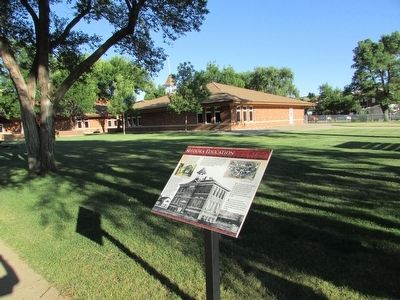
2. Medora Education Marker
More about this marker. The background of the marker contains a photograph of the De Mores School. Two pictures depicting the early days of Medora education appear on the top of the marker.
Additional commentary.
1. First teachers in Little Missouri/Medora
From what I have read, schooling began at the Badlands Cantonment as early as 1882. Sergeant George O Bartler was identified as the post school teacher in 1882. There was an unnamed woman who also taught at the cantonment in March, 1884; apparently she was not paid for her teaching.
Daniel Williams was, perhaps, the third teacher of record at the cantonment school in Little Missouri, starting in the summer of 1884. The anonymous female teacher is mentioned in the Bad Lands Cow Boy for Thursday, March 27, 1884, and Daniel Williams appears in the issues for Thursday,
Photographed by Bill Coughlin, July 20, 2015
3. Markers in Medora
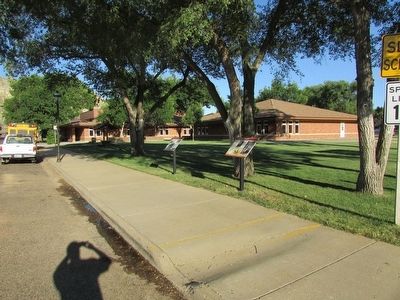
Two markers can be found at this location. The Medora Education marker is seen here on the left.
— Submitted June 1, 2024, by Mark Berg of Minot, North Dakota.
Credits. This page was last revised on June 10, 2024. It was originally submitted on September 1, 2015, by Bill Coughlin of Woodland Park, New Jersey. This page has been viewed 887 times since then and 40 times this year. Photos: 1, 2, 3. submitted on September 1, 2015, by Bill Coughlin of Woodland Park, New Jersey.
