Glasgow in South Lanarkshire, Scotland, United Kingdom — Northwestern Europe (the British Isles)
'The Most Magnificent Ruin in Scotland'
Bothwell Castle
Photographed by Brandon Fletcher, May 31, 2013
1. 'The Most Magnificent Ruin in Scotland' Marker
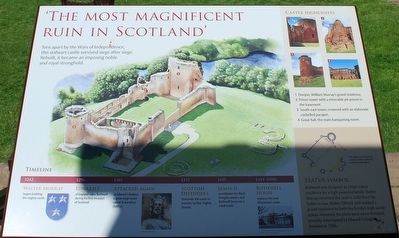
Torn apart by the Wars of Independence, this stalwart castle survived siege after siege. Rebuilt, it became an imposing noble and royal stronghold.
Castle Highlights
1. Donjon, William Murray's grand residence.
2. Prison tower with a miserable pit-prison in the basement.
3. South-east tower, crowned with an elaborate corbelled parapet.
4. Great hall, the main banqueting room.
Status Symbol
Bothwell was designed as a high status residence for a high powered family. Walter Murray inherited the land in 1242 from his father-in-law, Walter Olifard, and wanted a grand residence to befit the family's high social status. However, his plans were never finished, possibly interrupted by Edward I's English invasion in 1296.
Timeline
1242
Walter Murray
begins building the mighty castle.
1296
Edward I
of England takes Bothwell during his first invasion of Scotland.
1301
Attacked Again
as Edward I deploys a great siege tower called 'le befefrey' (belfry).
1337
Scottish Defenders
dismantled the castle to prevent further English attacks.
1455
James II
overthrows the Black Douglas owners and Bothwell
this page online
Late 1600's
Bothwell House
replaces the now dilapidated castle.
(Captions)
The yellow areas show the sections of the castle that remained unfinished.
Topics. This historical marker is listed in this topic list: Forts and Castles.
Location. 55° 48.572′ N, 4° 5.697′ W. Marker is in Glasgow, Scotland, in South Lanarkshire. It can be reached from Castle Avenue. Touch for map. Marker is in this post office area: Glasgow, Scotland G71 8BL, United Kingdom. Touch for directions.

Regionally, this marker is in Glasgow & Clyde Valley. Globally, it is on the Atlantic Ocean, in the North Atlantic Region, in Europe, on the Celtic Fringe, in Atlantic Europe, on one of the British Isles, in the Western World, and in the Anglosphere.
Other nearby markers. At least 5 other markers are within 24 kilometers of this marker, measured as the crow flies: Roman Military Bathhouse, Bothwellhaugh (approx. 4.4 kilometers away); Betrayed & Captured (approx. 11.3 kilometers away); Wallace's Well (approx. 11.3 kilometers away); Spirit of Scotland Monument (approx.
Photographed by Brandon Fletcher, May 31, 2013
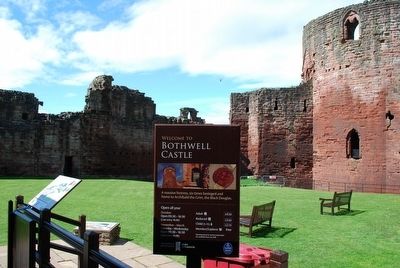
2. 'The Most Magnificent Ruin in Scotland' Marker
Photographed by Brandon Fletcher, May 31, 2013
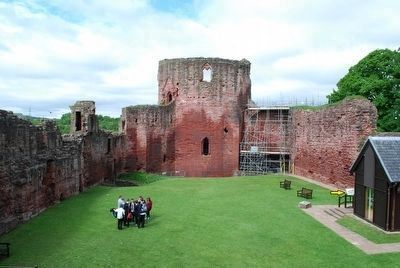
3. Bothwell Castle Interior
Interior of castle looking West. Marker in distance right (yellow arrow)
Photographed by Brandon Fletcher, May 31, 2013
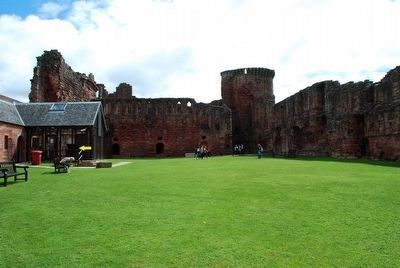
4. Bothwell Castle Interior
Interior of castle looking East. Marker in distance left (yellow arrow)
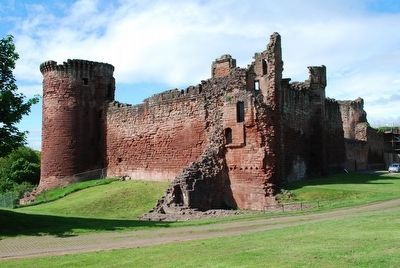
Photographed by Brandon Fletcher, May 31, 2013
5. Northeast View of Bothwell Castle
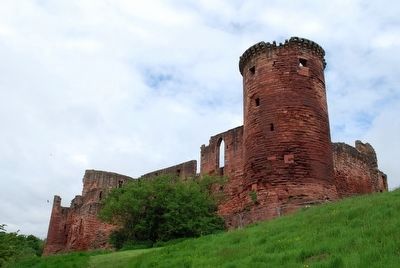
Photographed by Brandon Fletcher, May 31, 2013
6. Southeast Tower
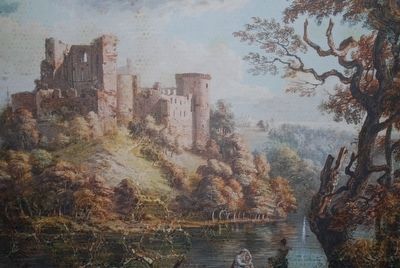
Photographed by Paul Sandby, circa 1780
7. Bothwell Castle Painting
From across the River Clyde
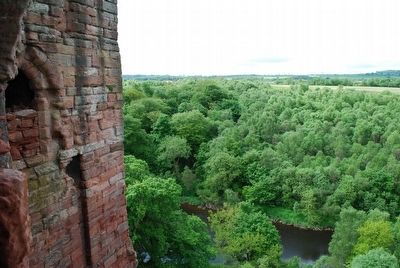
Photographed by Brandon Fletcher, May 31, 2013
8. River Clyde
The River Clyde as it runs adjacent to the castle.
Photographed by Brandon Fletcher, May 31, 2013
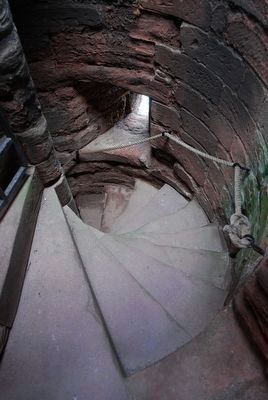
9. Bothwell Castle Tower Spiral Stairs
Photographed by Brandon Fletcher, May 31, 2013
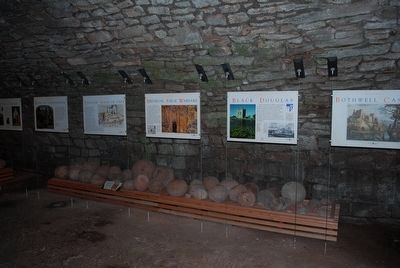
10. Interpretive Signs describing the History of Bothwell Castle
Photographed by Brandon Fletcher, May 31, 2013
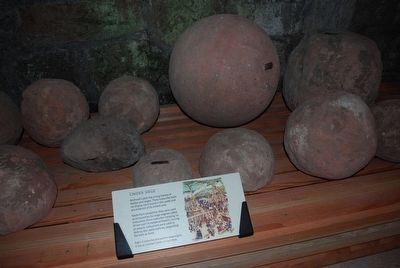
11. Trebuchet Balls
Bothwell Castle has a long history of battles and sieges. These trebuchet balls on display were found in the castle as evidence of its violent past.
Made from sandstone, they were used as ammunition for siege engines called trebuchets (from trebucher meaning 'to throw over' in medieval French). During an assault, trebuchets were used to destroy the castle walls by catapulting the balls at them.
Made from sandstone, they were used as ammunition for siege engines called trebuchets (from trebucher meaning 'to throw over' in medieval French). During an assault, trebuchets were used to destroy the castle walls by catapulting the balls at them.
Credits. This page was last revised on January 27, 2022. It was originally submitted on September 1, 2015, by Brandon Fletcher of Chattanooga, Tennessee. This page has been viewed 1,327 times since then and 23 times this year. Photos: 1, 2, 3, 4, 5, 6, 7, 8, 9, 10, 11. submitted on September 1, 2015, by Brandon Fletcher of Chattanooga, Tennessee. • Andrew Ruppenstein was the editor who published this page.
