Near Sweetwater in Nolan County, Texas — The American South (West South Central)
Women Airforce Service Pilots
Photographed by Mark Hilton, September 16, 2015
1. Women Airforce Service Pilots Marker
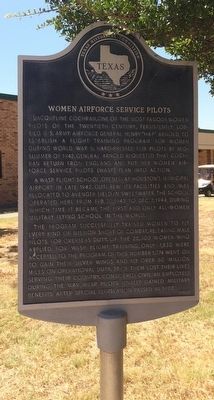
Jacqueline Cochran, one to the most famous women pilots of the twentieth century, persistently lobbied U.S. Army Airforce General Henry "Hap" Arnold to establish a flight training program for women during World War II. Hard-pressed for pilots by mid-summer of 1942, General Arnold requested that Cochran return from England and put her Women Airforce Service Pilots (WASP) plan into action.
A WASP flight school, opened at Houston's Municipal Airport in late 1942, outgrew its facilities and was relocated to Avenger Field in Sweetwater. The school operated here from Feb. 20, 1943 to Dec. 7, 1944, during which time it became the first and only all-women military flying school in the world.
The program successfully trained women to fly every kind of mission short of combat, releasing male pilots for overseas duty. Of the 25,000 women who applied for WASP flight training, only 1,830 were accepted to the program. Of this number 1,074 went on to gain their silver wings and fly over 60 million miles on operational duty; 38 of them lost their lives serving their country. Considered civilian employees during the war, WASP pilots finally gained military benefits after special legislation passed in 1977.
Erected 1993 by Texas Historical Commission. (Marker Number 5893.)
Topics and series. This historical marker is listed in these topic lists: Air & Space • Education • War, World II • Women. In addition, it is included in the Women Airforce Service Pilots (WASP) series list. A significant historical year for this entry is 1942.
Location. 32° 27.761′ N, 100° 28.41′ W. Marker is near Sweetwater, Texas, in Nolan County. It can be reached from the intersection of Homer K Taylor Drive and College Drive. Touch for map. Marker is at or near this postal address: 300 Homer K Taylor Drive, Sweetwater
this page online

Regionally, this marker is in Big Country. Globally, it is in North America, a Gulf of Mexico state, the Western Hemisphere, the Western World, and the Anglosphere. Historically, it finds itself in what was once New Spain, the Comanchería, the Republic of Texas, and one of the Confederate States of America.
Other nearby markers. At least 8 other markers are within 4 miles of this marker, measured as the crow flies: W.A.S.P. Training Base: Avenger Field (approx. 0.7 miles away); Roscoe Cemetery (approx. 3 miles away); Sweetwater Cemetery (approx. 3 miles away); S.D. Myres (approx. 3.8 miles away); W.A.S.P. (Women's Airforce Service Pilots) Training Base: Avenger Field (approx. 3.8 miles away); Ragland Building (approx. 3.8 miles away); Sweetwater Municipal Auditorium (approx. 3.9 miles away); Nolan County (approx. 3.9 miles away). Touch for a list and map of all markers in Sweetwater.
Another marker is no longer nearby. Herefords in Sweetwater (was approx. 3.9 miles away but has been confirmed missing).
Also see . . . Wikipedia article on Women Airforce Service Pilots.
Photographed by Mark Hilton, September 16, 2015
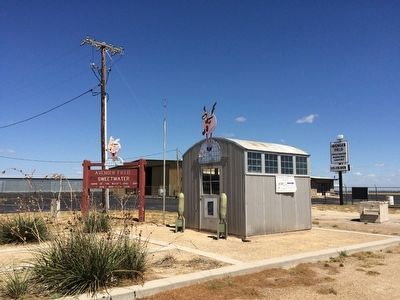
2. Avenger Field sign and old WASP building.
Photographed by Mark Hilton, September 16, 2015
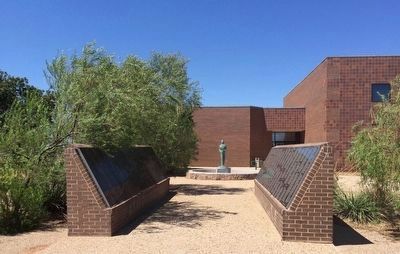
3. Women Airforce Service Pilots graduates memorial.
Marker is located behind left side memorial near trees.
Photographed by Mark Hilton, September 16, 2015
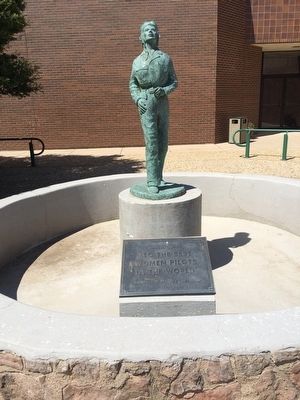
4. Statue of Jacqueline Cochran near marker.
We live in the wind and sand and our eyes are on the stars
Additional marker in front of statue:
March 11, 1944
"To the Best Women Pilots in the World"
General H. H. "Hap" Arnold
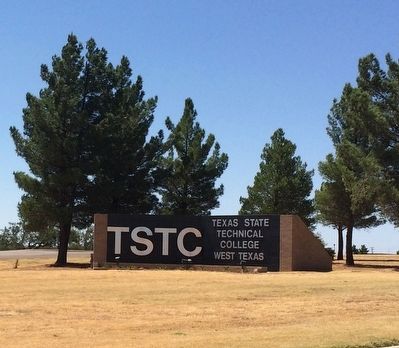
Photographed by Mark Hilton, September 16, 2015
5. Marker located on what is now the campus of Texas State Technical College in Sweetwater.
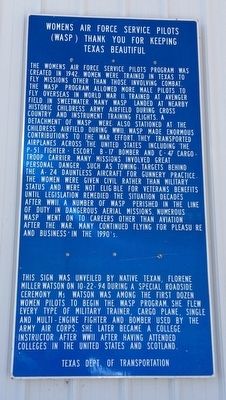
Photographed by Mark Hilton, September 16, 2015
6. Sign located at WASP World War II museum close to college and air field.
(WASP) Thank you for keeping
Texas beautiful
The Womens's Air Force Service Pilots program was created in 1942. Women were trained in Texas to fly missions other than those involving combat. The WASP program allowed more male pilots to fly overseas in World War II. Trained at Avenger Field in Sweetwater. Many WASP landed at nearby historic Childress Army Airfield during cross country and instrument training flights. A detachment of WASP were also stationed at the Childress Airfield during WWII. WASP made enormous contributions to the war effort. They transported airplanes across the United States including the P-51 fighter-escort, B-17 bomber and C-47 cargo-troop carrier. Many missions involved great personal danger, such as towing targets behind the A-24 dauntless aircraft for gunnery practice. The women were given civil rather than military status and were not eligible for veterans benefits until legislation remedied the situation decades after WWII. A number of WASP perished in the line of duty in dangerous aerial missions. Numerous WASP went on to careers other than aviation after the war. Many continued fling for pleasure and business in the 1990's.
This sign was unveiled by native Texan, Florene Miller Watson on 10-22-94 during a special roadside ceremony. Ms Watson was among the first dozen women pilots to begin the WASP program. She flew every type of military trainer, cargo plane single and multi-engine fighter and bomber used by the Army Air Corps. She later became a college instructor after WWII after having attended colleges in the United States and Scotland.
Texas Dept. of Transportation.
Credits. This page was last revised on June 16, 2016. It was originally submitted on September 16, 2015, by Mark Hilton of Montgomery, Alabama. This page has been viewed 734 times since then and 35 times this year. Photos: 1, 2, 3, 4, 5, 6. submitted on September 16, 2015, by Mark Hilton of Montgomery, Alabama.
