Sant'Eustachio in Roma in Città metropolitana di Roma Capitale, Latium, Rome, Italy — Central Italy (Tyrrhenian Coast)
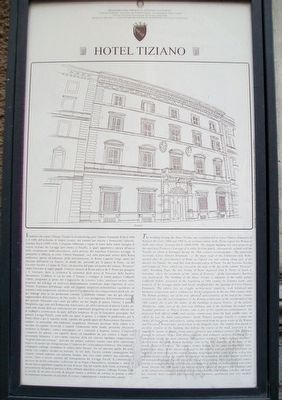
Hotel Tiziano
Photographed by William Fischer, Jr., October 4, 2013
1. Hotel Tiziano Marker
The building of the Hotel Tiziano is adjacent to the noble palace Caffarelli Vidoni, projected at the beginning of 16th century by Lorenzo Lotto, also property of the Lavaggi
this page online
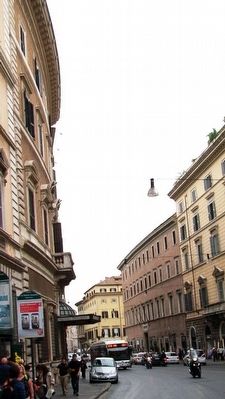
The slightly bent façade is [a] peculiar element of the building that follows the course of the road, projected to the outside by means of simple string-course
Photographed by William Fischer, Jr., October 4, 2013
2. Hotel Tiziano
———————————
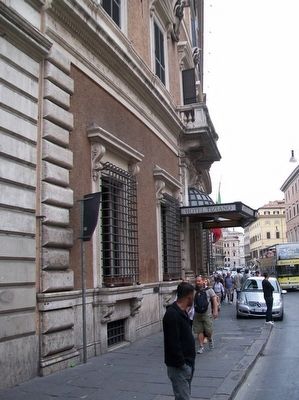
Il palazzo che ospita l'albergo Tiziano
Photographed by William Fischer, Jr., October 4, 2013
3. Hotel Tiziano
L'edificio in cui ha sede il Tiziano è contiguo al nobile palazzo Caffarelli Vidoni, progettato ai primi del Cinquecento da Lorenzo Lotto, anch'esso incluso nelle proprietà dei Lavaggi ed anch'esso profondamente modificato dopo l'apertura di corso Vittorio. Il palazzo dell'albergo, nella sua elegante semplicità architettonica, equilibrato ed armonico nelle proporzioni, mostra in sintesi la propensione neo-cinquecentista del Koch, che qui impiegò tutta la sua produzione corrente. L'architetto romano, uno dei più affermati rappresentanti dell'eclettismo di fine secolo, fu il vero protagonista dell'architettura romana del secondo Ottocento (suoi sono gli edifici sui lati lunghi di piazza Vittorio, il palazzo Margherita oggi sede, dell'Ambasciata Americana e gli edifici porticati di piazza Esedra, per citare solo alcune delle sue realizzazioni più importanti), progettista sia di opere ufficiali che di molteplici commissioni da parte dell'alta borghesia, di cui fu l'interprete principale. Nel palazzo Lavaggi Pacelli, come nelle sue opere in genere, è evidente la predilezione per le forme chiare e per le superfici nitide, ispirata alle grandi opere del Rinascimento fiorentino e romano, in particolare alla tradizione sangallesca.
Elemento peculiare dello stabile è la facciata lievemente incurvata a seguire l'andamento della strada, proiettata all'esterno mediante le semplici cornici marcapiano ed i cantonali a bugnato rustico. L'ingresso-compreso fra paraste con capitelli dorici ed inquadrato da una cornice a bugne con sovrastante balaustra- è un'evidente citazione della più classica tipologia cinquecentesca "bugnato-balcone-colonne", derivata dai palazzi nobiliari romani (una delle espressioni migliori di questo tipo d'impostazione è l'ingresso del vicino palazzo Farnese). Alla medesima compagine culturale rimandano le cornici delle finestre, fra cui spiccano quelle del piano nobile con timpano arcuato su mensole. Ai lati della finestra centrale campeggiano due eleganti stemmi nobiliari con protome leonina: uno reca come simbolo una colomba sul monte, l'altro è invece centrato dal monogramma dei Lavaggi Pacelli. Il coronamento è percorso da un bel cornicione evidenziato da un fregio a bassorilievo, sovrastato a sua volta[?] da una fascia aggettante scandita da teste di leone. Pur nel rispetto delle forme architetton[?] ottocentesche del palazzo patrizio e della raffinata atmosfera originale, l'albergo Tiziano, a cui si accede da un atrio rivestito di pregiati marmi e definito da colonne in granito, è stato recentemente restaurato ed arricchito di esclusivi appartamenti e modernissime camere.
Erected by Ministero Per I Beni E La Attivia Culturali, Comune di Roma – Assessorato alle Politche Culturali, Sovraintendenza ai Beni Culturali – Politiche Promozione Internazionale del Turismo e della Moda, Progetto Mirabilia - Piano di Comunicazione del Patrimonio Culturali Nazionale .
Topics. This historical marker is listed in this topic list: Notable Buildings. A significant historical year for this entry is 1886.
Location. This marker has been replaced by another marker nearby. It was located near 41° 53.777′ N, 12° 28.538′ E. Marker was in Roma, Lazio (Latium, Rome), in Città metropolitana di Roma Capitale. It was in Sant'Eustachio. It was at the intersection of Corso Vittorio Emanuele II and Via Monterone, on the right when traveling east on Corso Vittorio Emanuele II. Touch for map. Marker was at or near this postal address: Corso Vittorio Emanuele II 110, Roma, Lazio 00186, Italy. Touch for directions.

Regionally, it was in Europe, the European Union, the Schengen Area, a coastal Mediterranean country, and the Western World. Historically, it found itself in what was once the Roman Empire.
Other nearby markers. At least 8 other markers are within walking distance of this location: Hotel L'Orologio (here, next to this marker); Chile Democratico (within shouting distance of this marker); Giuseppe Gioachino Belli (within shouting distance of this marker); Adelaide Ristori Capranica del Grillo and Aldo Palazzeschi (within shouting distance of this marker); Adelaide Ristori and Aldo Palazzeschi (within shouting distance of this marker); Chiesa di Sant'Andrea della Valle / Church of Saint Andrew of the Valley (about 90 meters away, measured in a direct line); Galleria Spada / Spada Gallery (about 120 meters away); La Chiesa Di S. Nicola De' Calcarario Poi De' Cesarini (about 120 meters away). Touch for a list and map of all markers in Roma.
More about this marker. The hotel was renamed Hotel L'Orologio at some point between 2020 and 2025, and this marker was given a new title.
Also see . . . Hotel Tiziano, Rome, Italy. (Submitted on September 26, 2015, by William Fischer, Jr. of Reynoldsburg, Ohio.)
Credits. This page was last revised on October 3, 2025. It was originally submitted on September 26, 2015, by William Fischer, Jr. of Reynoldsburg, Ohio. This page has been viewed 531 times since then and 26 times this year. Photos: 1, 2, 3. submitted on September 26, 2015, by William Fischer, Jr. of Reynoldsburg, Ohio.
