Downtown in Baltimore, Maryland — The American Northeast (Mid-Atlantic)
The Battle Monument
Photographed by Allen C. Browne, September 27, 2015
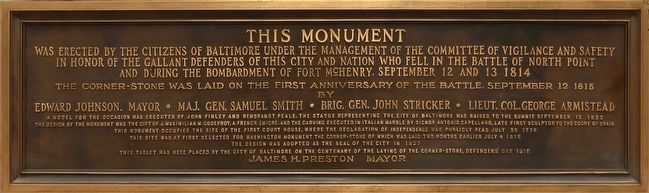
1. The Battle Monument Marker
was erected by the citizens of Baltimore under the management of the Committee of Vigilance and Safety
in honor of the gallant defenders of this City and Nation who fell in the Battle of North Point
and during the bombardment of Fort McHenry September 12 and 13, 1814.
The corner-stone was laid on the first anniversary of the Battle, September 12, 1815
by
Edward Johnson, Mayor • Maj. Gen. Samuel Smith • Brig. Gen. John Stricker • Lieut. Col. George Armistead.
A model for the occasion was executed by John Finley and Rembrandt Peale, The statue representing the city of Baltimore was raised to summit September 12, 1822
The design of the monument was the gift of J. Maximilian M. Godefroy, a French émigré, and the carving was executed in Italian marble by Signor Antonio Capellano, late first sculptor to the court of Spain
This site was first selected for Washington Monument the corner-stone of which was laid two months earlier July 4, 1815
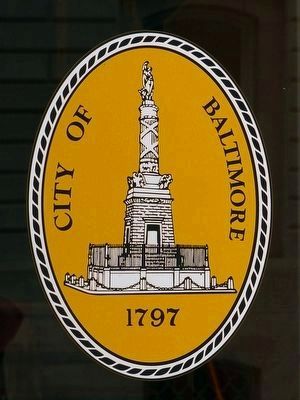
The design was adopted as the seal of the city in 1827
This tablet was placed by the City of Baltimore on the centenary of the laying of the corner-stone, Defenders'
this page online
James H. Preston Mayor
Erected 1914 by the City of Baltimore.
Topics. This monument and memorial is listed in these topic lists: Patriots & Patriotism • War of 1812.
Location. 39° 17.437′ N, 76° 36.744′ W. Monument is in Baltimore, Maryland. It is in Downtown. It can be reached from N Calvert Street. in Battle Monument Park. Touch for map. Monument is in this post office area: Baltimore MD 21202, United States of America. Touch for directions.

Regionally, this memorial monument is in Central Maryland. It is also in the American Mid-Atlantic, in the Chesapeake Bay Region, and on the Eastern Seaboard. Globally, it is in the North Atlantic Region, North America, the Western Hemisphere, the Western World, and the Anglosphere. Historically, it finds itself in what was once one of the original Thirteen Colonies and also the Antebellum South.
Other nearby markers. At least 8 other markers are within walking distance of this marker: A different marker also named The Battle Monument (here, next to this marker); a different marker also named The Battle Monument
Photographed by Allen C. Browne, September 27, 2015
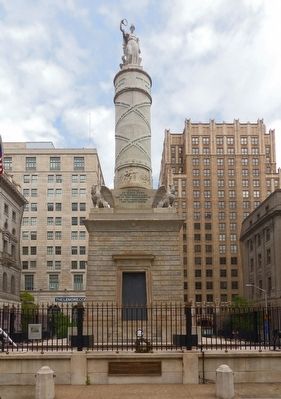
2. The Battle Monument Marker
Another marker is no longer nearby. The Equitable Building (was a few steps from this marker but has been replaced with another marker now near it).
Photographed by Allen C. Browne, September 27, 2015
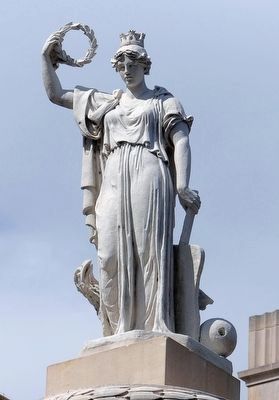
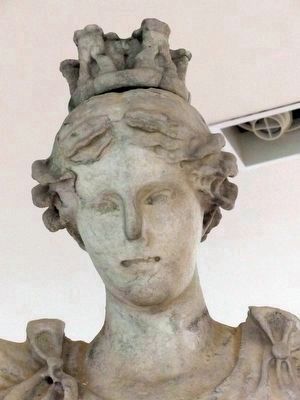
3. Lady Baltimore
A concrete casting of the Carrara marble original by Antonio Capellano.
Photographed by Allen C. Browne, September 27, 2015
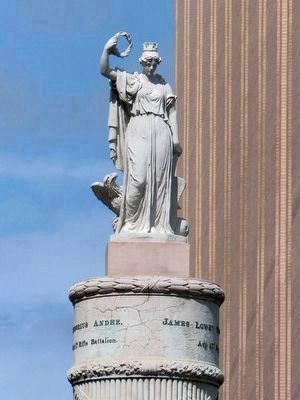
4. Lady Baltimore
This figure represents the city of Baltimore wearing a crown of victory and holding a laurel wreath with a rudder in her left hand representing Baltimore's maritime heritage, an American eagle on her right and on her left a bomb reminding us of the "bombs bursting in air."
Photographed by Allen C. Browne, September 5, 2015
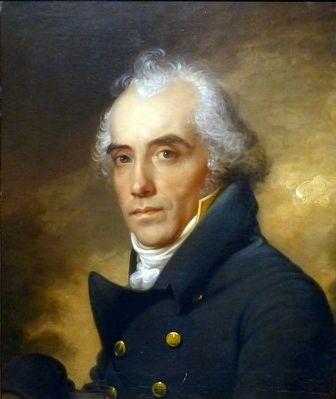
5. Maximilian Godefroy
This 1815 portrait of Maximiian Godefroy by Rembrandt Peale hangs in the Maryland Historical Society Museum in Baltimore, Maryland.
“Baltimore's Committee of Vigilance and Safety selected French-trained neoclassical architect and former soldier Maximilian Godefroy as the designer for its Battle Monument. Godefroy, a former soldier who fought on the royalist side of the French Revolution, chose the monument's symbolic Classical elements to memorialize Baltimore's fallen heroes. While Godefroy personally oversaw much of the monument's construction, he returned to Europe in 1819 well before his masterpiece was completed in 1825.” — Maryland Historical Society
“Baltimore's Committee of Vigilance and Safety selected French-trained neoclassical architect and former soldier Maximilian Godefroy as the designer for its Battle Monument. Godefroy, a former soldier who fought on the royalist side of the French Revolution, chose the monument's symbolic Classical elements to memorialize Baltimore's fallen heroes. While Godefroy personally oversaw much of the monument's construction, he returned to Europe in 1819 well before his masterpiece was completed in 1825.” — Maryland Historical Society
Photographed by Allen C. Browne, September 5, 2015
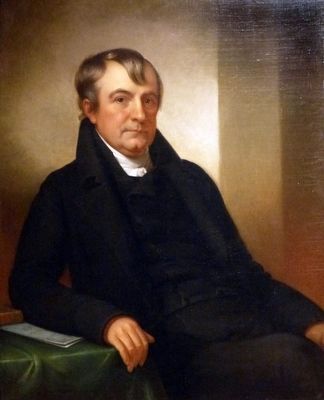
6. Edward Johnson
This 1817 portrait of Edward Johnson by Rembrandt Peale hangs in the Maryland Historical Society Museum in Baltimore, Maryland.
“Edward Johnson served six two-year terms as mayor of Baltimore and led the city during the tumultuous period from 1812 to 1814. In 1812, Johnson navigated the brutal riot directed towards anti-war newspaper publisher, Alexander Contee Hanson. Although Johnson remained staunchly anti-British. He put his own political opinions aside and led Hanson and his followers to the city jail where he mistakenly thought they would be protected. In 1814, Johnson headed the Committee of Vigilance and Safety and directed preparations for a British invasion. His obituary lauded him as ‘…one of the most benevolent men that ever lived.’ ” — Maryland Historical Society
“Edward Johnson served six two-year terms as mayor of Baltimore and led the city during the tumultuous period from 1812 to 1814. In 1812, Johnson navigated the brutal riot directed towards anti-war newspaper publisher, Alexander Contee Hanson. Although Johnson remained staunchly anti-British. He put his own political opinions aside and led Hanson and his followers to the city jail where he mistakenly thought they would be protected. In 1814, Johnson headed the Committee of Vigilance and Safety and directed preparations for a British invasion. His obituary lauded him as ‘…one of the most benevolent men that ever lived.’ ” — Maryland Historical Society
Photographed by Allen C. Browne, September 5, 2015
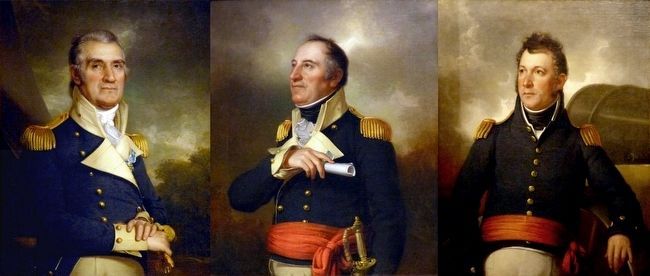
7. Samuel Smith, John Stricker and George Armistead
These three portraits painted in 1817 and 1818 by Rembrandt Peale hang in the Maryland Historical Society Museum in Baltimore, Maryland. Samuel Smith (left) was in over-all command of American forces at Baltimore in September 1814; John Stricker (middle) commanded the troops at the Battle of North Point; and George Armistead (right) was in charge of Fort McHenry.
Photographed by Allen C. Browne, September 27, 2015
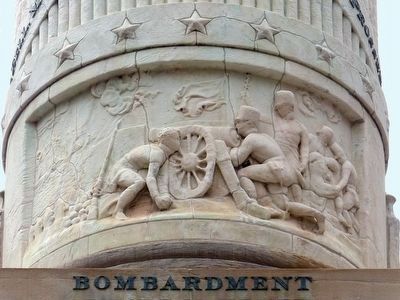
8. The Bombardment of Fort McHenry
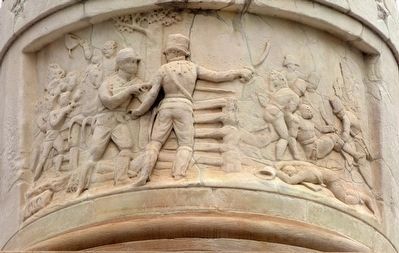
Photographed by Allen C. Browne, September 27, 2015
9. The Battle of North Point
Photographed by Allen C. Browne, September 27, 2015
10. The Baltimore City Seal
Photographed by Allen C. Browne, September 5, 2015
11. Lady Baltimore
The original Carrara marble statue of Lady Baltimore by Antonio Capellano resides in the Maryland Historical Society Museum.
Library of Congress
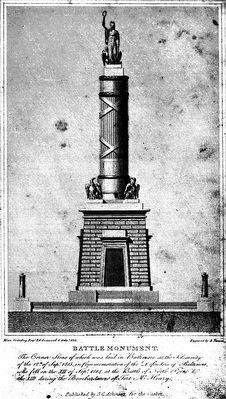
12. The Battle Monument
The Corner Stone of which was laid in Baltimore at the Solemnity of the 12th of Sept. 1815, in commemoration of the Defenders of Baltimore, who fell on the XII of Sept. 1814, at the Battle of North Point & the XII during the Bombardment of Fort McHenry.
Max. Godefroy Esqu.r P.A. & cinvenit & delin. 1815
Engraved by B. Tanner
Max. Godefroy Esqu.r P.A. & cinvenit & delin. 1815
Engraved by B. Tanner
Credits. This page was last revised on February 17, 2025. It was originally submitted on September 30, 2015, by Allen C. Browne of Silver Spring, Maryland. This page has been viewed 1,355 times since then and 105 times this year. Photos: 1, 2, 3, 4, 5, 6, 7, 8, 9, 10, 11, 12. submitted on September 30, 2015, by Allen C. Browne of Silver Spring, Maryland. • Bill Pfingsten was the editor who published this page.
