
Near Keystone in Pennington County, South Dakota — The American Midwest (Upper Plains)
The Power to Carve a Mountain
Photographed by Barry Swackhamer, September 6, 2015
1. The Power to Carve a Mountain Marker
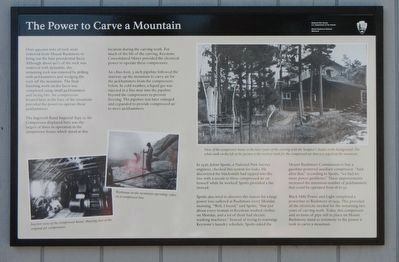
Captions: (bottom left) Interior view of the compressor house showing two of the original compressors.; (bottom center) Workman on the mountain operating valve on a compressor line.; (top right) View of the compressor house in the later years of the carving with the Sculptor's Studio in the background. The white tank on the left of the picture is the receiver tank for the compressed air that was piped up the mountains.
The Ingersoll-Rand Imperial Type 10 Air Compressor displayed here was the largest of three in operation in the compressor house which stood at this location during the carving work. For much of the life of the carving, Keystone Consolidated Mines provided the electrical power to operate these compressors.
An 1,800-foot, 3-inch pipeline followed the stairway up the mountain to carry air for the jackhammers from the compressor below. In cold weather, a liquid gas was injected in a fine mist into the pipeline beyond the compressors to prevent freezing. The pipeline was later enlarged and expanded to provide compressed air to more jackhammers.
In 1936, Julian Spotts, a National
this page online
Spotts also tried to discover the reason for a large power loss suffered at Rushmore every Monday morning. "Well, I found," said Spotts, "that just about every woman in Keystone washed clothes on Monday, and a lot of them had electric washing machines." Instead of trying to rearrange Keystone's laundry schedule, Spotts asked the Mount Rushmore Commission to buy a gasoline-powered auxiliary compressor. "And after that," according to Spotts, "we had no more power problems." These improvements increased the minimum number of jackhammers that could be operated from 16 to 22.
Black Hills Power and Light completed a power line to Rushmore in 1939. This provided all the electricity needed for the remaining two years of carving work. Today, this compressor and sections of pipe still in place on Mount Rushmore stand as testimony to the power it took to carve a mountain.
Erected by National Park Service, Mount Rushmore Memorial.
Topics.
Photographed by Barry Swackhamer, September 6, 2015
2. The Power to Carve a Mountain Marker
Location. 43° 52.73′ N, 103° 27.275′ W. Marker is near Keystone, South Dakota, in Pennington County. It can be reached from State Highway 244. Touch for map. Marker is at or near this postal address: 13000 South Dakota Highway 244, Keystone SD 57751, United States of America. Touch for directions.

Regionally, this marker is in South Dakota’s West River, in the Badlands, and in Greater Rapid City. It is also in the American Black Hills, in the Lewis & Clark Corridor, on the prairies, and on the Northern Plains. Globally, it is in North America, the Western Hemisphere, the Western World, and the Anglosphere. Historically, it finds itself in what was once Rupert’s Land and also the Louisiana Purchase.
Other nearby markers. At least 8 other markers are within walking distance of this marker: (Mount Rushmore) Chronology (about 400 feet away, measured in a direct line); History of the United States of America (about 400 feet away); Theodore Roosevelt (about 500 feet away); Thomas Jefferson (about 700 feet away); George Washington (about 700 feet away); Abraham Lincoln (approx. 0.2 miles away); Rushmore Workers (approx. 0.2 miles away); "We Are Still Here" (approx. 0.2 miles away). Touch for a list and map of all markers in Keystone.
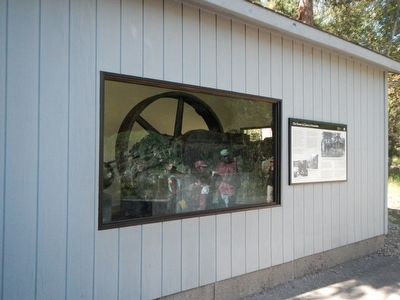
More about this marker. This marker is located below the Sculptor's Studio at Mount Rushmore National Memorial.
Credits. This page was last revised on June 16, 2016. It was originally submitted on October 9, 2015, by Barry Swackhamer of Brentwood, California. This page has been viewed 1,902 times since then and 144 times this year. Photos: 1, 2. submitted on October 9, 2015, by Barry Swackhamer of Brentwood, California.
