Staunton, Virginia — The American South (Mid-Atlantic)
Sears Hill Bridge
Photographed by Shane Oliver, June 8, 2020
1. Sears Hill Bridge Marker
Bridge History and Restoration
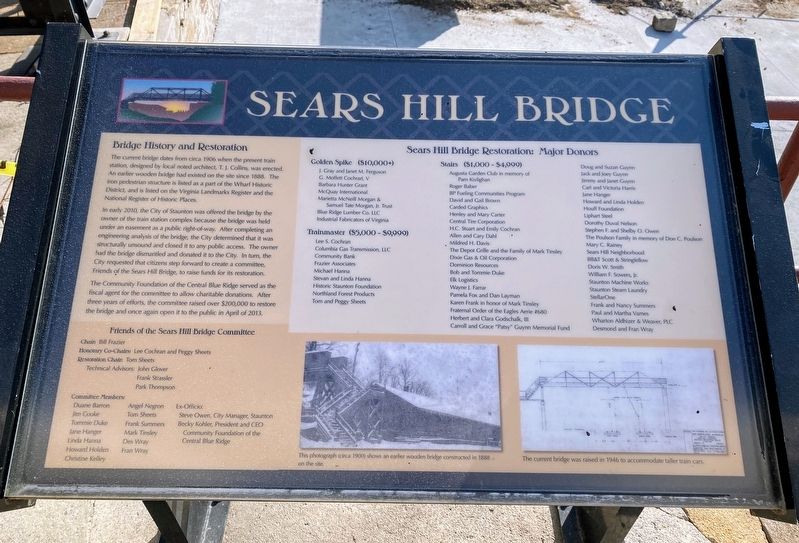
The current bridge dates from circa 1906 when the present train station, designed by local noted architect, T. J. Collins, was erected. An earlier wooden bridge had existed on the site since 1888. The iron pedestrian structure is listed as a part of the Wharf Historic District, and is listed on the Virginia Landmarks Register and the National Register of Historic Places.
In early 2010, the City of Staunton was offered the bridge by the owner of the train station complex because the bridge was held under an easement as a public right-of-way. After completing an engineering analysis of the bridge, the City determined that it was structurally unsound and closed it to any public access. The owner had the bridge dismantled and donated it to the City. In turn, the City requested that citizens step forward to create a committee, Friends of the Sears Hill Bridge, to raise funds for its restoration.
The Community Foundation of the Central Blue Ridge served as the fiscal agent for the committee to allow charitable donations. After three years of efforts, the committee raised over $200,000 to
this page online
Topics. This historical marker is listed in this topic list: Bridges & Viaducts. A significant historical year for this entry is 1906.
Location. 38° 8.841′ N, 79° 4.366′ W. Marker is in Staunton, Virginia. It is on Middlebrook Avenue (Route 252) just west of South New Street, on the left when traveling south. Touch for map. Marker is in this post office area: Staunton VA 24401, United States of America. Touch for directions.

Regionally, this marker is in the Shenandoah Valley. It is also in the American South and specifically in the Upper South. Globally, it is in North America, the Western Hemisphere, the Western World, and the Anglosphere. Historically, it finds itself in what was once the territory of the Mississippian Culture, one of the original Thirteen Colonies, one of the Confederate States of America, and the Antebellum South.
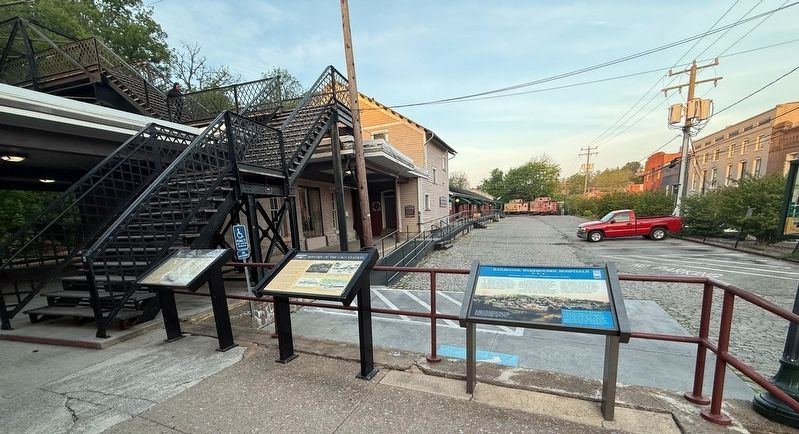
Other nearby markers. At least 8 other markers are within walking distance of this marker: History of the C&O Station (here, next to this marker); Railroads, Warehouses, Hospitals (here, next to this marker); Staunton’s Wharf Historic District History

Photographed by J. J. Prats, September 28, 2015
2. Sears Hill Bridge Marker
This is a photo of the marker before the glass was added on top.
Another marker is no longer nearby. Staunton (was here, next to this marker but has been replaced with another marker now near it).
More about this marker. The marker contains lists of officials and donors as well as two images. The lists are for “Friends of the Sears Hill Bridge Committee” and “Sears Hill Bridge Restoration: Major Donors.” The images are captioned: “This photograph (circa 1900) shows an earlier wooden bridge constructed in 1888 on the site.” and “The current bridge was raised in 1946 to accommodate taller train cars.” This second image is a architectural drawing of the bridge.
Regarding Sears Hill Bridge. This bridge connects the Sears Hill District of Staunton
Photographed by J. J. Prats, September 28, 2015
4. This Marker is the One on the Left
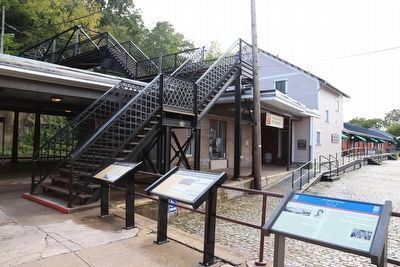
The first flight of steps for the Sears Hill Bridge start here. This is a photo of the marker before Staunton photo was removed.
Photographed by J. J. Prats, September 28, 2015
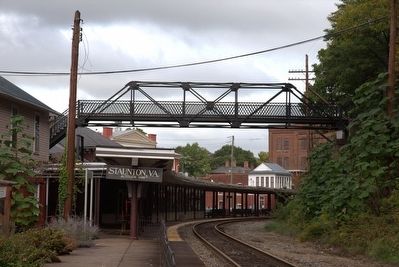
5. Street View of the Sears Hill Bridge
Photographed by J. J. Prats, September 28, 2015
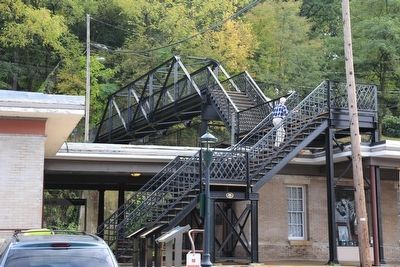
6. Sears Hill Bridge over Staunton Station
There are no steps on the Sears Hill side of the bridge. A paved path, the extension of Winthrop Street, continues up the hill to Sears Hill Road.
Photographed by Shane Oliver, June 8, 2020
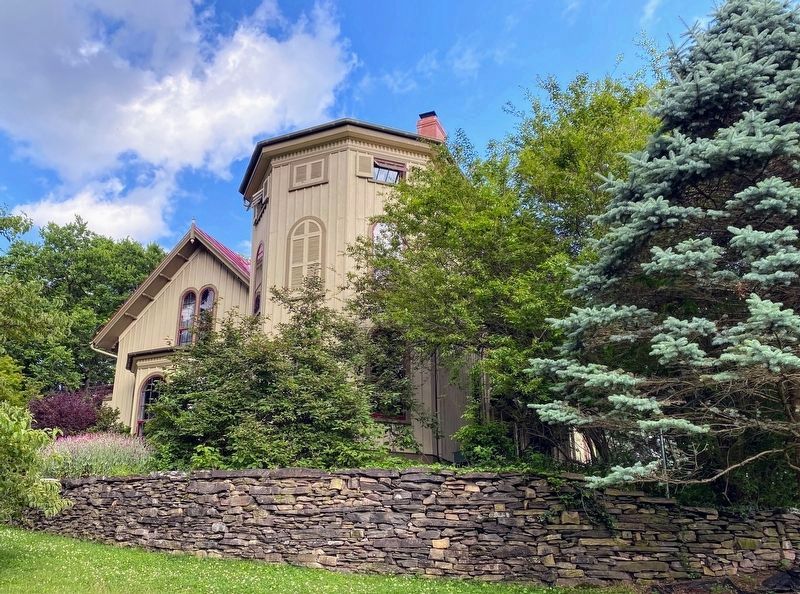
7. Sears House Rear View
Credits. This page was last revised on April 26, 2026. It was originally submitted on October 11, 2015, by J. J. Prats of Powell, Ohio. This page has been viewed 1,632 times since then and 168 times this year. Photos: 1. submitted on June 10, 2021, by Shane Oliver of Richmond, Virginia. 2. submitted on October 11, 2015, by J. J. Prats of Powell, Ohio. 3. submitted on April 26, 2026, by Devry Becker Jones of Washington, District of Columbia. 4. submitted on October 9, 2015, by J. J. Prats of Powell, Ohio. 5, 6. submitted on October 11, 2015, by J. J. Prats of Powell, Ohio. 7. submitted on June 10, 2021, by Shane Oliver of Richmond, Virginia.
Editor’s want-list for this marker. A link to the National Register nomination, citing historical significance. • Can you help?
