William Morrison
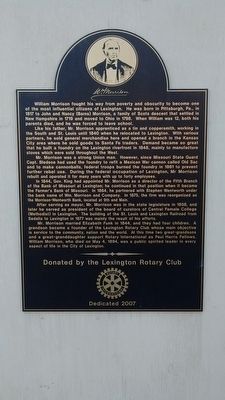
Like his father, Mr. Morrison apprenticed as a tin and coppersmith, working in the South and St. Louis until 1840 when he relocated to Lexington. With various partners, he sold general merchandise here and opened a branch in the Kansas City area where he sold goods to Santa Fe traders. Demand became so great that he built a foundry on the Lexington riverfront in 1848, mainly to manufacture stoves which were sold throughout the West.
Mr. Morrison was a strong Union man. However, since Missouri State Guard Capt. Bledsoe had used the foundry to refit a Mexican War cannon called Old Sac and to make cannonballs, federal troops burned the foundry in 1861 to prevent further rebel use. During the federal occupation of Lexington, Mr. Morrison rebuilt and operated it for many years with up to forty employees.
In 1844, Gov. King had appointed Mr. Morrison as a director of the Fifth Branch of the Bank of Missouri at Lexington; he continued in that position when it became the Farmer's Bank of Missouri. In 1864, he partnered with Stephen Wentworth under the bank name of Wm. Morrison and Company. In 1875, the firm was recognized as the Morrison-Wentworth Bank, located at 9th and Main.
After serving as mayor, Mr. Morrison was in the state legislature in 1858, and later he served as president of the board of curators of Central Female College (Methodist) in Lexington. The building of the St. Louis and Lexington Railroad from Sedalia to Lexington in 1877
this page online
Mr. Morrison married Elizabeth Funk in 1844, and they had four children. A grandson became a founder of the Lexington Rotary Club whose main objective is service to the community, nation and the world. At this time two great-grandsons and a great-granddaughter support Rotary International as Paul Harris Fellows. William Morrison, who died on May 4, 1894, was a public spirited leader in every aspect of life in the City of Lexington.
Erected 2007 by Lexington Rotary Club.
Topics and series. This historical marker is listed in these topic lists: Industry & Commerce • Settlements & Settlers • War, US Civil. In addition, it is included in the Rotary International series list. A significant historical year for this entry is 1817.
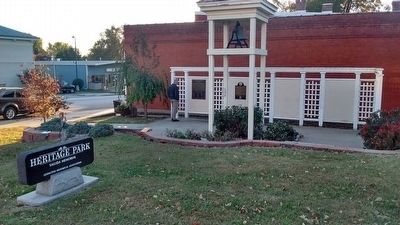
Location. 39° 11.077′ N, 93° 52.799′ W. Marker is in Lexington, Missouri, in Lafayette County. It is on 13th Street, on the left when traveling north. Marker is located in Heritage Park. Touch for map. Marker is in this post office area: Lexington MO 64067, United States of America. Touch for directions.
Regionally, this marker is in the Missouri River Corridor.
Other nearby markers. At least 8 other markers are within walking distance of this marker: The Steamboat Saluda Disaster (here, next to this marker); Christ Church (within shouting distance of this marker); The Library Building (within shouting distance of this marker); Mount Vernon Foundation Stones (within shouting distance of this marker); Lexington (about 700 feet away, measured in a direct line); Lafayette County Courthouse (approx. 0.2 miles away); Lexington's First Public School Building (approx. 0.2 miles away); Wentworth World War Memorial (approx. 0.2 miles away). Touch for a list and map of all markers in Lexington.
Credits. This page was last revised on November 24, 2019. It was originally submitted on November 10, 2015, by Tom Bosse of Jefferson City, Tennessee. This page has been viewed 735 times since then and 38 times this year. Photos: 1, 2. submitted on November 10, 2015, by Tom Bosse of Jefferson City, Tennessee. • Bill Pfingsten was the editor who published this page.
