Cokeville in Lincoln County, Wyoming — The American West (Mountains)
Cokeville
Photographed by Barry Swackhamer, September 11, 2015
1. Cokeville Marker
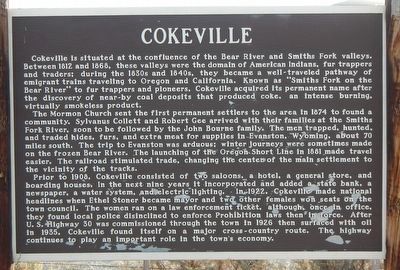
The Mormon Church sent the first permanent settlers to the area in 1874 to found a community. Sylvanus Collett and Robert Gee arrived with their families at the Smiths Fork River, soon to be followed by the John Bourne family. The men trapped, hunted, and traded hides, fur, and extra meat for supplies in Evanston, Wyoming about 70 miles south. The trip to Evanston was arduous; winter journeys were sometimes made on the frozen Bear River. The launching of the Oregon Shoreline in 1881 made travel easier. The railroad stimulated trade, changing the center of the main settlement to the vicinity of the tracks.
this page online
Prior to 1908, Cokeville consisted of two saloons, a hotel, a general store, and boarding houses. In the next nine years it incorporated and added a state bank, a newspaper, a water system, and electric lighting. In 1922, Cokeville made national headlines when Ethel Stoner became mayor and two other females won seats on the town council. The women ran on a law enforcement ticket, although once in office, they found local police disinclined to enforce Prohibition laws then in force. After U.S. Highway 30 was commissioned through the town in 1926 then surfaced with oil in 1935, Cokeville found itself itself on a major cross-country route. The highway continues to play an important role in the town's economy.
Erected by Wyoming State Archives and Historical Department.
Topics. This historical marker is listed in this topic list: Settlements & Settlers.
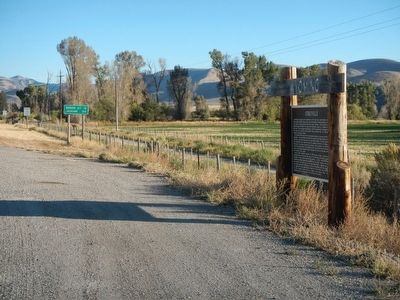
Location. 42° 5.394′ N, 110° 56.976′ W. Marker is in Cokeville, Wyoming, in Lincoln County. It is on U.S. 30 at milepost 11 near East Main Street (Wyoming Highway 232), on the right when traveling north. Touch for map. Marker is
Photographed by Barry Swackhamer, September 11, 2015
2. Cokeville Marker

Regionally, this marker is in the Westward Expansion Trails Region and in Greater Yellowstone. It is also in the American Mountain West. Globally, it is in North America, the Rocky Mountains, the Western Hemisphere, the Western World, and the Anglosphere. Historically, it finds itself in what was once Mexico’s Alta California.
Other nearby markers. At least 7 other markers are within 14 miles of this marker, measured as the crow flies: Old Oregon Trail (approx. 0.3 miles away); State Boundary Monument (approx. 0.6 miles away); Idaho, Utah and Wyoming Intersect Point (approx. 7.9 miles away in Utah); Oregon Trail 1847 (approx. 9.9 miles away); Golden Anniversary 1940 (approx. 9.9 miles away); Thomas Fork (approx. 10½ miles away in Idaho); Emigrant Springs (approx. 13.9 miles away).
Credits. This page was last revised on June 16, 2016. It was originally submitted on November 11, 2015, by Barry Swackhamer of Brentwood, California. This page has been viewed 2,179 times since then and 216 times this year. Photos: 1, 2. submitted on November 11, 2015, by Barry Swackhamer of Brentwood, California.
