
Big Stone Gap in Wise County, Virginia — The American South (Mid-Atlantic)
Southwest Virginia Museum
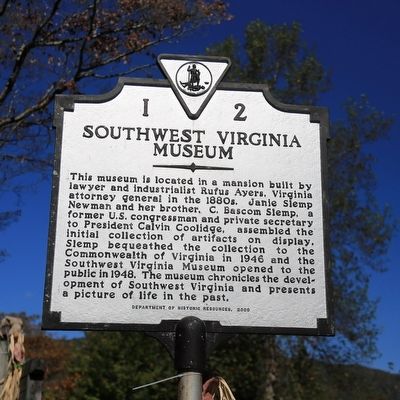
Photographed by J. J. Prats, October 17, 2015
1. Southwest Virginia Museum Marker
Erected 2000 by Department of Historic Resources. (Marker Number I-2.)
Topics and series. This historical marker is listed in these topic lists: Education • Industry & Commerce • Settlements & Settlers. In addition, it is included in the Former U.S. Presidents: #30 Calvin Coolidge, and the Virginia Department of Historic Resources (DHR) series lists. A significant historical year for this entry is 1880.
Location. 36° 51.806′ N, 82° 46.783′ W. Marker is in Big Stone Gap, Virginia, in Wise County. It is at the intersection of Wood Avenue West (Alternate U.S. 58) and West
this page online

Regionally, this marker is in Southwest Virginia. It is also in the American South, specifically in the Upper South, in Appalachia, and specifically in Southern Appalachia. Globally, it is in North America, the Western Hemisphere, the Western World, and the Anglosphere. Historically, it finds itself in what was once the original Cherokee Nation, the territory of the Mississippian Culture, one of the original Thirteen Colonies, one of the Confederate States of America, and the Antebellum South.
Other nearby markers. At least 8 other markers are within 3 miles of this marker, measured as the crow flies: Christ Episcopal Church (approx. 0.2 miles away); Carl Martin (approx. 0.3 miles away); Big Stone Gap (approx. 0.4 miles away); Origins of Big Stone Gap (approx. half a mile away); a different marker also named Big Stone Gap (approx. 0.6 miles away); Kelly View School (approx. 2½ miles away); Trail Head (approx. 2½ miles away); The Bee Rock Troll
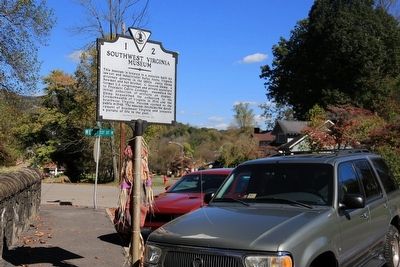
Photographed by J. J. Prats, October 17, 2015
2. Southwest Virginia Museum Marker
Regarding Southwest Virginia Museum. Adult admission is $5.
Also see . . . Southwest Virginia Museum. “The museum is housed in a mansion built in the 1880s by Rufus Ayers, a Virginia attorney general. The museum was bequeathed to the commonwealth in 1946 by C. Bascom Slemp, private secretary to President Calvin Coolidge and a member of the U. S. Congress. The museum was officially dedicated by the state in 1948. It features a collection comprised of more than 25,000 pieces, about one third of which is on display at any given time. The museum chronicles the exploration and development of the region during the pioneer period of the 1700s and the coal boom of the 1890s. It offers activities for kids, scout and school programs, workshops, an annual Festival of Trees program, a quilt show, a music festival and outdoor exhibits. The museum sells archival supplies and offers the opportunity to have pictures of collection pieces copied, as well as copies of reference files. A gift shop at the museum features Victorian-era and pioneer
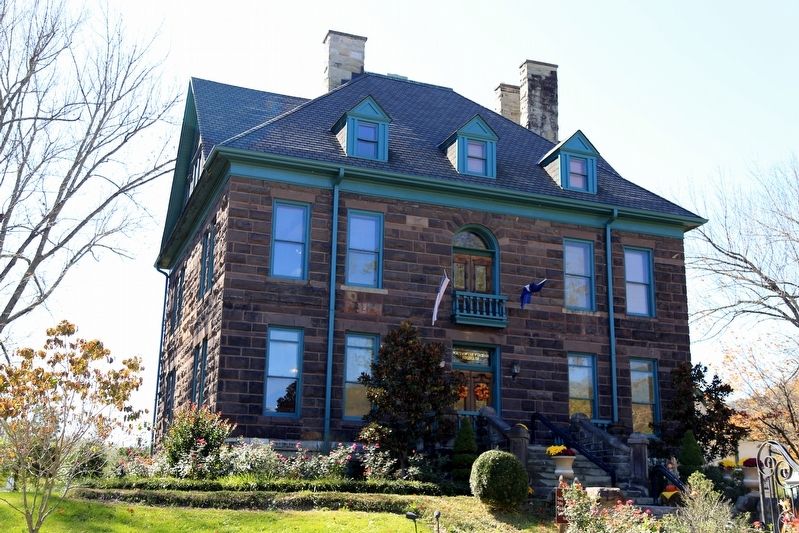
Photographed by J. J. Prats, October 17, 2015
3. Southwest Virginia Museum
“The museum tells the story of the 1890s coal boom and chronicles early exploration and settlement of the region. By the mid-1700s, settlers looking for a fresh start were traveling south out of Pennsylvania and Maryland into the valley of Virginia. In 1775 Daniel Boone pushed the Wilderness Road through Cumberland Gap, opening the way west. The flow of immigrants into and through southwestern Virginia increased dramatically.
“Braving the unknown and constantly facing the threat of Indian attacks, pioneer settlers were almost totally dependent on the land, their own skills and the contents of their wagon for their every need. Displays of tools, household furnishings, quilts and early commerce tell the story of these hardy pioneers. There are also displays about the area's coal mining booms and busts, and there's an interactive kiosk that features life and labor in the coal camps.” (Submitted on November 23, 2015.)
Credits. This page was last revised on December 27, 2019. It was originally submitted on November 23, 2015, by J. J. Prats of Powell, Ohio. This page has been viewed 543 times since then and 17 times this year. Photos: 1, 2, 3. submitted on November 23, 2015, by J. J. Prats of Powell, Ohio.
