Ranville in Calvados, Normandy, France — Western Europe
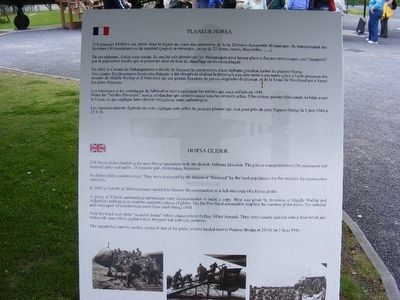
Horsa Glider
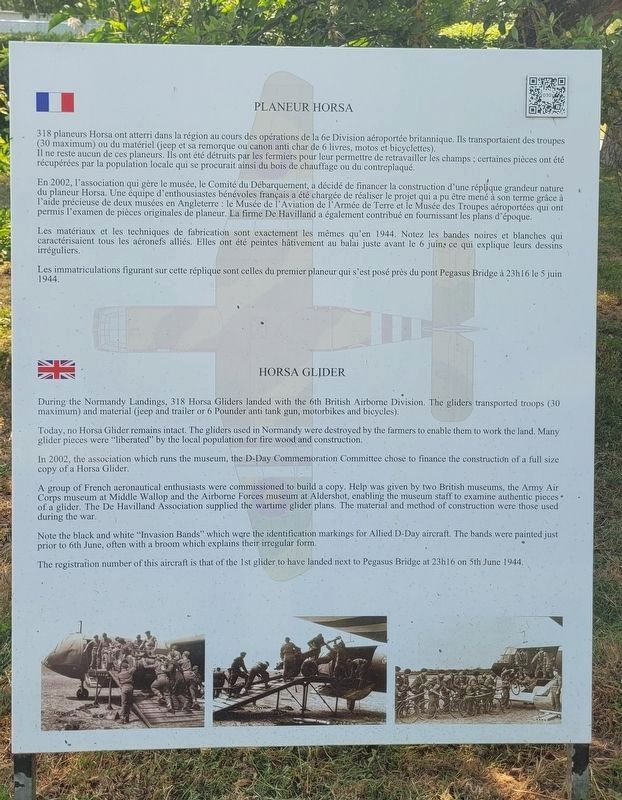
Planeur Horsa
Photographed by James Hulse, June 2, 2025
1. Horsa Glider Marker

De ces planeurs, il n'en reste aucun. Ils ont été suit détruites par les Britanniques pour laisser place a d'autres atterrissages, soit "récupéreres" par la population locale, qui se procurait ainsi du bois de chauffage ou du contreplaqué.
En 2002 le Comité du Débarquement a décidé de financer la construction d'une réplique grandeur nature du planeur Horsa. Une équipe d'enthousiastes bénévoles français a été chargée de réaliser le projet qui a pu être mené a son terme grâce 'à l'aide précieuse des musées de Middle Wallop et d'Aldershot qui ont permis l'examen de pièces originales de planeur, et de la firm De Havilland qui a fourni les plans d'epoque.
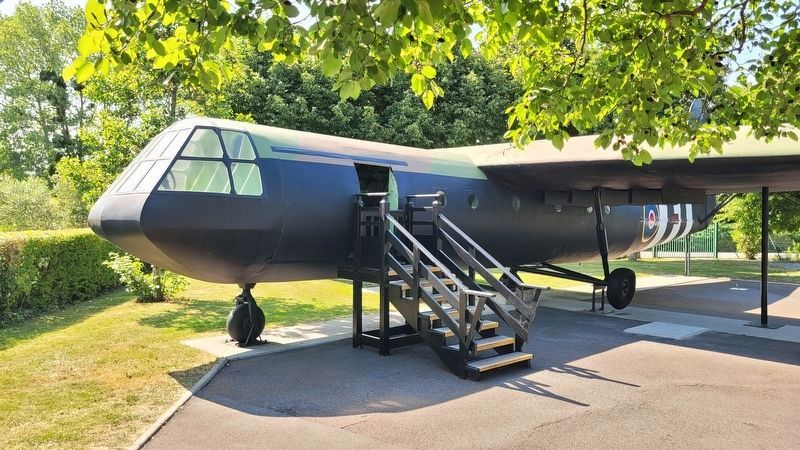
Les matériaux et les techniques de fabrication sont exactement les mêmes qui ceux utilisés en 1944. Notez les "bandes d'Invasion" noires et blanches qui caractèrisaient tous les aéronefs alliés. Elles étaient peintes bativement
this page online
Les immatriculations figurant sur cette réplique sont celles du premier planeur qui s'est posé près du pont Pegasus Bridge le 5 juin à 23 h 16.
318 Horsa gliders landed on the area during operations with the 6th British Airborne Division. The gliders transported men (30 maximum) and material (jeep and trailer, 25 pounder gun, motorbikes, bicycles)
No Horsa glider remains intact. They were destroyed by the British or “liberated” by the local population, for fire wood or for construction materials.
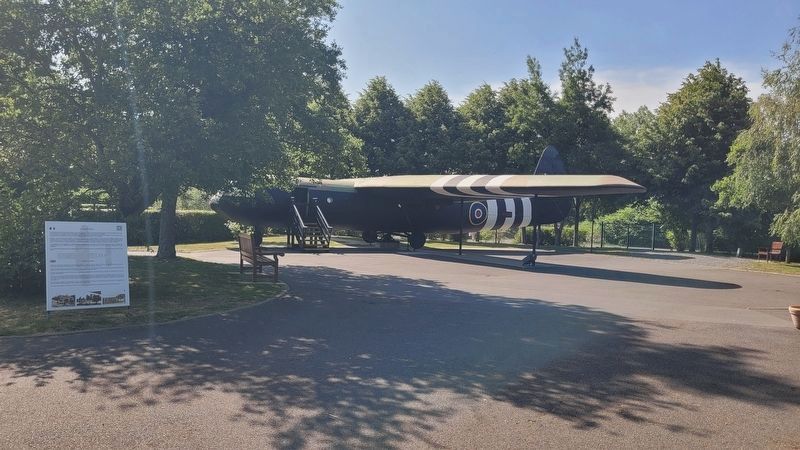
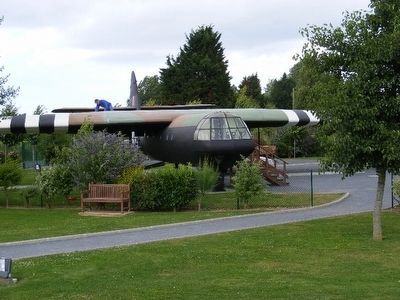
In 2002 le Comite du Débarquement decided to finance the construction of a full-size Horsa glider.
Note the black and white “invasion bands” which characterized D-Day Allied Aircraft. They were usually painted with a flour brush
Photographed by James Hulse, June 2, 2025
2. Horsa Glider Marker
The registration number on this replica is that of 1st glider to have landed next to Pegasus Bridge at 23h16 on 5 June 1944.
Topics. This historical marker is listed in this topic list: War, World II. A significant historical year for this entry is 2002.
Location. 49° 14.588′ N, 0° 16.269′ W. Marker is in Ranville, Normandie (Normandy), in Calvados. It is on Rue Major John Howard. This marker is on the grounds of the Pegasus Bridge Memorial Museum. Touch for map. Marker is in this post office area: Ranville, Normandie 14970, France. Touch for directions.

Regionally, it is in the North Atlantic Region, Europe, the European Union, Atlantic Europe, the Schengen Area, Western Europe, a coastal Mediterranean country, and the Western World. Historically, it finds itself in what was once a French colony and also the Roman Empire.
Other nearby markers. At least 8 other markers are within walking distance of this marker: Ce pont Bailey / This Bailey bridge (a few steps from this marker); The Veterans Charity (a few steps from this marker); 'Coup de Main' Glider Operation Memorial
Photographed by Don Morfe, June 27, 2008
3. Horsa Glider
Photographed by Don Morfe, June 27, 2008
4. Horsa Glider
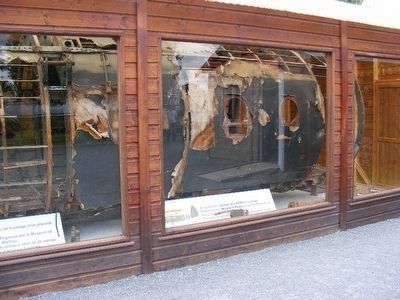
Inscription in the photo-An authentic section of a Horsa fuselage. Offered to the Memorial Pegasus by the Museum of Army Flying (Middle Wallop). The total length of the fuselage is 20 meters, more that twice the length of this section.
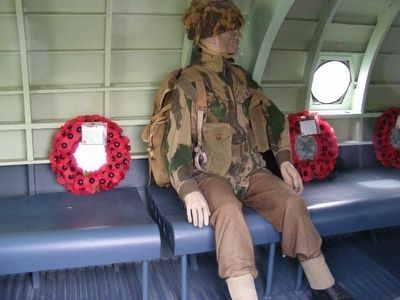
Photographed by Don Morfe, June 27, 2008
5. Horsa Glider-inside sitting
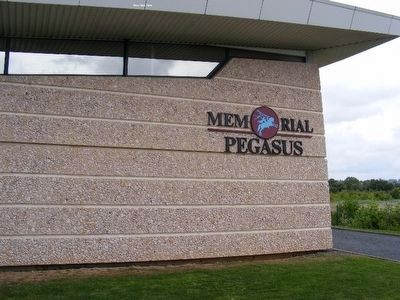
Photographed by Don Morfe, June 27, 2008
6. Pegasus Bridge Memorial Museum
Photographed by James Hulse, June 2, 2025
7. Horsa Glider Marker
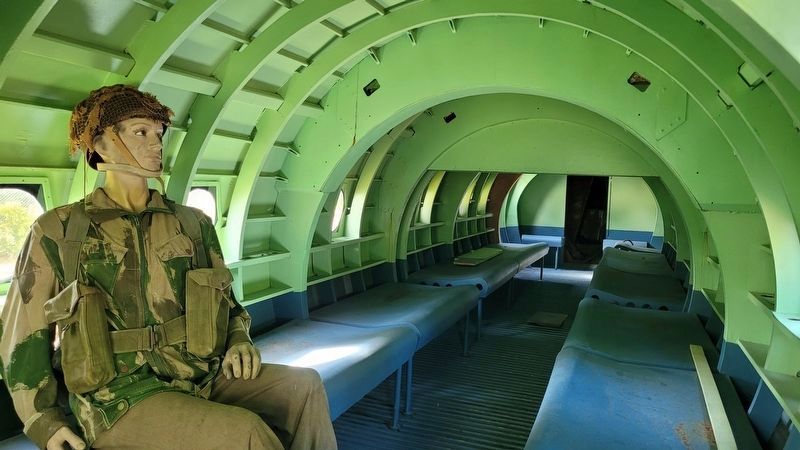
Photographed by James Hulse, June 2, 2025
8. Inside view of the Horsa Glider
Photographed by Don Morfe, June 27, 2008
9. Horsa Glider Marker
Credits. This page was last revised on July 1, 2025. It was originally submitted on January 2, 2016, by Don Morfe of Baltimore, Maryland. This page has been viewed 654 times since then and 36 times this year. Photos: 1, 2. submitted on July 1, 2025, by James Hulse of Medina, Texas. 3, 4, 5, 6. submitted on January 2, 2016, by Don Morfe of Baltimore, Maryland. 7, 8. submitted on July 1, 2025, by James Hulse of Medina, Texas. 9. submitted on January 2, 2016, by Don Morfe of Baltimore, Maryland. • Andrew Ruppenstein was the editor who published this page.
