Sunbury in Liberty County, Georgia — The American South (South Atlantic)
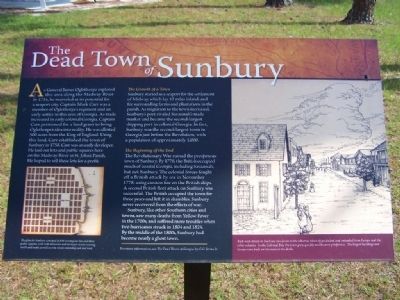
The Dead Town Of Sunbury
Photographed by Mike Stroud, July 2008
1. The Dead Town Of Sunbury Marker
The Growth of a Town
Sunbury started as a seaport for the settlement of Medway, which lay 10 miles inland, and for surrounding farms and plantations in the parish. As migration to the town increased, Sunbury's port rivaled Savannah's trade market and became the second - largest shipping port in colonial Georgia. In fact, Sunbury was the second - largest town in Georgia just before the Revolution, with a population off approximately 1,000.
The Beginning of the End
The
this page online
Topics. This historical marker is listed in these topic lists: Colonial Era • Industry & Commerce • War, US Revolutionary. A significant historical month for this entry is November 1778.
Location. 31° 46.227′ N, 81° 16.831′ W. Marker is in Sunbury, Georgia, in Liberty County. It is on Brigantine Dunsmore Road near Fort Morris Road. Located in small park at the intersection of the roads. Touch for map. Marker is in this post office area: Midway GA 31320, United
Photographed by Mike Stroud, 2008
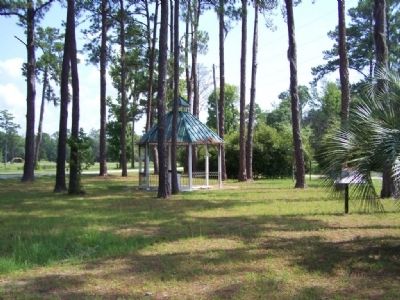
2. Partial view of The Dead Town Of Sunbury Marker, at right, in small park

Regionally, this marker is on the Coastal Plain, on the Georgia Coast and the Golden Isles, and on the Sea Islands. It is also in the American South, specifically in the Deep South, and on the Eastern Seaboard. Globally, it is in the North Atlantic Region, North America, the Western Hemisphere, the Western World, and the Anglosphere. Historically, it finds itself in what was once New Spain, the territory of the Mississippian Culture, one of the original Thirteen Colonies, one of the Confederate States of America, and the Antebellum South.
Other nearby markers. At least 8 other markers are within 5 miles of this marker, measured as the crow flies: Saint John's Lodge Number Six (within shouting distance of this marker); Sunbury (within shouting distance of this marker); The Old Sunbury Road (approx. 0.2 miles away); Sunbury Cemetery (approx. 0.2 miles away); a different marker also named The Sunbury Cemetery (approx. 0.2 miles away); The Famous Sunbury "Masonic" Oak (approx. 0.6 miles away); Fort Morris (approx. 0.7 miles away); Colonel's Island (approx. 4.2 miles away). Touch for a list and map
The Dead Town Of Sunbury Marker
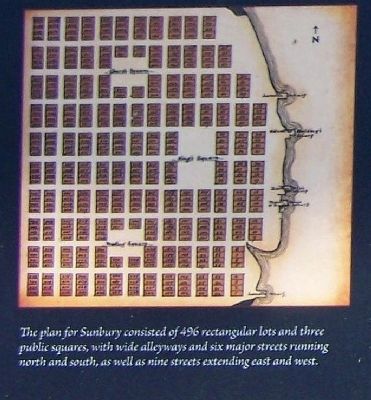
3. The Dead Town Of Sunbury Marker
Lower left Picture text
The plan for Sunbury consisted of 496 rectangular
lots and three public squares, with wide alleyways
and six major streets running north and south,
as well as nine streets extending east and west.
The Dead Town Of Sunbury Marker, 2008
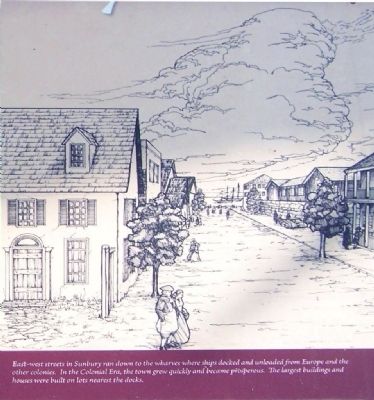
4. The Dead Town Of Sunbury Marker
Right picture text
East-west streets in Sunbury ran down to the wharves where ship docked and unloaded from Europe and the other colonies. In the Colonial Era. the Town grew quickly and became prosperous. The largest buildings and houses were built on lots nearest docks.
East-west streets in Sunbury ran down to the wharves where ship docked and unloaded from Europe and the other colonies. In the Colonial Era. the Town grew quickly and became prosperous. The largest buildings and houses were built on lots nearest docks.
Credits. This page was last revised on October 21, 2020. It was originally submitted on July 16, 2008, by Mike Stroud of Bluffton, South Carolina. This page has been viewed 3,884 times since then and 131 times this year. Photos: 1, 2, 3, 4. submitted on July 16, 2008, by Mike Stroud of Bluffton, South Carolina. • Christopher Busta-Peck was the editor who published this page.
