Fort Smith in Sebastian County, Arkansas — The American South (West South Central)
The New Theatre in 1911
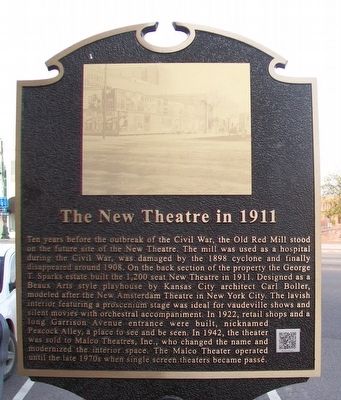
Photographed by William Fischer, Jr., January 17, 2016
1. The New Theatre in 1911 Marker
Erected 2012 by City of Fort Smith and Others.
Topics. This historical marker is listed in these topic lists: Architecture • Arts, Letters, Music • Entertainment • Industry & Commerce. A significant historical year for this entry is 1898.
Location. 35° 23.074′ N,
this page online

Regionally, this marker is in the Arkansas River Valley, in the Cherokee Heritage Region, and in Osage Territory. It is also in the American South and specifically in the Upper South. Globally, it is in North America, the Western Hemisphere, the Western World, and the Anglosphere. Historically, it finds itself in what was once the territory of the Mississippian Culture, the Louisiana Purchase, one of the Confederate States of America, and the Antebellum South.
Other nearby markers. At least 8 other markers are within walking distance of this marker: Fort Towson Trail (within shouting distance of this marker); Texas Corner in 1958 (within shouting distance of this marker); Great Cyclone at Fort Smith (within shouting distance of this marker); Immaculate Conception Church in 1906 (approx. 0.2 miles away);
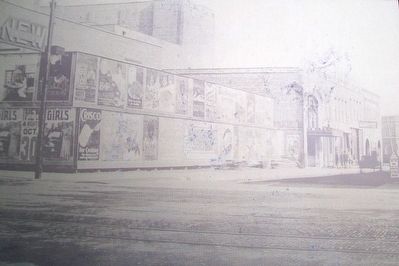
Photographed by Unknown, circa 1910s
2. Photo on The New Theatre in 1911 Marker
More about this marker. The markers in this series are placed so that viewers can only read them from the sidewalk while facing the historical subject of the marker.
Also see . . .
1. The New Theatre on YouTube.
2. Historical plaques placed in downtown Fort Smith. (Submitted on January 24, 2016, by William Fischer, Jr. of Reynoldsburg, Ohio.)
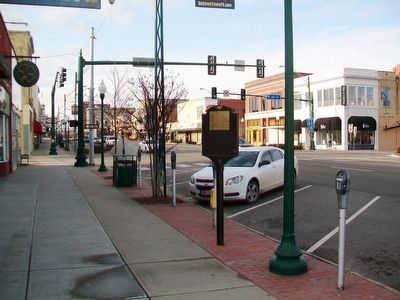
Photographed by William Fischer, Jr., January 17, 2016
3. The New Theatre in 1911 Marker
Photographed by William Fischer, Jr., January 17, 2016
4. The New Theatre in 1911 Marker (rear)
Credits. This page was last revised on August 16, 2020. It was originally submitted on January 24, 2016, by William Fischer, Jr. of Reynoldsburg, Ohio. This page has been viewed 852 times since then and 72 times this year. Photos: 1, 2, 3, 4. submitted on January 24, 2016, by William Fischer, Jr. of Reynoldsburg, Ohio.
