Grafton in Worcester County, Massachusetts — The American Northeast (New England)
Hassanamesit
1630 - 1930
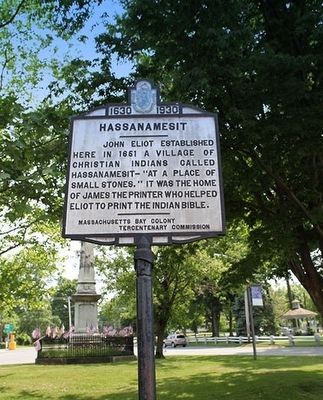
Photographed by Russell C. Bixby, June 8, 2011
1. Hassanamesit Marker
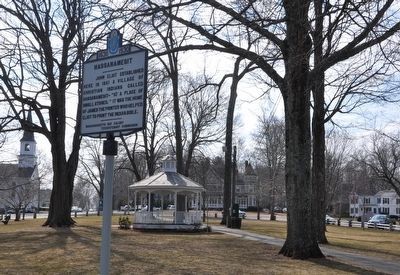
Note: Marker pictured in its original location. It was refurbished and replaced, in 2016, across the street where it is more accessible.
John Eliot established here in 1651 a village of Christian Indians called Hassanamesit - "at a place of small stones." It was the home of James the Printer who helped Eliot to print the Indian Bible.
Erected 1930 by Massachusetts Bay Colony-Tercentenary Commission.
Topics and series. This historical marker is listed in this topic list: Colonial Era. In addition, it is included in the King Philip's War 1675-1676 series list. A significant historical year for this entry is 1651.
Location. 42° 12.408′ N, 71° 41.109′ W. Marker is in Grafton, Massachusetts, in Worcester County. It is at the intersection of Grafton Common and Worcester Street (Massachusetts Route 140), on the right when traveling east on Grafton Common. The marker stands on the Town Common. Touch for map. Marker is at or near this postal address: One Grafton Cmn, Grafton MA 01519, United States of America. Touch for directions.

Regionally, this marker is in Massachusetts’ Quiet Corner, in Greater Worcester, and in the Blackstone Valley. It is also in the American Northeast and in New England. Globally, it is in North America, the Western Hemisphere,
this page online
Other nearby markers. At least 8 other markers are within 6 miles of this marker, measured as the crow flies: Thomas Hooker Trail (approx. 0.7 miles away); Indian Reservation (approx. one mile away); Rockdale Mill (approx. 4 miles away); The Old Connecticut Path (approx. 4½ miles away); Westborough's Response to the Alarm of April 19, 1775 (approx. 4.8 miles away); The Jonah Warren House (approx. 5.1 miles away); The Boston Post Road (approx. 5.6 miles away); Ronald B. Gibson (approx. 5.6 miles away). Touch for a list and map of all markers in Grafton.
Related markers. Click here for a list of markers that are related to this marker. To better understand the relationship, study each marker in the order shown.
Also see . . .
1. Historical Markers Erected by Massachusetts Bay Colony Tercentenary Commission (1930). Original 1930 publication by the Commonwealth of Massachusetts of Tercentenary Commission Markers, commemorating the three hundredth anniversary of the Massachusetts Bay Colony.
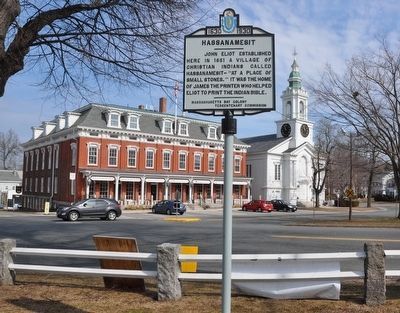
Photographed by Robert Aberg, March 8, 2016
2. Hassanamesit Marker
New location within common for easy pedestrian access.
2. Grafton Historical Society. The Grafton Historical Society, incorporated in 1964, is a private organization that collects, preserves and interprets objects related to the history of Grafton, Massachusetts. The office and museum are located in the Lower Level of the Grafton Town House (the former Town Hall). (Submitted on September 10, 2011, by Russell Chaffee Bixby of Bernardston, Massachusetts.)
3. Praying town - Wikipedia.
Praying towns were settlements established by English colonial governments in New England from 1646 to 1675 in an effort to convert local Native Americans to Christianity. The Native people who moved into the towns were known as Praying Indians.(Submitted on March 23, 2026, by G.W.Bartlett of Hingham, Massachusetts.)
4. James Printer - Wikipedia.
Wawaus, also known as "James Printer", was a Nipmuc leader from Hassanamesit (today Grafton, Massachusetts), who experienced the incorporation and marginalization of his people in colonial Massachusetts.[1] He is most commonly known for his work(Submitted on April 22, 2026, by G.W.Bartlett of Hingham, Massachusetts.)at the first printing press in the American colonies, yet like many Indigenous people during the 17th century in New England, was mistreated, abused, arrested, threatened, falsely imprisoned, and forced into exile on Deer Island in the Boston Harbor by the settlers. He helped produce the first Indian Bibles in the Massachusett language (an Algonquin language), which were used in part by the colonists for the cultural assimilation of Native Americans. He also set the type for books including the famous Narrative of the Captivity and Restoration of Mrs. Mary Rowlandson.Photographed by Robert Aberg, March 8, 20163. Hassanamesit MarkerNew location within town common
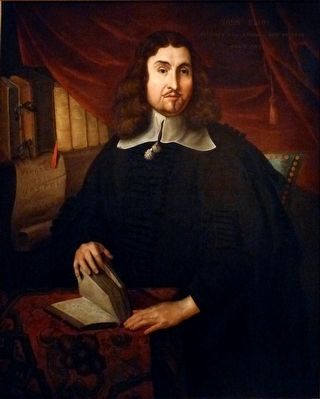
Photographed by Allen C. Browne, August 9, 2015
4. John Eliot
This portrait by of John Eliot an unknown artist hangs in the National Portrait Gallery in Washington, DC.
“No Puritan leader in seventeenth-century New England was more interested in the welfare of the region's Native American population than John Eliot. A graduate of Cambridge University, Eliot immigrated to Boston in 1631. While serving as the pastor of a church in Roxbury, Eliot began to search for ways to perform missionary work among the region's tribal communities. He studied the local Algonquian language, and by 1646 he was preaching to the native inhabitants in their own language.
In order to protect his potential Christian converts, he established the first of fourteen towns for so called ‘praying Indians’ in 1651. Perhaps his most extraordinary accomplishment, though, was the translation of the Bible into an Algonquian dialect a task that required Eliot to invent new words and new grammatical structures. Its publication in 1661 marked the first printing of a Bible in America.” — National Portrait Gallery
“No Puritan leader in seventeenth-century New England was more interested in the welfare of the region's Native American population than John Eliot. A graduate of Cambridge University, Eliot immigrated to Boston in 1631. While serving as the pastor of a church in Roxbury, Eliot began to search for ways to perform missionary work among the region's tribal communities. He studied the local Algonquian language, and by 1646 he was preaching to the native inhabitants in their own language.
In order to protect his potential Christian converts, he established the first of fourteen towns for so called ‘praying Indians’ in 1651. Perhaps his most extraordinary accomplishment, though, was the translation of the Bible into an Algonquian dialect a task that required Eliot to invent new words and new grammatical structures. Its publication in 1661 marked the first printing of a Bible in America.” — National Portrait Gallery
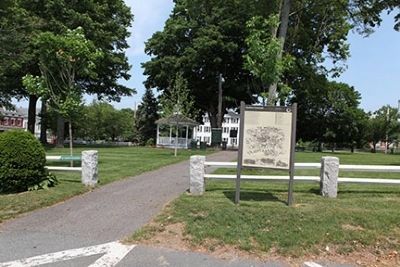
Photographed by Russell C. Bixby, June 8, 2011
5. Grafton Town Common
Credits. This page was last revised on May 20, 2026. It was originally submitted on June 8, 2011, by Russell Chaffee Bixby of Bernardston, Massachusetts. This page has been viewed 1,896 times since then and 95 times this year. Last updated on March 23, 2026, by G.W.Bartlett of Hingham, Massachusetts. Photos: 1. submitted on June 8, 2011, by Russell Chaffee Bixby of Bernardston, Massachusetts. 2, 3. submitted on March 14, 2016, by Robert Aberg of Grafton, Massachusetts. 4. submitted on October 24, 2015, by Allen C. Browne of Silver Spring, Maryland. 5. submitted on June 8, 2011, by Russell Chaffee Bixby of Bernardston, Massachusetts. • Devry Becker Jones was the editor who published this page.
