Number 9 School
Built 1867
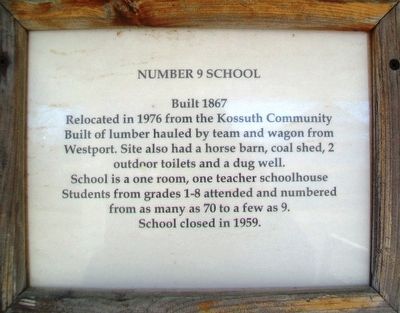
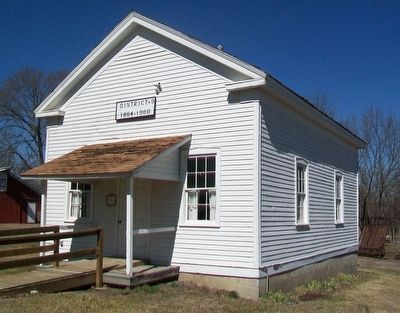
Relocated in 1976 from the Kossuth Community. Built of lumber hauled by team and wagon from Westport. Site also had a horse barn, coal shed, 2 outdoor toilets and a dug well.
School is a one room, one teacher schoolhouse. Students from grades 1-8 attended and numbered from as many as 70 to a few as 9. School closed in 1959.
Erected by Mound City Historical Society.
Topics. This historical marker is listed in this topic list: Education. A significant historical year for this entry is 1976.
Location. 38° 8.573′ N, 94° 49.055′ W. Marker is in Mound City, Kansas, in Linn County. It is on Main Street (State Highway 52) west of 7th Street, on the right when traveling west. Touch for map. Marker is at or near this postal address: Mound City Historical Park, Mound City KS 66056, United States of America. Touch for directions.
Regionally, this marker is in Eastern Kansas and specifically in Bleeding Kansas Border War Country. It is also in the American Midwest, in the Corn Belt, on the prairies, on the Southern Plains, and on the Santa Fe Trail Corridor. Globally, it is in North America, the Western Hemisphere,
this page online
Other nearby markers. At least 8 other markers are within walking distance of this marker: Clausen Cabin (a few steps from this marker); Wesley Chapel Bell (a few steps from this marker); Log Corncrib (within shouting distance of this marker); Windmill and Water Trough (within shouting distance of this marker); Mound City Bandwagon (within shouting distance of this marker); Fort Montgomery (within shouting distance of this marker); Barn (within shouting distance of this marker); Warzel Bungalow (within shouting distance of this marker). Touch for a list and map of all markers in Mound City.
Additional commentary.
1. Early teacher at Number 9
My great grandmother, Lizzie Linton Corbin, was a teacher at Number 9 District school from 1868-69 and again from 1881-1884. No. 9 school district was in Paris Township. The school room was heated by a small stove burning soft coal (a pile of which ws kept at the rear of the building). The children were age 5-14 (8th grade). A recess game called “Andy Over” was one game that was
Lizzie met my great grandfather, Myron Corbin. One of their children, Arthur Linton Corbin, was my grandfather, and author of Corbin on Contracts, the contract law treatise still the “bible” today of contract law. His older sister, Alberta (Berta) taught at the University of Kansas. Corbin Hall is named after her.
Lizzie Linton Corbin also taught at No. 6 district in 1979-80, and then the Centerville district (called “Georgetown”) in 1880-81 at $35/mo and her children attended school with her.
Credits. This page was last revised on March 31, 2025. It was originally submitted on March 28, 2016, by William Fischer, Jr. of Reynoldsburg, Ohio. This page has been viewed 808 times since then and 38 times this year. Photos: 1, 2. submitted on March 28, 2016, by William Fischer, Jr. of Reynoldsburg, Ohio.
