Fayetteville in Cumberland County, North Carolina — The American South (South Atlantic)
Omar ibn Said
ca. 1770-1863
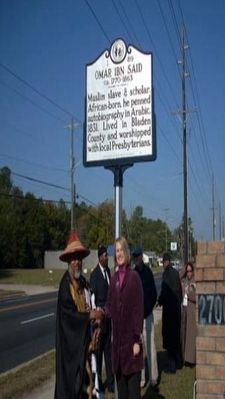
Photographed by J.B. Gachogu, May 26, 2016
1. Omar Ibn Said Marker
Erected 2010. (Marker Number I-89.)
Topics and series. This historical marker is listed in these topic lists: African Americans • Communications • Education • Religion & Religious Structures. In addition, it is included in the North Carolina Division of Archives and History series list.
Location. 35° 5.476′ N, 78° 54.637′ W. Marker is in Fayetteville, North Carolina, in Cumberland County. It is on Murchison Road just south of Patina Court. Touch for map. Marker is in this post office area: Fayetteville NC 28301, United States of America. Touch for directions.

Regionally, this marker is in the Coastal Plain. It is also in the American South and specifically in the Upper South. Globally, it is in North America, the Western Hemisphere, the Western World, and the Anglosphere. Historically, it finds itself in what was once the territory of the Mississippian Culture, one of the original Thirteen Colonies, one of the Confederate States of America, and the Antebellum South.
Other nearby markers. At least 8 other markers are within 3 miles of this marker, measured as the crow flies: Fayetteville State University (approx. 1.7 miles away); Frank P. Graham (approx. 1.8 miles away); Confederate Breastworks (approx. 1.8 miles away); Confederate Women's Home (approx. 1.9 miles away); Robert Strange (approx. 1.9 miles away); Lewis Leary (approx. 1.9 miles away); Hiram R. Revels (approx. 2.2 miles away); James C. Dobbin (approx. 2½ miles away). Touch for a list and map of all markers in Fayetteville.
Another marker is no longer nearby. Cumberland County Confederate Memorial (was approx. 2.3
this page online
Also see . . .
1. Omar Ibn Said - North Carolina Department of Cultural Resources. (Submitted on May 28, 2016, by Bill Pfingsten of Bel Air, Maryland.)
2. Omar ibn Said. Essay dated Jan 2, 2024. Excerpt:
Umar ibn Said is best known for the brief autobiography that he penned in Arabic in 1831 and sent in 1836 to Lamine Kebe, a freed slave and Muslim of Futa Toro, living in New York and preparing to return to Africa. His fifteen-page manuscript is the only extant autobiography written by an enslaved person in a native language. Umar’s notoriety brought many visitors to the Owen’s Wilmington residence. Because people were so fascinated with Umar and his Arabic script, he often was asked to translate something such as the Lords Prayer or the Twenty-third Psalm. Fourteen Arabic manuscripts in Umar’s hand are extant. Many of them include excerpts from the Qu’ran and references to Allah.(Submitted on January 27, 2025, by J. J. Prats of Powell, Ohio.)
Credits. This page was last revised on January 27, 2025. It was originally submitted on May 26, 2016, by J.B. Gachogu of Knightdale, North Carolina. This page has been viewed 843 times since then and 59 times this year. Photo 1. submitted on May 26, 2016, by J.B. Gachogu of Knightdale, North Carolina. • Bill Pfingsten was the editor who published this page.
Editor’s want-list for this marker. A close-up image of the marker • Can you help?
