Laramie in Albany County, Wyoming — The American West (Mountains)
Chief Washakie
Photographed by Barry Swackhamer, May 28, 2016
1. Chief Washakie Marker
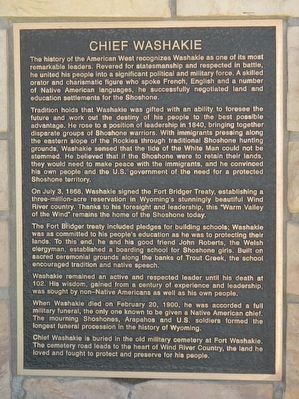
Tradition holds that Washakie was gifted with the ability to foresee the future and work out the destiny of his people to the best possible advantage. He rose to a position of leadership in 1840, bringing together disparate groups of Shoshone warriors. With immigrants pressing along the eastern slope of the Rockies through traditional Shoshone hunting grounds, Washakie sensed that the tide of the White Man could not be stemmed. He believed that if the Shoshone were to retain their lands, they would need to make peace with the immigrants, and he convinced his own people and the U.S. government of the need for a protected Shoshone territory.
On July 2, 1868, Washakie signed the Fort Bridger Treaty, establishing a three-million-acre
this page online
The Fort Bridger treaty included pledges for building schools; Washakie was as committed to his people's education as he was to protecting their lands. To this end, he and his good friend John Roberts, the Welsh clergyman, established a boarding school for Shoshone girls. Built on sacred ceremonial grounds along the banks of Trout Creek, the school encouraged traditional and native speech.
Washakie remained an active and respected leader until his death at 102. His wisdom, gained from a century of experience and leadership, was sought by non-Native Americans as well as his own people.
When Washakie died on February 20, 1900, he was accorded a full military funeral, the only one known to be given a Native American chief. The mourning Shoshone, Arapahos and U.S. soldiers formed the longest funeral procession in the history of Wyoming.
Chief Washakie is buried in the old military cemetery at Fort Washakie. The cemetery road leads to the heart of the Wind
Photographed by Barry Swackhamer, May 28, 2016
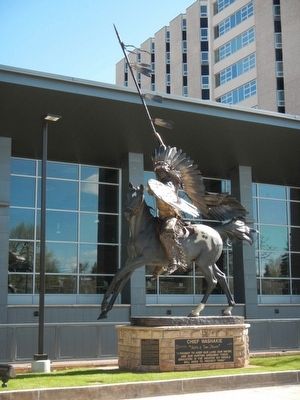
2. Chief Washakie Statue and Marker
Erected by Wyoming Legislature.
Topics. This historical marker is listed in this topic list: Indigenous Peoples and Communities. A significant historical date for this entry is February 20, 1900.
Location. 41° 18.604′ N, 105° 34.538′ W. Marker is in Laramie, Wyoming, in Albany County. It is on Grand Avenue (Business Interstate 80) near 17th Street, on the right when traveling west. Touch for map. Marker is at or near this postal address: 1649 Grand Avenue, Laramie WY 82070, United States of America. Touch for directions.

Regionally, this marker is in Wyoming’s Laramie Basin. It is also in the American Mountain West. Globally, it is in North America, the Rocky Mountains, the Western Hemisphere, the Western World, and the Anglosphere. Historically, it finds itself in what was once the Republic of Texas.
Other nearby markers. At least 8 other markers are within walking distance of this marker: The Appaloosa (here, next to this marker); Battle of Crowheart Butte (here, next to this marker); University Neighborhood Historic District (approx. 0.6 miles
Photographed by Wikipedia
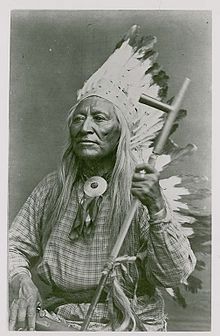
3. Chief Washakie Marker
More about this marker. The Washakie statue is located in front of the Washakie Center on the University of Wyoming campus.
Also see . . . Chief Washakie of the Shoshone - Jackson Hole Historical Society. Chief Washakie (born circa 1804-1810, died 1900) is perhaps the most famous of all Eastern Shoshone headmen and leaders. Known for his prowess as both warrior and statesperson, Washakie played a prominent role in the territorial and statehood development of Idaho, Montana, Utah, and Wyoming. (Submitted on June 21, 2016, by Barry Swackhamer of Brentwood, California.)
Credits. This page was last revised on June 21, 2016. It was originally submitted on June 21, 2016, by Barry Swackhamer of Brentwood, California. This page has been viewed 1,142 times since then and 53 times this year. Photos: 1, 2, 3. submitted on June 21, 2016, by Barry Swackhamer of Brentwood, California.
