Ballpark District in Denver in Denver County, Colorado — The American Mountains (Southwest)
Hop Alley/Chinese Riot of 1880
| — | Lower Downtown Walking Tour | — |
Photographed by Mark Hilton, July 28, 2016
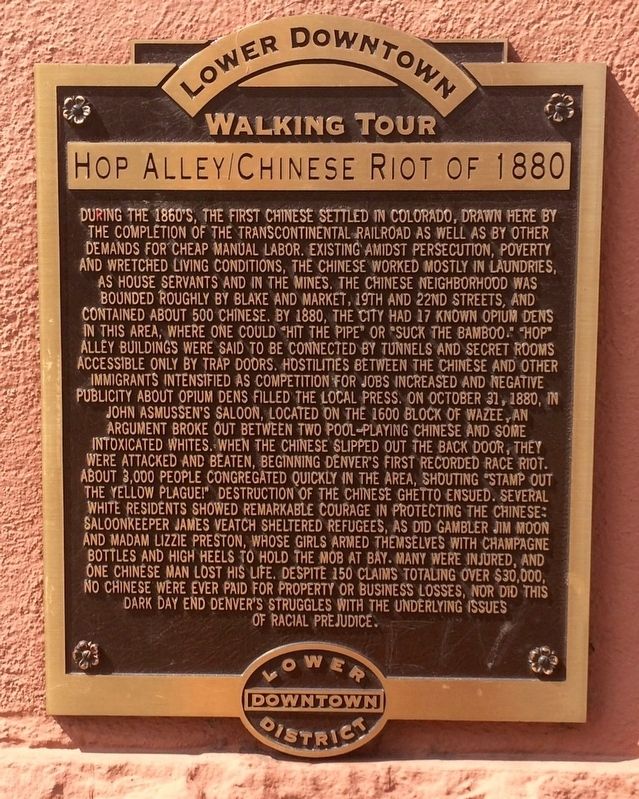
1. Hop Alley/Chinese Riot of 1880 Marker
During the 1860's, the first Chinese settled in Colorado, drawn here by the completion of the transcontinental railroad as well as by other demands for cheap manual labor. Existing amidst persecution, poverty and wretched living conditions, the Chinese worked mostly in laundries, as house servants and in the mines. The Chinese neighborhood was bounded roughly by Blake and Market, 19th and 22nd Streets, and contained about 500 Chinese. By 1880, the city had 17 known opium dens in this area, where one could "hit the pipe" or "suck the bamboo." "Hop" Alley buildings were said to be connected by tunnels and secret rooms accessible only by trap doors. Hostilities between the Chinese and other immigrants intensified as competition for jobs increased and negative publicity about opium dens filled the local press. On October 31, 1880, in John Asmussen's Saloon, located on the 1600 block of Wazee, an argument broke out between two pool-playing Chinese and some intoxicated whites. When the Chinese slipped out the back door, they were attacked and beaten, beginning Denver's first recorded race riot. About 3,000 people congregated
this page online
Erected by Lower Downtown Historic District.
Topics. This historical marker is listed in these topic lists: Asian Americans • Disasters • Settlements & Settlers. A significant historical date for this entry is October 31, 1880.
Location. Marker has been permanently removed. It was located near 39° 45.237′ N, 104° 59.646′ W. Marker was in Denver, Colorado, in Denver County. It was in the Ballpark District. It was at the intersection of 20th Street and Blake Street, on the right when traveling south on 20th Street. Was located on the
Photographed by Mark Hilton, July 28, 2016
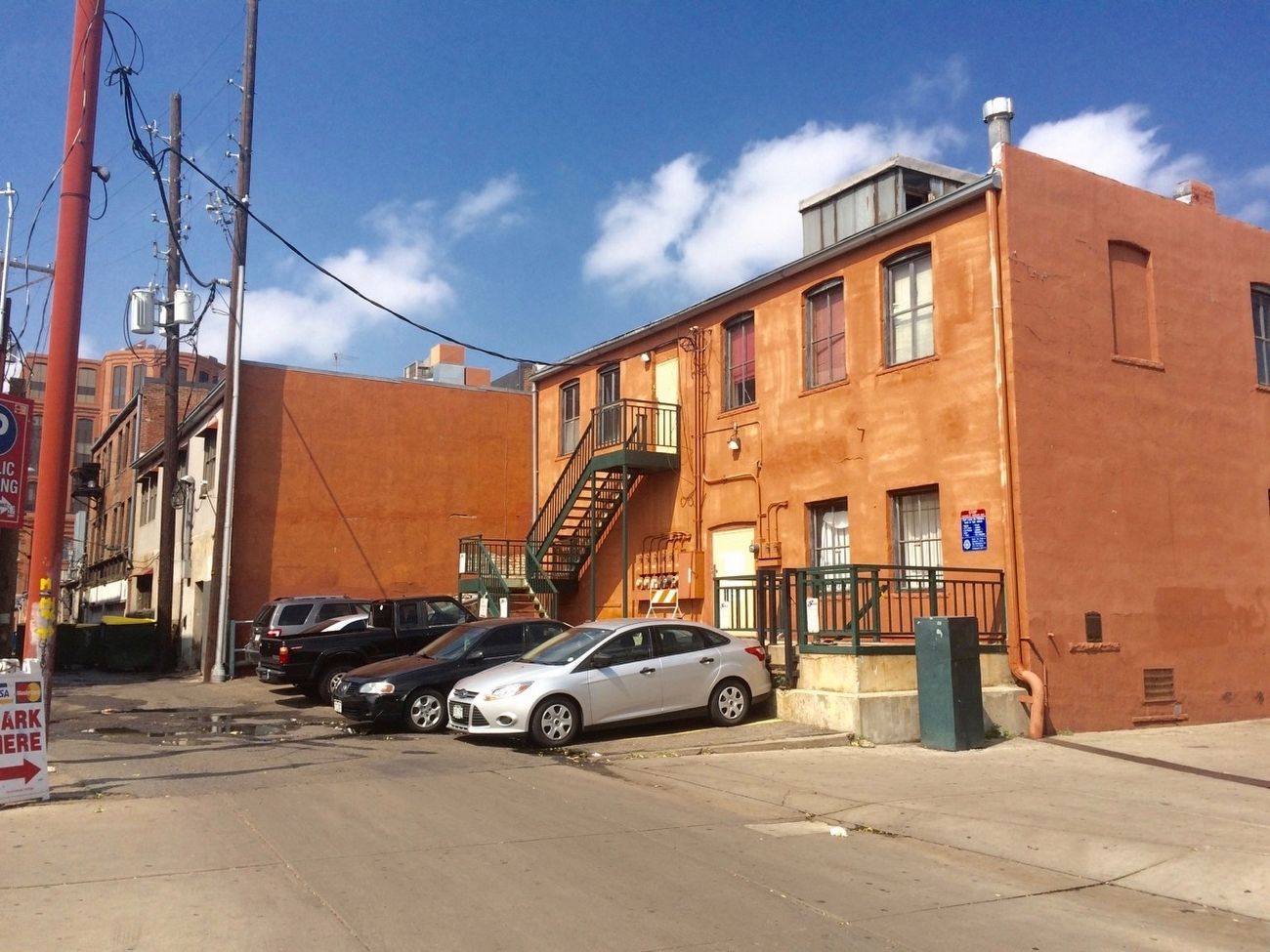
2. View of the marker on building (right) and Hop Alley to left.
We have been informed that this marker is no longer there and will not be replaced. This page is an archival view of what was.
Regionally, this marker was in Colorado’s Front Range. It was also in the American Mountain West. Globally, it was in North America, the Rocky Mountains, the Western Hemisphere, the Western World, and the Anglosphere. Historically, it found itself in what was once the Louisiana Purchase.

Other nearby markers. At least 8 other markers are within walking distance of this location: The Branch Rickey Award (within shouting distance of this marker); The House of Mirrors (about 300 feet away, measured in a direct line); Windsor Farm Dairy Building (about 500 feet away); The Reverend Yoshitaka Tamai (about 700 feet away); Merchandise Mart (about 700 feet away); Rockies Legend #17 Todd Helton (approx. 0.2 miles away); Back-to-Back Postseasons 2017 & 2018 (approx. 0.2 miles away); Incredible 2007 21-of-22 Run to the World Series
Photographed by N.B. Wilkins, 1880
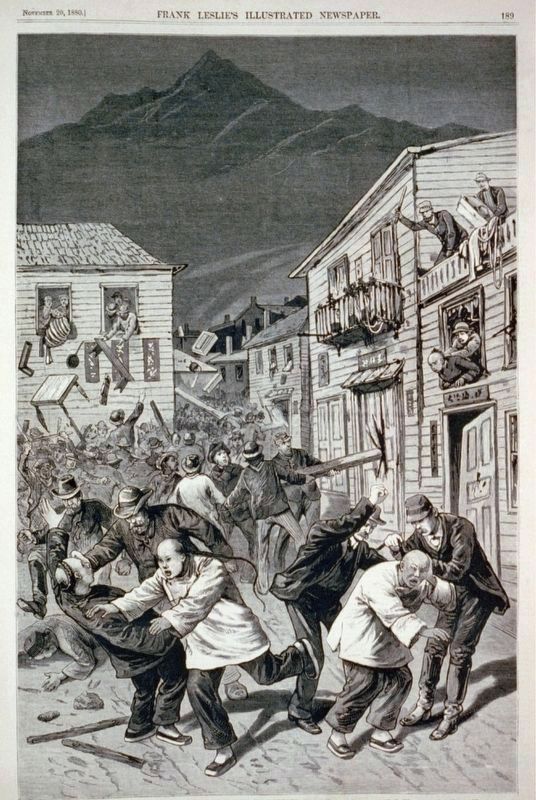
3. Colorado - the anti-Chinese riot in Denver, on October 31st 1880
Wood engraving after sketch by N.B. Wilkins. Title and other information transcribed from caption card. Illustration in: Frank Leslie's illustrated newspaper, vol. 51 (1880 Nov. 20), p. 189. (Courtesy of the Library of Congress).
Other markers no longer nearby. Red Light District Market Street (was within shouting distance of this marker but has been confirmed missing); Blake Street Area (was within shouting distance of this marker but has been confirmed missing).
Also see . . .
1. University of Nebraska - Encyclopedia of the Great Plains article on Chinese Riot. (Submitted on July 28, 2016, by Mark Hilton of Montgomery, Alabama.)
2. A plaque near Denver’s historic Chinatown marks a race riot. Its critics see it as an opportunity. An effort to replace the Lower Downtown marker has raised the possibility of reconciling a painful chapter in the city’s history -- and reimagining a new Asian district. (Submitted on January 9, 2022, by Mark Hilton of Montgomery, Alabama.)
3. Denver removes anti-Chinese historical marker (KUSA-TV). The marker, removed on Monday, Aug. 8th, misrepresents a violent riot on Oct. 31, 1880, in what was then Denver's Chinatown. It reads "Hop Alley/Chinese Riot of 1880," when the riot that took place can be more accurately

Photographed by Carita Rancourt, August 11, 2025
4. Hop Alley/Chinese Riot of 1880 Marker
“ This bronze plaque hung at Twentieth and Blake as the only historical marker of Chinatown in Denver.
Chinese and AANHPI communities pointed out inaccuracies, and called attention to inappropriate language to describe both the neighborhood and the Anti-Chinese Riot. It was removed after decades of community urging in 2022.”
This plaque is preserved and displayed at the ‘History Colorado’ museum for the ‘Where is Denver’s Chinatown? Stories Remembered, Reclaimed, Reimagined’ exhibit running OCT 10, 2024 TO SEP 1, 2025.
Credits. This page was last revised on August 11, 2025. It was originally submitted on July 28, 2016, by Mark Hilton of Montgomery, Alabama. This page has been viewed 2,756 times since then and 186 times this year. Photos: 1, 2. submitted on July 28, 2016, by Mark Hilton of Montgomery, Alabama. 3. submitted on November 25, 2019, by J. Makali Bruton of Washington, District of Columbia. 4. submitted on August 10, 2025, by Carita Rancourt of Denver, Colorado.
