Caldwell in Sumner County, Kansas — The American Midwest (Upper Plains)
Cowtown Law Enforcement
⎯⎯⎯
Caldwell's Early Government
Photographed by Mark Hilton, August 2, 2016
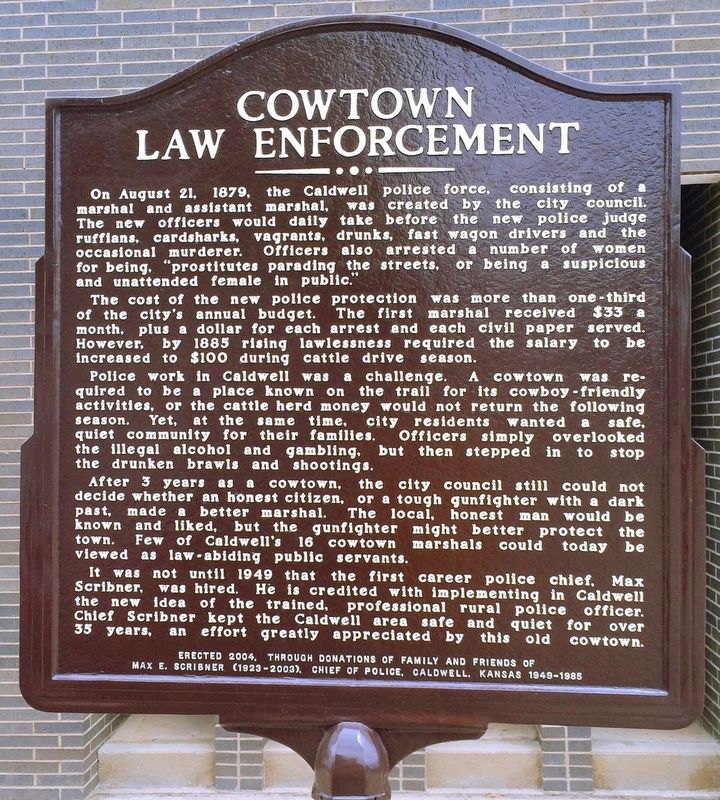
1. Cowtown Law Enforcement Marker
Front
The cost of the new police protection was more than one-third of the city's annual budget. The first marshal received $33 a month, plus a dollar for each arrest and civil paper served. However, by 1883 rising lawlessness required the salary to be increased to $100 during cattle drive season.
Police work in Caldwell was a challenge. A cowtown was required to be a place known on the trail for its cowboy-friendly activities, or the cattle herd money would not return the following season. Yet, at the same time, city residents wanted a safe, quiet community for their families. Officers simply overlooked the illegal alcohol and gambling, but then stepped in to stop the drunken
this page online
After 3 years as a cowtown, the city council still could not decide whether an honest citizen, or tough gunfighter with a dark past, made a better marshal. The local, honest man would be known and liked, but the gunfighter might better protect the town. Few of Caldwell's 16 cowboy marshals could today be viewed as law-abiding public servants.
It was not until 1949 that the first career police chief, Max Scribner, was hired. He is credited with implementing in Caldwell the new idea of the trained, professional rural police officer. Chief Scribner kept the Caldwell area safe and quiet for over 35 years, an effort greatly appreciated by this old cowtown.
Rear
Photographed by Mark Hilton, August 2, 2016
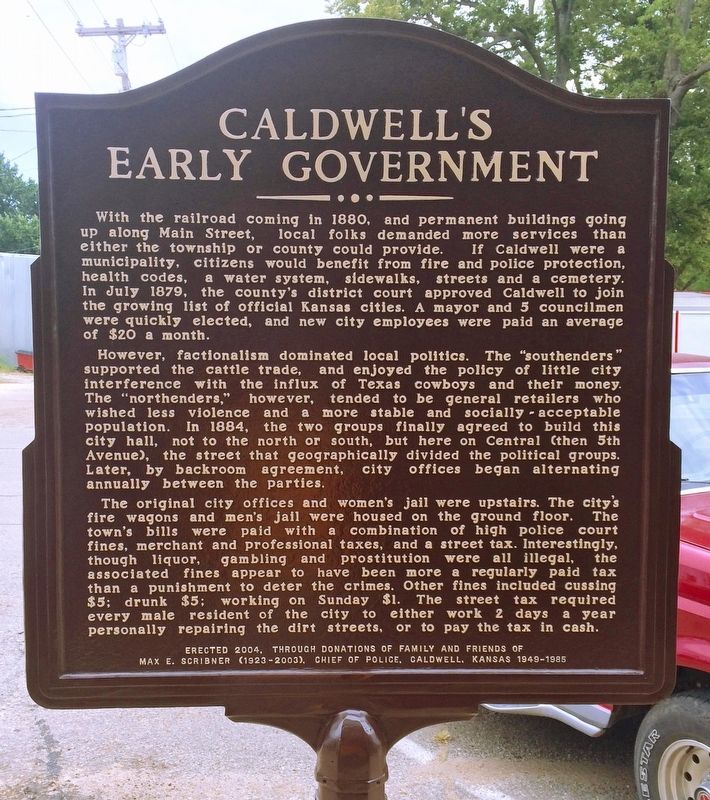
2. Caldwell's Early Government Marker
However, factionalism dominated local politics. The "southerners" supported the cattle trade, and enjoyed the policy of little city interference with the influx of Texas cowboys and their money. The "northerners," however, tended to be general retailers who wished less violence and a more stable and socially ~ acceptable population. In 1884, the two groups finally agreed to build this city hall, not to the north or south, but here on Central (then 5th Avenue), the street that geographically divided the political groups. Later, by backroom agreement, city offices began alternating annually between the parties.
The original city offices and women's jail were upstairs. The city's fire wagons and men's jail were housed on the ground floor. The town's bills were paid with a combination of high police court fines, merchant and professional taxes, and a street tax interestingly, though liquor, gambling and prostitution were all illegal; the associated fines appear to have been more a regularly paid tax than a punishment
Photographed by Mark Hilton, August 2, 2016
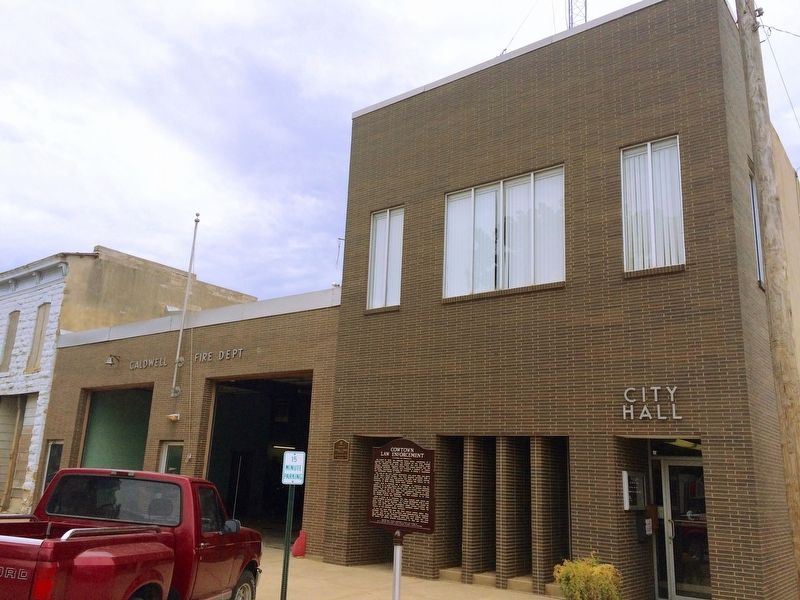
3. Caldwell City Hall and Fire Station.
Erected 2004 by The Caldwell Historical Society.
Topics. This historical marker is listed in these topic lists: Government & Politics • Notable Events • Notable Places • Settlements & Settlers. A significant historical month for this entry is July 1879.
Location. 37° 1.955′ N, 97° 36.463′ W. Marker is in Caldwell, Kansas, in Sumner County. It is on West Central Avenue west of North Main Street (Kansas Highway 49), on the right when traveling west. Located in front of City Hall and next to the Fire Station. Touch for map. Marker is at or near this postal address: 14 West Central Avenue, Caldwell KS 67022, United States of America. Touch for directions.

Regionally, this marker is in Eastern Kansas and in Greater Wichita. It is also in the American Midwest, in the Corn Belt, on the prairies, and on the Southern Plains. Globally, it is in North America, the Western Hemisphere, the
Photographed by Mark Hilton, August 2, 2016
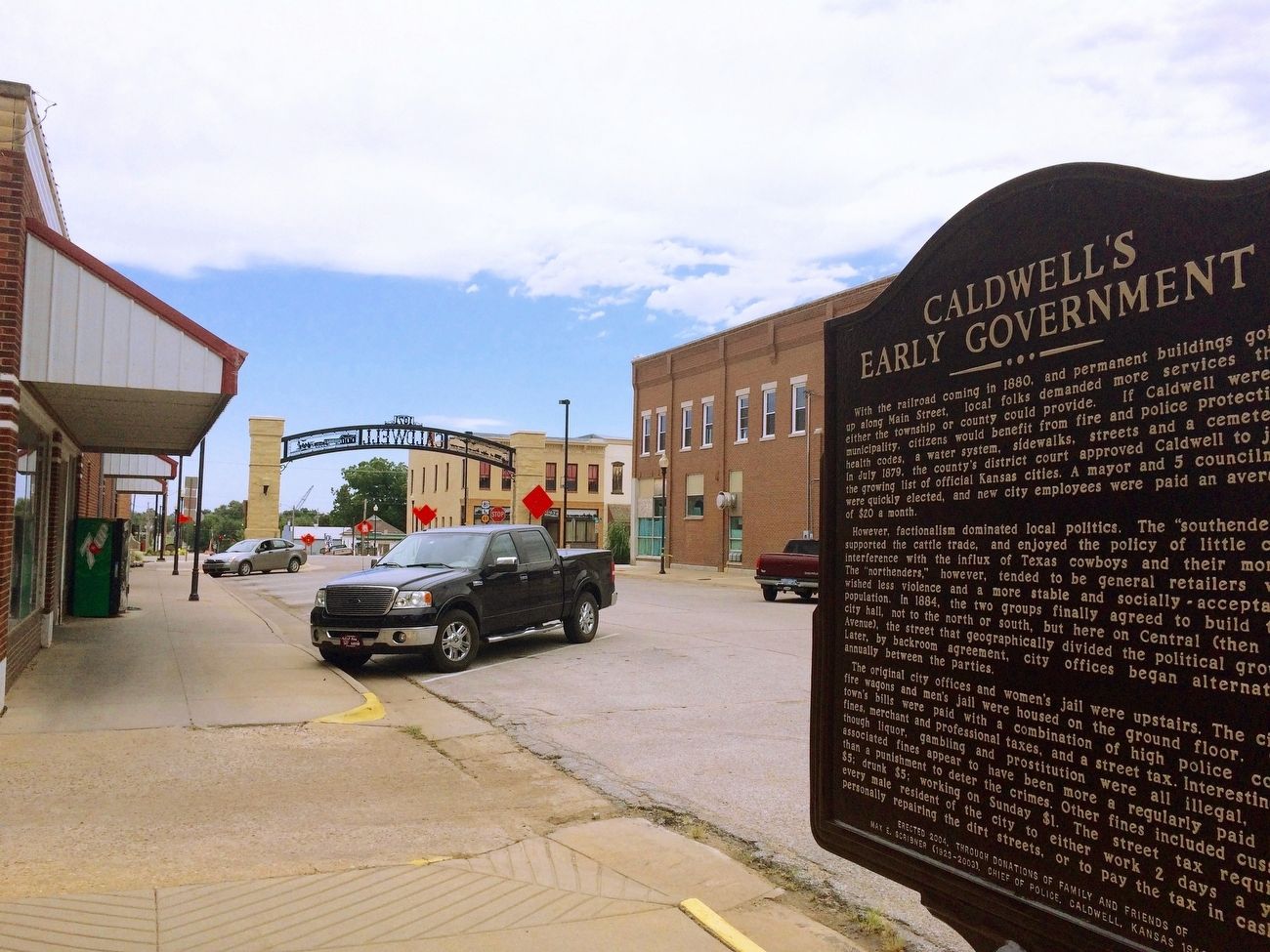
4. View from marker towards the Caldwell Arch.
Other nearby markers. At least 8 other markers are within walking distance of this marker: Shooting Up Main Street (within shouting distance of this marker); The Last Chance Saloon (within shouting distance of this marker); Henry Newton Brown (about 300 feet away, measured in a direct line); Murder of Marshal George Flatt (about 300 feet away); Talbot Gang Shootout (about 300 feet away); Red Light Saloon / Chisholm Trail (about 400 feet away); The Last Land Rush / Historic Marker Project (about 400 feet away); "Those Who Came Before" (about 400 feet away). Touch for a list and map of all markers in Caldwell.
More about this marker. Funded through donations of family and friends of Max E. Sribner (1923-2003) Chief of Police, Caldwell, Kansas 1949-1985.
Also see . . . Legends of America on Caldwell Kansas and its past. (Submitted on August 8, 2016, by Mark Hilton of Montgomery, Alabama.)
Credits. This page was last revised on August 8, 2016. It was originally submitted on August 8, 2016, by Mark Hilton of Montgomery, Alabama. This page has been viewed 774 times since then and 95 times this year. Photos: 1, 2, 3, 4. submitted on August 8, 2016, by Mark Hilton of Montgomery, Alabama.
