Sheafe Warehouse
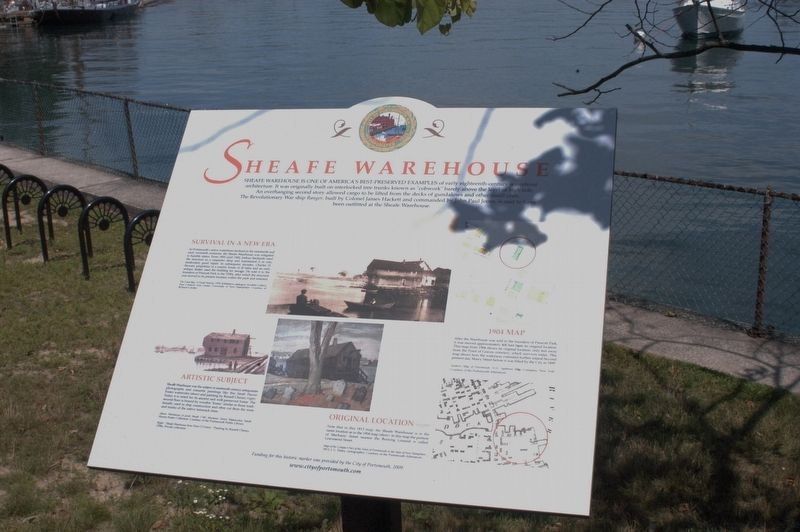
Photo 1
Survival in a new era as Portsmouth’s waterfront declined in the nineteenth and early twentieth centuries, the Sheafe Warehouse was relegated to humble status. From 1850 until 1900, Joshua Stackpole used the structure as a carpenter shop and maintained it in only moderately good repair. In subsequent decades, Charles H. Stewart, proprietor of a nearby house of ill fame and an early antique dealer, used the building for storage. He sold it to the founders of Prescott Park in the 1930s, after which the structure was moved to its present location within the park and restored. The Great Bay, a Visual History, 1970, exhibition catalogue, Scudder
this page online
Photo 2
1904 Map After the warehouse was sold to the founders of Prescott Park, it was moved approximately 400 feet from its original location, only feet away from the Point of Graves cemetery, which survives today. This map shows how the waterway extended further inland beyond present day Marcy Street before it was filled by the city in 1899. Sanborn Map of Portsmouth N.H. Sanborn Map Company, New York. Courtesy of the Portsmouth Athenaeum.
Photo 3
Original Location Note that in this 1813 map, the Sheafe Warehouse is in the same location as the 1904 map (above). In the map the portion of Mechanic Street nearest the Burying Ground is called Gravesend Street. Map of the compact port of Portsmouth in the State of New Hampshire, 1813 J.G. Hales Cartographer, Courtesy of the Portsmouth Athenaeum.
Photos 4&5
Artistic Subject Sheafe Warehouse was the subject of nineteenth century antiquarian photographs and romantic paintings like this Sarah Haven Foster watercolor (above) and painting by Russell Cheney (right). Today it is noted for its ancient
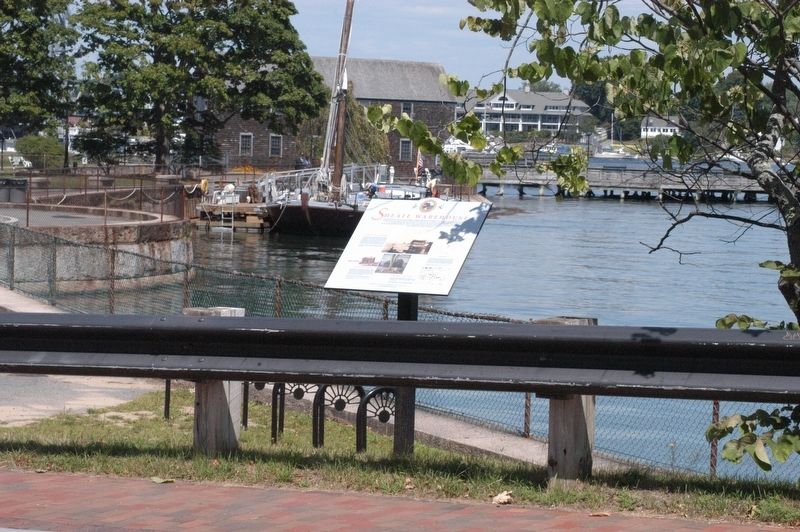
Erected 2009 by City of Portsmouth NH.
Topics. This historical marker is listed in these topic lists: Architecture • Industry & Commerce. A significant historical year for this entry is 1850.
Location. 43° 4.539′ N, 70° 45.029′ W. Marker is in Portsmouth, New Hampshire, in Rockingham County. It is on Mechanic Street, on the left when traveling east. Marker is in the corner of Prospect Park, on Mechanic Street, just before you cross over the Pierce Island Bridge. Touch for map. Marker is in this post office area: Portsmouth NH 03801, United States of America. Touch for directions.

Regionally, this marker is on the Seacoast. It is also in the American Northeast, in New England, and on the Eastern Seaboard. Globally, it is in the North Atlantic Region, North America, the Western Hemisphere, the Western World, and the Anglosphere. Historically, it finds itself in what was once one of the original Thirteen Colonies.
Other nearby markers. At least 8 other markers are within walking distance of this marker: Point of Graves (within shouting distance of this marker); a different marker also named Point of Graves (within shouting distance of this marker); Liberty Pole and Bridge (about 400 feet away, measured in a direct line); Red Light District (about 400 feet away); Black Yankees and The Sea (about 400 feet away); Portsmouth NH Marine Railway (about 500 feet away); Colonel Tobias Lear (about 600 feet away); Portsmouth Navy Yard (about 600 feet away). Touch for a list and map of all markers in Portsmouth.
Credits. This page was last revised on August 23, 2016. It was originally submitted on August 18, 2016, by James R. Murray of Elkton, Florida. This page has been viewed 794 times since then and 33 times this year. Photos: 1, 2. submitted on August 18, 2016, by James R. Murray of Elkton, Florida. • Bill Pfingsten was the editor who published this page.
