Palm Beach Gardens in Palm Beach County, Florida — The American South (South Atlantic)
Historic Banyan Trees
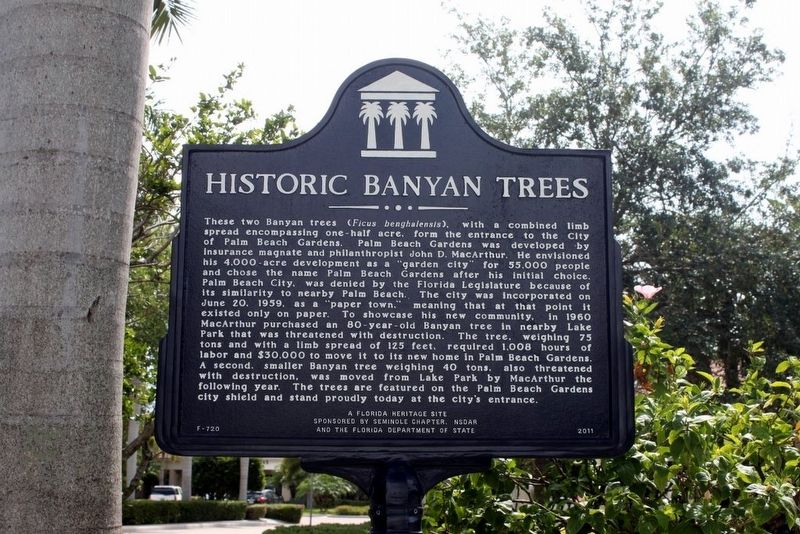
Photographed by Tim Fillmon, July 13, 2016
1. Historic Banyan Trees Marker
this page online
Erected 2011 by Seminole Chapter, NSDAR and the Florida Department of State. (Marker Number F-720.)
Topics and series. This historical marker is listed in this topic list: Horticulture & Forestry. In addition, it is included in the Daughters of the American Revolution (DAR), and the Historic Trees series lists. A significant historical date for this entry is June 20, 1959.
Location. 26° 48.542′ N, 80° 5.257′ W. Marker is in Palm Beach Gardens, Florida, in Palm Beach County. It is on MacArthur Boulevard just north of Northlake Boulevard, on the right when traveling north. Touch for map. Marker is in this post office area: West Palm Beach FL 33403, United States of America. Touch for directions.

Regionally, this marker is in South Florida, on the Gold Coast, on the Treasure Coast, and in Greater Miami. It is also in the American South and on the Eastern Seaboard. Globally, it is in the North Atlantic Region, North America, a Gulf of Mexico state, the Western Hemisphere, the Western World, and the Anglosphere. Historically, it finds itself in what was once New Spain, the territory of the
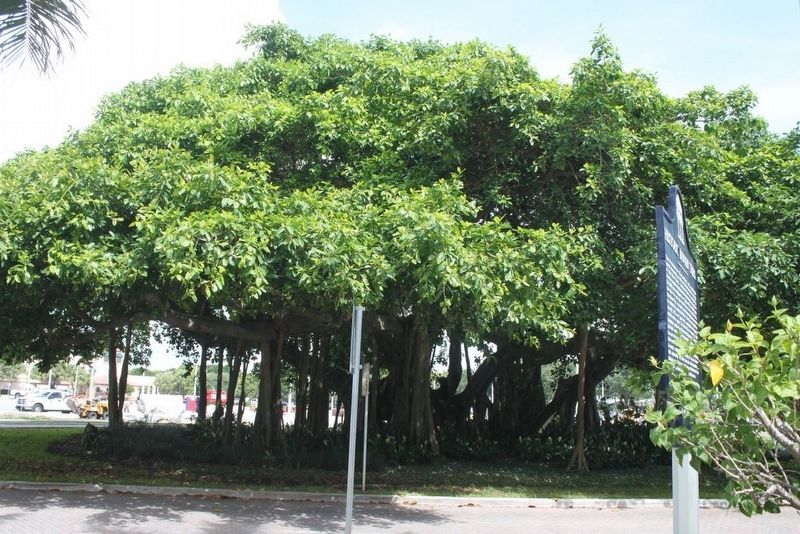
Photographed by Tim Fillmon, July 13, 2016
2. Historic Banyan Trees Marker with tree in background looking west across MacArthur Boulevard
Other nearby markers. At least 8 other markers are within 6 miles of this marker, measured as the crow flies: The Historic Kelsey Gates (approx. 1.1 miles away); Lake Park Town Hall (approx. 1.7 miles away); John D. MacArthur (approx. 1.9 miles away); Old Dade County Court House (approx. 3.1 miles away); Memorial (approx. 3.8 miles away); Old Northwood Historic District (approx. 4.9 miles away); Evergreen Cemetery (approx. 5.2 miles away); Hurricane of 1928 Mass Burial Site (approx. 5.3 miles away). Touch for a list and map of all markers in Palm Beach Gardens.
Credits. This page was last revised on March 5, 2018. It was originally submitted on August 20, 2016, by Tim Fillmon of Webster, Florida. This page has been viewed 2,632 times since then and 168 times this year. Photos: 1, 2. submitted on August 20, 2016, by Tim Fillmon of Webster, Florida. • Bernard Fisher was the editor who published this page.
