Chalmette in St. Bernard Parish, Louisiana — The American South (West South Central)
Battery Four
Jean Lafitte National Historical Park and Preserve
Photographed by Tom Bosse, July 31, 2016
1. Battery Four Marker
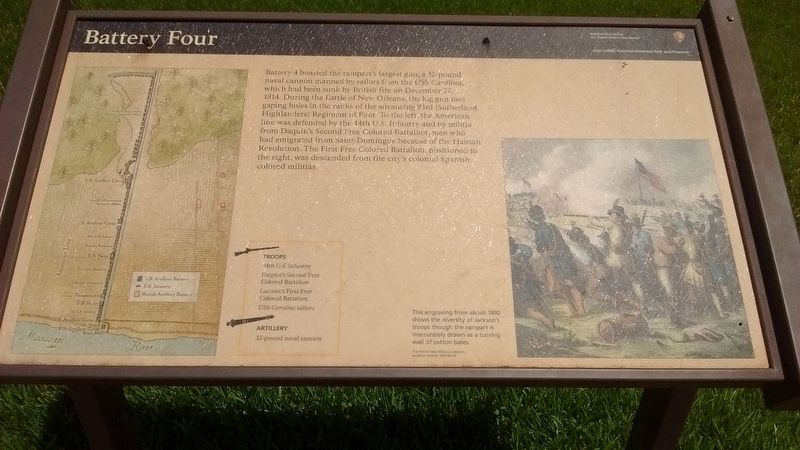
Battery 4 boasted the rampart's largest gun, a 32-pound naval cannon manned by sailors from the USS Carolina, which had been sunk by British fire on December 27, 1814. During the Battle of New Orleans, the big gun tore gaping holes in the ranks of the advancing 93rd (Sutherland Highlanders) Regiment of Foot. To the left, the American line was defended by the 44th U.S. Infantry and by militia from Daquin's Second Free Colored Battalion, men who had emigrated from Saint-Domingue because of the Haitian Revolution. The First Free Colored Battalion, positioned to the right, was descended from the city's colonial Spanish colored militias.
(captions)
This engraving from about 1892 shows the diversity of Jackson's troops though the rampart is inaccurately drawn as a curving wall of cotton bales.
Troops
14th U.S. Infantry
Daquin's Second Free Colored Battalion
Lacoste's First Free Colored Battalion
USS Carolina sailors
Artillery, Battery 2
32-pound naval cannon
Erected by National Park Service - United States Department of the Interior.
Topics. This historical marker is listed in this topic list: War of 1812. A significant historical date for this entry is December 27, 1814.
Location. 29° 56.582′ N,
this page online

Regionally, this marker is in Bayou Country and in Greater New Orleans. It is also in the American South, specifically in the Deep South, and on the Gulf Coast. Globally, it is in North America, a Gulf of Mexico state, the Western Hemisphere, the Western World, and the Anglosphere. Historically, it finds itself in what was once New Spain, the Viceroyalty of New France, the territory of the Mississippian Culture, the Louisiana Purchase, one of the Confederate States of America, and the Antebellum South.
Other nearby markers. At
Photographed by James Hulse, January 13, 2023
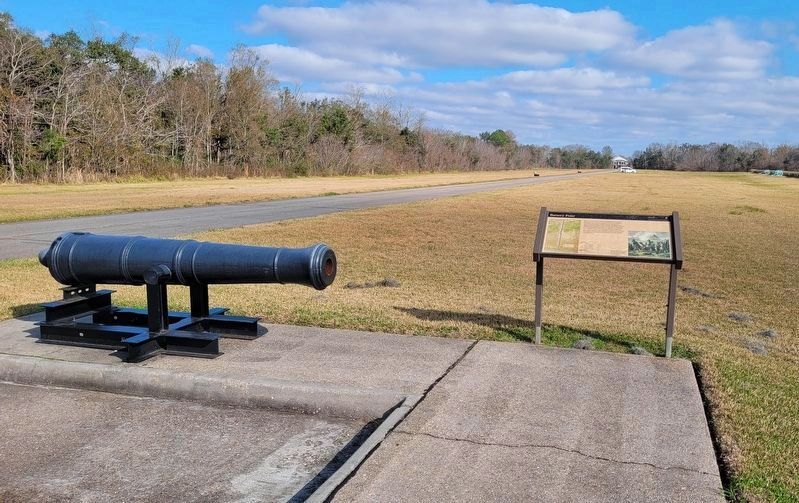
2. The Battery Four Marker with cannon
Another marker is no longer nearby. Battery 4 (was a few steps from this marker but has been confirmed missing).
Also see . . . Chalmette Battlefield. NPS Jean Lafitte National Historical Park and Preserve website entry (Submitted on August 23, 2016, by Tom Bosse of Jefferson City, Tennessee.)
Photographed by Tom Bosse, July 31, 2016
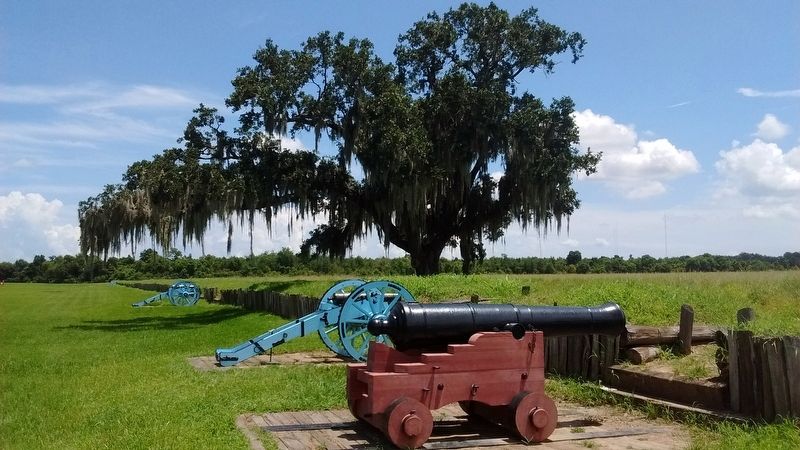
3. Battery Four
Credits. This page was last revised on January 13, 2023. It was originally submitted on August 23, 2016, by Tom Bosse of Jefferson City, Tennessee. This page has been viewed 622 times since then and 33 times this year. Photos: 1. submitted on August 23, 2016, by Tom Bosse of Jefferson City, Tennessee. 2. submitted on January 13, 2023, by James Hulse of Medina, Texas. 3. submitted on August 23, 2016, by Tom Bosse of Jefferson City, Tennessee. • Bernard Fisher was the editor who published this page.
