Black Rock in Buffalo in Erie County, New York — The American Northeast (Mid-Atlantic)
"The Black Rock"
Photographed by Anton Schwarzmueller, September 25, 2016
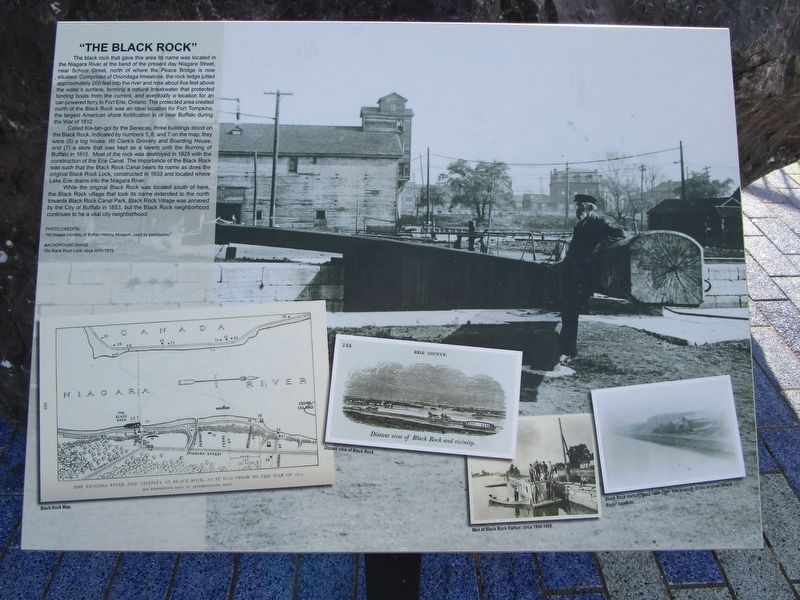
1. "The Black Rock" Marker
The black rock that gave this area its name was located in the Niagara River at the bend of the present day Niagara Street, near School Street, north of where the Peace Bridge is now situated. Comprised of Onondaga limestone, the rock ledge jutted approximately 200 feet into the river and rose about five feet above the water's surface, forming a natural breakwater that protected landing boats from the current, and eventually a location for an oar-powered ferry to Fort Erie, Ontario. The protected area created north of the Black Rock was an ideal location for Fort Tompkins, the largest American shore fortification in or near Buffalo during the War of 1812.
Called Kis-tan-gol by the Senecas, three buildings stood on the Black Rock. Indicated by numbers 5, 6, and 7 on the map, they were (5) a log house, (6) Clark's Grocery and Boarding House, and (7) a store that was kept as a tavern until the Burning of Buffalo in 1813. Most of the rock was destroyed in 1825 with the construction of the Erie Canal. The importance of the Black Rock was such that the Black Rock Canal bears its name as does the original Black Rock Lock,
this page online
While the original Black Rock was located south of here, the Black Rock village that took its name extended to the north towards Black Rock Canal Park. Black Rock Village was annexed by the City of Buffalo in 1853, but the Black Rock neighborhood continues to be a vital city neighborhood.
Topics and series. This historical marker is listed in these topic lists: War of 1812 • Waterways & Vessels. In addition, it is included in the Erie Canal series list. A significant historical year for this entry is 1812.
Location. Marker is missing. It was located near 42° 56.701′ N, 78° 54.585′ W. Marker was in Buffalo, New York, in Erie County. It was in Black Rock. It was on Black Rock Harbor Road 0.2 miles west of Niagara Street (New York State Route 266), on the left when traveling west. Marker is in Black Rock Canal Park. Access the park from Niagara Street (NY Route 266) just south of the Ontario Street entrance to Interstate 190 North. Touch for map. Marker was at or near this postal address: 2200 Niagara St, Buffalo NY 14207, United States of America.
Photographed by Anton Schwarzmueller, September 25, 2016
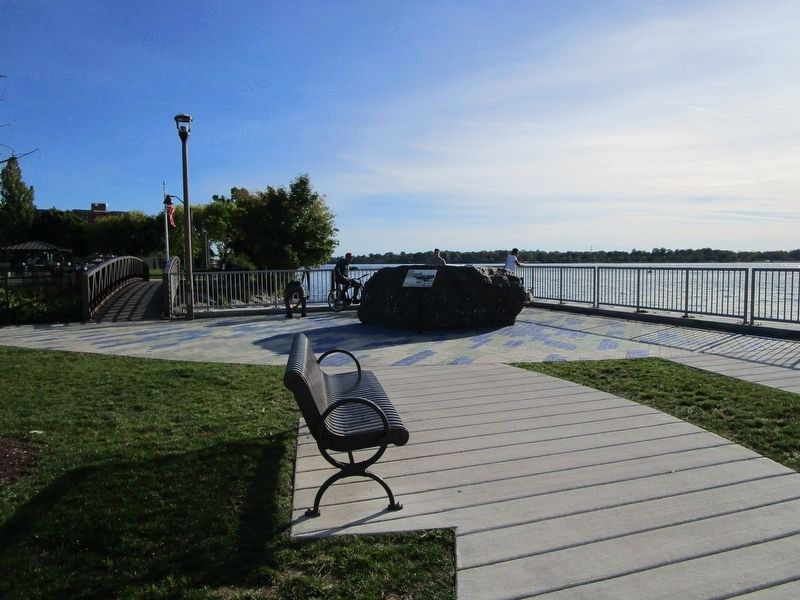
2. "The Black Rock" Marker & Upriver view
Southward. Marker at center in front of the large rock.

Regionally, this marker was in Upstate New York and specifically in Western New York. It was also in the American Northeast and in the Mid-Atlantic. Globally, it was in North America, on the Great Lakes, in the Western Hemisphere, in the Western World, and in the Anglosphere. Historically, it found itself in what was once the Viceroyalty of New France, the Haudenosaunee (Iroquois) Confederacy, New Netherland, and one of the original Thirteen Colonies.
Other nearby markers. At least 8 other markers are within walking distance of this location: The Niagara River (within shouting distance of this marker); Niagara River Corridor / Avian Walk (about 700 feet away, measured in a direct line); Hunting and Fishing off the Porch (approx. 0.2 miles away); Tow Path Park (approx. 0.4 miles away); The Fenian Invasion of 1866 (approx. 0.4 miles away); Bernard G. Hitro Jr. (approx. 0.6 miles away); Jubilee Springs (approx. 0.7 miles away); Buffalo and Niagara Falls Railroad (approx. 0.7 miles away). Touch for a list and map of all markers in Buffalo.
Photographed by Anton Schwarzmueller, September 25, 2016
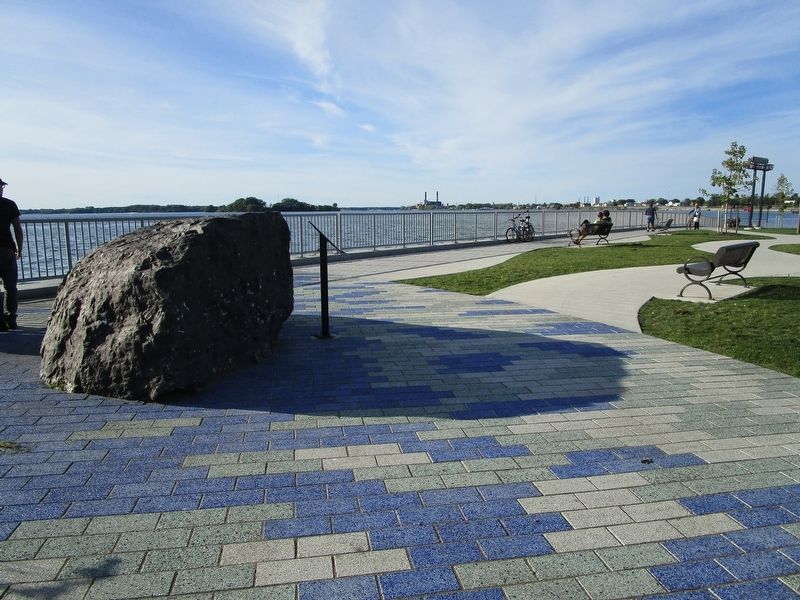
3. "The Black Rock" Marker & Downriver View
Northward. Strawberry Island and NRG Huntley power plant (in Tonawanda) in background.
Credits. This page was last revised on March 12, 2026. It was originally submitted on September 25, 2016, by Anton Schwarzmueller of Wilson, New York. This page has been viewed 1,479 times since then and 51 times this year. Photos: 1, 2, 3. submitted on September 25, 2016, by Anton Schwarzmueller of Wilson, New York.
