Gering in Scotts Bluff County, Nebraska — The American Midwest (Upper Plains)
Robidoux Trading Post
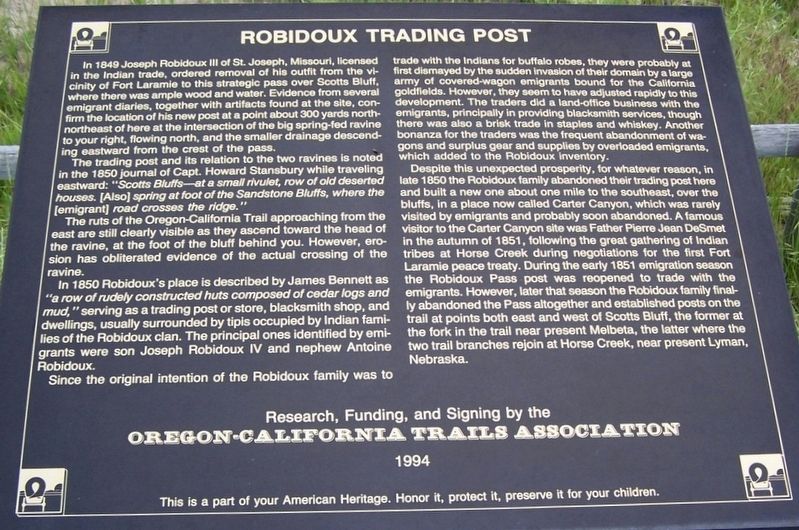
Photographed by David J Gaines, June 12, 2014
1. Robidoux Trading Post Marker
The trading post and its relation to the two ravines is noted in the 1850 journal of Capt. John Stansbury while traveling eastward: “Scotts Bluff – at a small rivulet, row of old deserted houses. [Also] spring at foot of the Sandstone Bluffs, where the (emigrant) road crosses the ridge.”
The ruts of the Oregon-California Trail approaching from the east are still clearly visible as they ascend toward the head of the ravine, at the foot of the bluff behind you. However, erosion has obliterated evidence of the actual crossing of the ravine.
In 1850 Robidoux’s place is described
this page online
Since the original intention of the Robidoux family was to trade with the Indians for buffalo robes, they were probably at first dismayed by the sudden invasion of their domain by a large army of covered-wagon emigrants bound for the California goldfields. However, they seem to have adjusted rapidly to this development. The traders did a land-office business with the emigrants, principally in providing blacksmith services, though there was also a brisk trade in staples and whiskey. Another bonanza for the traders was the frequent abandonment of wagons and surplus gear and supplies by overloaded emigrants, which added to the Robidoux inventory.
Despite this unexpected property, for whatever reason in later 1850 the Robidoux family abandoned their trading post here and built a new one about one mile to the southeast, over
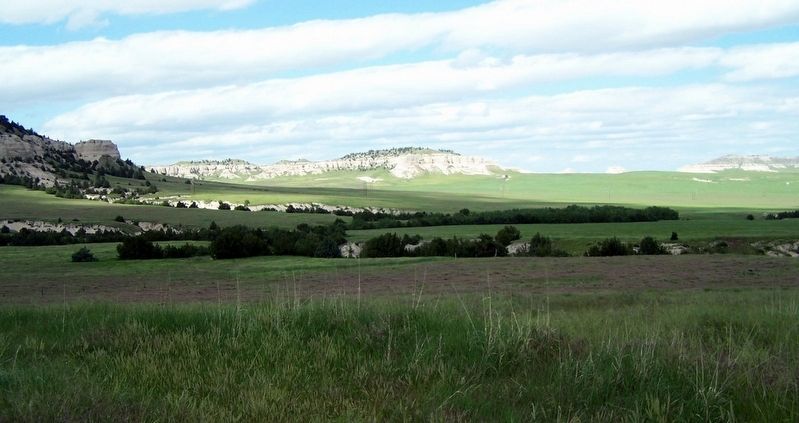
Photographed by David J Gaines, June 12, 2014
2. Robidoux Pass Area
Erected 1994 by Oregon-California Trails Association.
Topics. This historical marker is listed in these topic lists: Indigenous Peoples and Communities • Industry & Commerce • Settlements & Settlers. A significant historical year for this entry is 1849.
Location. 41° 48.163′ N, 103° 49.641′ W. Marker is in Gering, Nebraska, in Scotts Bluff County. It is on Robidooux Road, on the left when traveling west. Touch for map. Marker is in this post office area: Gering NE 69341, United States of America. Touch for directions.

Regionally, this marker is in the Nebraska Panhandle. It is also in the American Midwest, in the Corn Belt, and on the prairies. Globally, it is in North America, the Western Hemisphere, the Western World, and the Anglosphere. Historically, it finds itself in what was once the Louisiana Purchase.
Other nearby markers. At least 8 other markers are within 7 miles of this marker, measured as the crow flies: Robedeau Trading Post (here, next to this marker); Oregon Trail Memorial (approx. ¼ mile away); Robidoux Pass (approx. 1.6 miles away); a different marker also named Robidoux Trading Post (approx. 2.7 miles away); Fort Mitchell, 1864-1867 (approx. 6 miles away); Oregon Trail (approx. 6.2 miles away); Assistance on the Trail (approx. 6.3 miles away); History Lives on in Art (approx. 6.3 miles away). Touch for a list and map of all markers in Gering.
Another marker is no longer nearby. The Bullwhackers (was approx. 6.3 miles away but has been permanently removed).
Credits. This page was last revised on December 22, 2024. It was originally submitted on October 25, 2016, by David J Gaines of Pinson, Alabama. This page has been viewed 976 times since then and 81 times this year. Photos: 1, 2. submitted on October 25, 2016, by David J Gaines of Pinson, Alabama. • Bill Pfingsten was the editor who published this page.
