Midtown in Memphis in Shelby County, Tennessee — The American South (East South Central)
The Overton Park Shell/The Levitt Shell At Overton Park
Photographed by Steve Masler, October 26, 2016
1. The Overton Park Shell/The Levitt Shell At Overton Park Marker
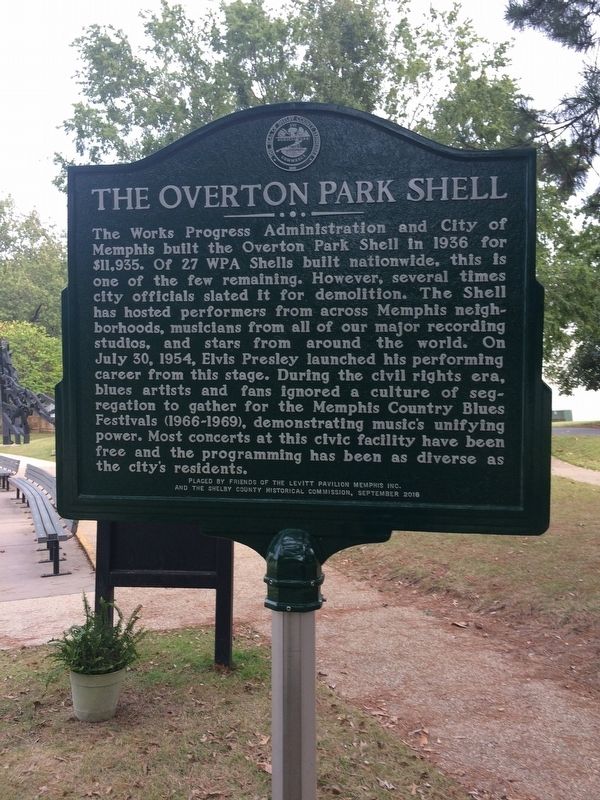
The Overton Park Shell
The Works Progress Administration and City of Memphis built the Overton park Shell in 1936 for $11,935. Of 27 WPA Shells built nationwide, this is one of the few remaining. However, several time city officials slated it for demolition. The Shell has hosted performers from across Memphis neighborhoods, musicians from all of our major recording studios, and stars from around the world. On July 30, 1954, Elvis Presley launched his performing career from this stage. During the civil rights era, blues artists and fans ignored a culture of segregation together for the Memphis Country Blues Festivals (1966-1969), demonstrating music's unifying power. Most concerts at this civic facility have been free and the programming has been as diverse as the city's residents.
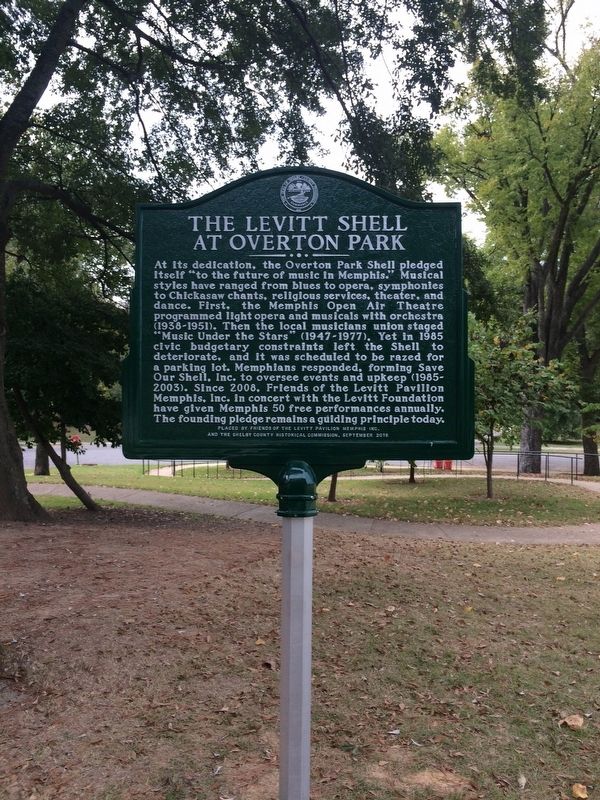
The Levitt Shell at Overton Park
At its dedication, the Overton Park Shell pledged itself "to the future of music in Memphis." Musical styles have ranged from blues to opera, symphonies to Chickasaw chants, religious services, theater, and dance. First, the Memphis Open Air Theatre programmed light opera and musicals with orchestra (1938-1951).
this page online
Erected 2016 by Friends of the Levitt Shell and the Shelby County Historical Commission.
Topics. This historical marker is listed in these topic lists: Arts, Letters, Music • Entertainment. A significant historical year for this entry is 1936.
Location. 35° 8.709′ N, 89° 59.695′ W. Marker is in Memphis, Tennessee, in Shelby County. It is in Midtown. It is on Museum Drive 0 miles east of Morrie Moss, on the right when traveling west. Located in Overton Park, north of the Memphis Brooks Museum of Art. Touch for map. Marker is at or near this postal address: 1924 Poplar Avenue, Memphis TN 38112, United States of America. Touch for directions.

Regionally, this marker is in West Tennessee. It is also
Photographed by Steve Masler, October 26, 2016
2. The Overton Park Shell/The Levitt Shell At Overton Park Marker
Other nearby markers. At least 8 other markers are within walking distance of this marker: Blues at the Overton Park Shell (within shouting distance of this marker); The Overton Park Shell (within shouting distance of this marker); The Levitt Era (within shouting distance of this marker); Memphis Belle (approx. 0.2 miles away); Rhodes College (approx. half a mile away); The 1969 Miss Memphis Review (approx. half a mile away); Griffin House (approx. 0.6 miles away); Overton Square (approx. 0.7 miles away). Touch for a list and map of all markers in Memphis.
Also see . . .
1. The Levitt Shell. (Submitted on October 27, 2016, by Steve Masler of Memphis, Tennessee.)
2. Musicians at Levitt Shell. From Wikimedia Commons, the free media repository (Submitted on October 27, 2016, by Steve Masler of Memphis, Tennessee.)
3. Dedication of The Orchestra Shell--Program. (Submitted on October 29, 2016, by Steve Masler of Memphis, Tennessee.)
Additional keywords. WPA
Credits. This page was last revised on August 16, 2024. It was originally submitted on October 27, 2016, by Steve Masler of Memphis, Tennessee. This page has been viewed 1,081 times since then and 46 times this year. Photos: 1, 2. submitted on October 27, 2016, by Steve Masler of Memphis, Tennessee. • Bill Pfingsten was the editor who published this page.
