
Lisbon in Waukesha County, Wisconsin — The American Midwest (Great Lakes)
Lisbon Plank School
Photographed by Paul F, July 1, 2010
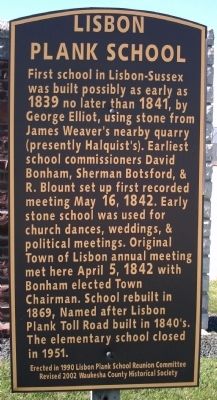
1. Lisbon Plank School Marker
First school in Lisbon-Sussex was built possibly as early as 1839 no later than 1841, by George Elliot, using stone from James Weaver’s nearby quarry (presently Halquist’s). Earliest school commissioners David Bonham, Sherman Botsford, & R. Blount set up first recorded meeting May 16, 1842. Early stone school was used for church dances, weddings, & political meetings. Original Town of Lisbon annual meeting met here April 5, 1842 with Bonham elected Town Chairman. School rebuilt in 1869, Named after Lisbon Plank Toll Road built in 1840’s. The elementary school closed in 1951.
Erected in 1990 Lisbon Plank School Reunion Committee Revised 2002 Waukesha County Historical Society.
Erected 2002 by Waukesha County Historical Society. (Marker Number 13-03.)
Topics. This historical marker is listed in these topic lists: Education • Settlements & Settlers. A significant historical month for this entry is April 1929.
Location. Marker has been permanently removed. It was located near 43° 6.729′ N, 88° 12.892′ W. Marker was in Lisbon, Wisconsin, in Waukesha County. It was on Lisbon Road (County Road K) ¼ mile west of State Route 74, on the right when traveling west. Touch for map. Marker was at or near this postal address: W23558 Lisbon Road (County Hwy K), Sussex WI 53089, United States of America.
We have been informed that this marker is no longer there and will not be replaced. This page is an archival view of what was.
Regionally, this marker was in Southeast Wisconsin and in Greater Milwaukee. It was also in the American Midwest and in the Corn Belt. Globally, it was in North America, the Western Hemisphere, the Western World, and the Anglosphere. Historically, it found itself in what was once the Viceroyalty of New France, the territory of the Mississippian Culture, and the Northwest Territory.

this page online
Other nearby markers. At least 8 other markers are within 3 miles of this location, measured as the crow flies: Hon. Thomas Weaver Home (approx. 0.4 miles away); Sussex Mills and Bug Line RR (approx. 1½ miles away); Mammoth Spring Hotel - Saloon (approx. 1½ miles away); George Washington Burr Oak (approx. 1.6 miles away); First Woman in Town of Lisbon (approx. 1.6 miles away); Zion Evangelical Cemetery (approx. 1.9 miles away); Pioneer St. James Catholic Church (approx. 2.3 miles away); Sixteen School (approx. 2.9 miles away). Touch for a list and map of all markers in Lisbon.
Other markers no longer nearby. Halquist Quarry (was within shouting distance of this marker but has been permanently removed); Sussex (was approx. 1½ miles away but has been confirmed missing); St. Alban’s Episcopal Church (was approx. 1.6 miles away but has been permanently removed).
More about this marker. The marker now resides at Sussex-Lisbon Historical Society in Sussex.
Additional commentary.
1. The Lisbon Plank School
The Lisbon Plank School was the first school in the Lisbon-Sussex School District. The original school building was
Photographed by Paul F, July 1, 2010
2. Lisbon Plank School Marker
Photographed by Paul F, July 1, 2010
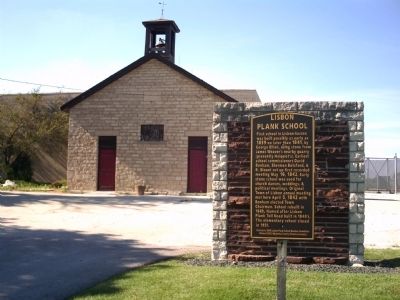
3. Lisbon Plank School Marker
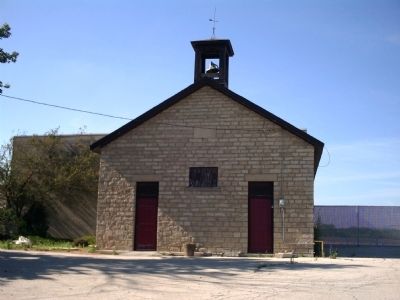
The one-room school survived until 1950 when many one-room schools were replaced by larger schools. The building was used as a home for a while, and then Halquist Stone Co. purchased it and has been using it as a company store and a mineral and fossil museum.
An all-class reunion for the students and faculty was held Aug. 12, 1990. A memorial tree was planted near the building during the reunion. The first historical marker was placed on that day. You can still see the original school bell on top of the building just over the inscription.
— Submitted May 10, 2011, by Linda Hansen of Waukesha, Wisconsin.
Photographed by Paul F, July 1, 2010
4. Lisbon Plank School Marker
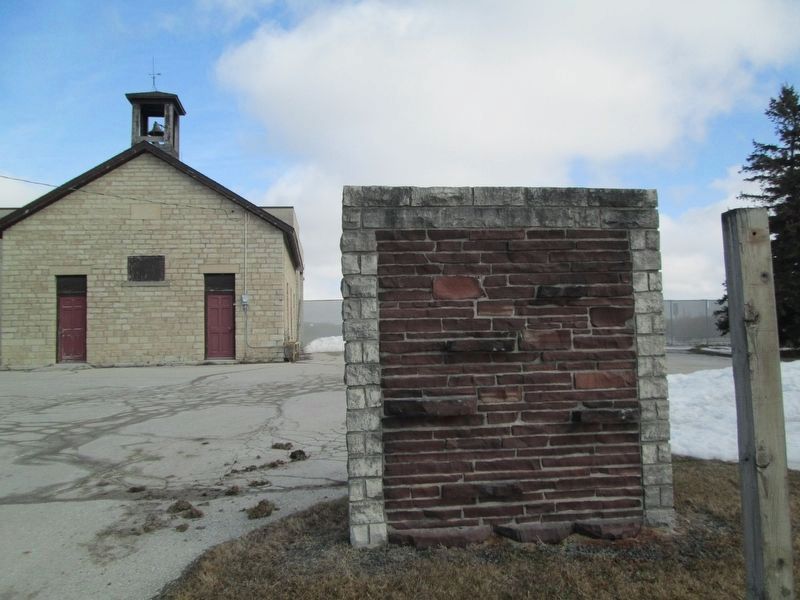
Photographed by Jim Schaettle, March 7, 2021
5. Lisbon Plank School Marker is missing.
Credits. This page was last revised on March 16, 2025. It was originally submitted on July 2, 2010, by Paul Fehrenbach of Richfield, Wisconsin. This page has been viewed 1,509 times since then and 36 times this year. Last updated on March 14, 2025, by Linda Hansen of Waukesha, Wisconsin. Photos: 1, 2, 3, 4. submitted on July 2, 2010, by Paul Fehrenbach of Richfield, Wisconsin. 5. submitted on March 7, 2021, by Jim Schaettle of Madison, Wisconsin. • Devry Becker Jones was the editor who published this page.
