American University Park in Northwest Washington in Washington, District of Columbia — The American Northeast (Mid-Atlantic)
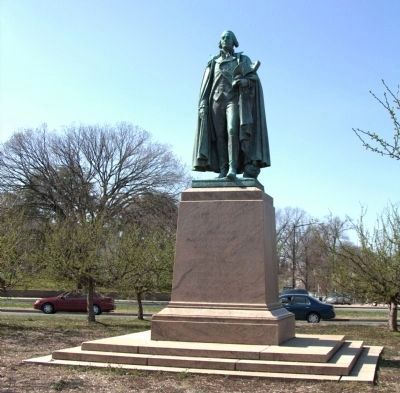
General Artemas Ward Monument
1727–1800
Photographed by J. J. Prats, March 19, 2011
1. General Artemas Ward Monument
Erected 1938 by a Harvard alumnus.
Topics and series. This historical marker and monument is listed in this topic list: War, US Revolutionary. In addition, it is included in the DC, American Revolution Statuary series list. A significant historical year for this entry is 1781.
Location. 38° 56.275′ N, 77° 5.155′ W. Marker is in Northwest Washington in Washington, District of Columbia. It is in American University Park. It is at the intersection of Ward Circle Northwest and Massachusetts Avenue Northwest, in the median on Ward Circle Northwest. Touch for map. Marker is at or near this postal address: 4401 Massachusetts Avenue Northwest, Washington DC 20016, United States of America. Touch for directions.

Regionally, this marker and monument is in the Washington Metropolitan Area. It is also in the American Northeast, in the Upper South, in the Mid-Atlantic, in the Tidewater, and in the Chesapeake Bay Region. Globally, it is
this page online
Other nearby markers. At least 8 other markers are within walking distance of this marker: American University (within shouting distance of this marker); September 11 Memorial (about 600 feet away, measured in a direct line); U.S. Navy Bomb Disposal School (about 600 feet away); John Fletcher Hurst (about 600 feet away); Battelle Memorial Building (about 700 feet away); Korean Cherry Trees (about 700 feet away); Jeju Dolhareubang (about 700 feet away); World War II Memorial (approx. 0.2 miles away). Touch for a list and map of all markers in Northwest Washington.
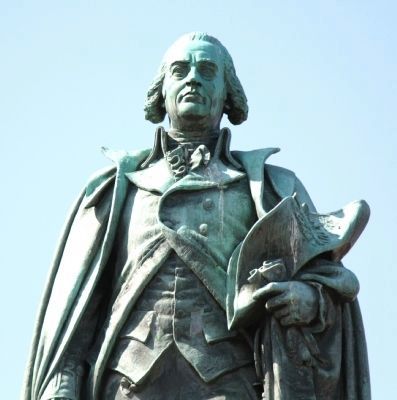
More about this marker. Ward Circle was constructed to hold this monument. From the Smithsonian American Art Museum Art Inventories Catalog: “The artist, Leonard Crunelle, modeled his portrait after an oil painting of Ward by Charles Willson Peale. Crunelle also used the military cape actually worn by Ward as a model.”
Also see . . . Artemas Ward. Wikipedia entry. “In the General Court Ward was placed on the taxation committee along with Samuel Adams and
Photographed by J. J. Prats, March 19, 2011
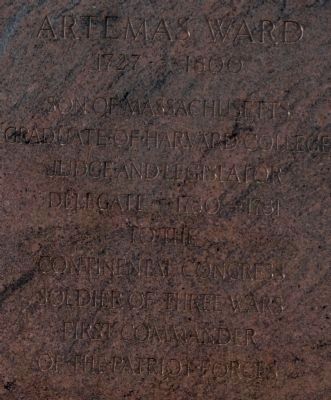
2. General Artemas Ward Monument Inscription
The inscription is on the front of the pedestal. The other three sides are blank.
Photographed by J. J. Prats, March 19, 2011
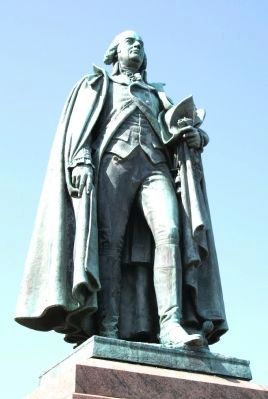
3. General Artemas Ward (1727–1800)
1938 bronze by Leonard Crunelle (1872–1944) is approx. 10 feet high on a 10 foot high base.
Photographed by J. J. Prats, March 19, 2011
4. General Artemas Ward (1727–1800)
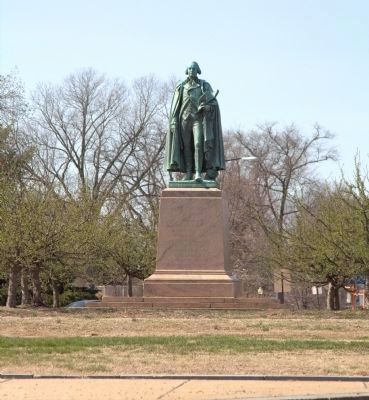
Photographed by J. J. Prats, March 19, 2011
5. General Artemas Ward Monument
Artemus Ward gazes southeast, down the length of Massachusetts Avenue into the heart of the city of Washington.
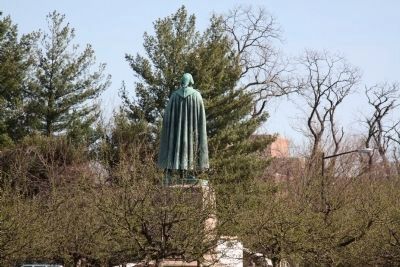
Photographed by J. J. Prats, March 19, 2011
6. General Artemas Ward Monument
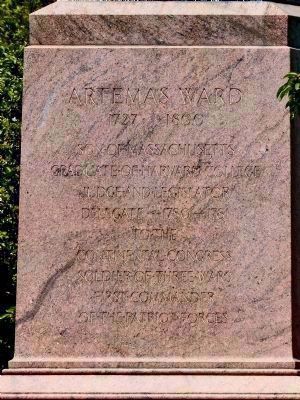
Photographed by Allen C. Browne, May 3, 2015
7. General Artemas Ward Marker
Son of Massachusetts
Graduate of Harvard College
Judge and Legislator
Delegate 1780–1781 to the Continental Congress
Soldier of Three Wars
First Commander of Patriot Forces.
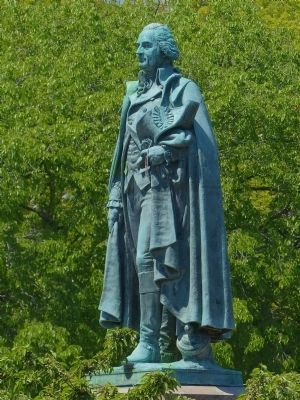
Photographed by Allen C. Browne, May 3, 2015
8. General Artemas Ward
This 1936 statue by Leonard Crunelle was unveiled by Mrs. Lewis Wesley Feick, a direct descendant of Artemas Ward, on November 3, 1938 and paid for with a grant from Wards great-grandson “Artemis Ward of the Seventh Generation”, a Harvard alumnus.
“General Ward is tall, thin, and majestic-looking, with a definite air of command that undoubtedly projects out over a specially designed Washington traffic circle. This is curious, considering that most sources describe General Ward as round and dumpy. The bronze version is thus a polar opposite. Yet a short, fat General Ward would not do if the goal was to create an icon, suitable by Artemas Ward of the Seventh Generation's standards, to represent both the family and his own posterity.” — Rebecca Anne Goetz, General Artemas Ward: A Forgotten Revolutionary Remembered and Reinvented
“General Ward is tall, thin, and majestic-looking, with a definite air of command that undoubtedly projects out over a specially designed Washington traffic circle. This is curious, considering that most sources describe General Ward as round and dumpy. The bronze version is thus a polar opposite. Yet a short, fat General Ward would not do if the goal was to create an icon, suitable by Artemas Ward of the Seventh Generation's standards, to represent both the family and his own posterity.” — Rebecca Anne Goetz, General Artemas Ward: A Forgotten Revolutionary Remembered and Reinvented
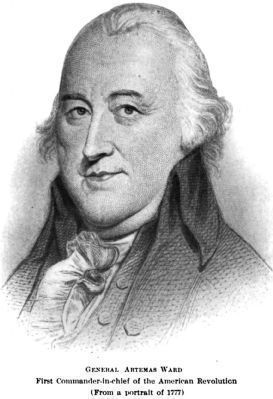
9. General Artemas Ward
(From a portrait in 1777)
Master Minds at the Commonwealth's Heart, 1909.
Credits. This page was last revised on January 30, 2023. It was originally submitted on October 15, 2011, by J. J. Prats of Powell, Ohio. This page has been viewed 1,885 times since then and 64 times this year. Photos: 1, 2, 3, 4, 5, 6. submitted on October 15, 2011, by J. J. Prats of Powell, Ohio. 7, 8, 9. submitted on May 15, 2015, by Allen C. Browne of Silver Spring, Maryland.
