Near Foothill Boulevard 0.1 miles west of Rochester Avenue, on the right when traveling east.
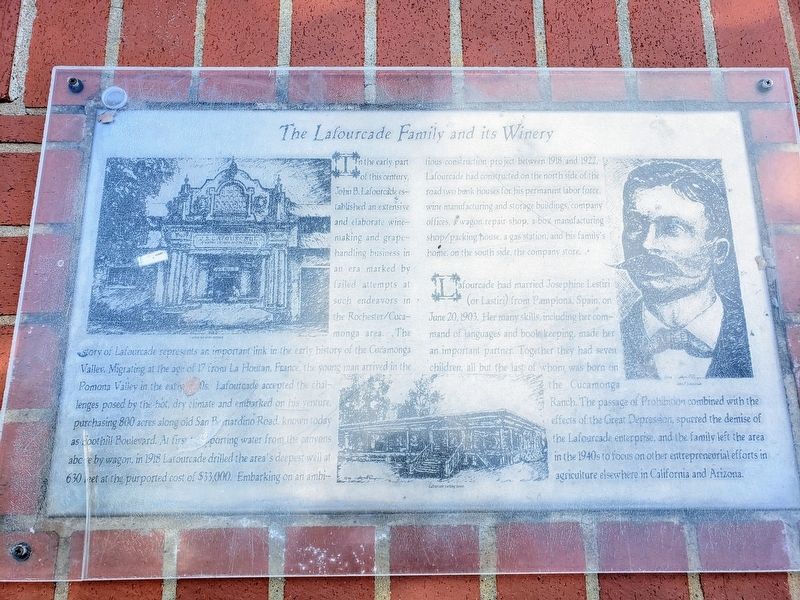
In the early part of this century, John B. Lafourcade established an extensive and elaborate wine-making and grape-handling business in an era marked by failed attempts at such endeavors in the Rochester/Cucamonga area. The story of Lafourcade . . . — — Map (db m149459) HM
Near Foothill Boulevard 0.1 miles west of Rochester Avenue, on the right when traveling east. Reported unreadable.
The Cucamonga Valley's earliest grape vines required the efforts and labor of a wide range of people - Spanish padres, Native American Indians, rebels from the American South, and disgruntled gold seekers, to name a few. Tuburcio Tapia was awarded . . . — — Map (db m149460) HM
Near Foothill Boulevard 0.1 miles west of Rochester Avenue, on the right when traveling east.
The enlarged vineyard of the Cucamonga Rancho in the 1860s, covering over 150 acres, set the standard for others who come to seek a living or a fortune in viticulture. After her husband, John Rains, was murdered in 1862, faced with mounting debts . . . — — Map (db m149461) HM
Near Foothill Boulevard 0.1 miles west of Rochester Avenue, on the right when traveling east.
Born in 1859 in the Piemonte region of Italy, Secundo Guasti had been surrounded by vines and wines throughout his childhood. Coming to America in 1884, he assimilated into the Italian community in Los Angeles and soon began growing grapes there. . . . — — Map (db m149463) HM
Near Foothill Boulevard 0.1 miles west of Rochester Avenue, on the right when traveling east.
A major blow to the Cucamonga Valley's expanding vineyards was the passage of The Eighteenth Amendment to the Constitution in 1919, known simply as "Prohibition". This national ban on the production and sale, not to mention the consumption, of . . . — — Map (db m149467) HM
Near Foothill Boulevard 0.1 miles west of Rochester Avenue, on the right when traveling east.
The post-war migration to Southern California from all parts of the country, when combined with other key factors, eroded the Cucamonga Valley viticulture industry irreparably. Starting in 1942 with Kaiser's mammoth steel plant in Fontana, which . . . — — Map (db m149468) HM
Near Foothill Boulevard 0.1 miles west of Rochester Avenue, on the right when traveling east.
In many ways the Masi family represents the fulfillment of the American Dream for the millions of immigrants who came to the country in the early decades of this century. Jennie Cassara married Sebastian Masi in 1937, fifteen years after Jennie and . . . — — Map (db m149472) HM