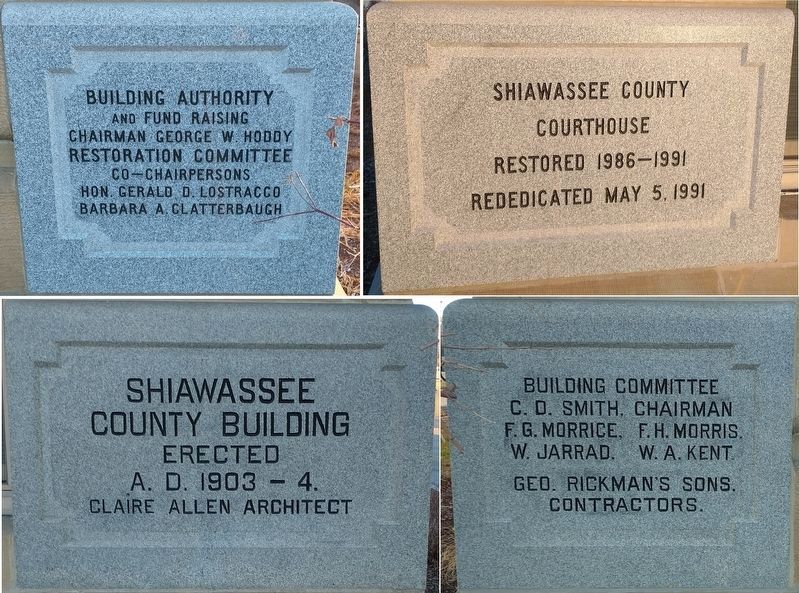
On North Shiawassee Avenue (State Highway 71) at Corunna Avenue, on the right when traveling north on North Shiawassee Avenue.
Territorial Governor Lewis Cass established Shiawassee County in 1822, but as there were few white settlers in the area, its government was not organized until 1837. Two years later, the county commissioners designated this site in the village of . . . — — Map (db m119307) HM
On West Corunna Avenue (State Highway 71) east of Hastings Street, on the left when traveling east.
Hugh McCurdy
Hugh McCurdy (1829-1908), a native of Scotland, immigrated with his parents to Birmingham, Michigan, in 1837. He first worked as a cooper's apprentice, and after reading the law was admitted to the Michigan bar in 1854 and . . . — — Map (db m119364) HM
Near S. Lakeshore Road (State Highway 25) 0.2 miles south of Atwater Road, on the left when traveling south.
In the early 1800s, "White Rock", a point well known to the Indians and early voyagers, played a significant role in defining settlements.
The Act establishing the Territory of Michigan was passed January 11, 1805, and took effect June . . . — — Map (db m68866) HM
On East McNeil Street (State Highway 71) at South Comstock Street, on the left when traveling west on East McNeil Street.
Andrew Parsons was born in Hoosick, New York, in 1817. In 1836, he settled in Shiawassee County and at the age of nineteen was elected the first county clerk. After holding a number of county and state offices, Parsons in 1852 became a regent of the . . . — — Map (db m119290) HM
On North Shiawassee Street (State Highway 71) at East Corunna Avenue, on the right when traveling north on North Shiawassee Street.
In memory of
the
Union soldiers
& Marines
Erected by
W.R.C. No. 133
Dedicated Memorial Day, May 30, 1916 to the memory of
the Grand Army of the Republic
and those from Shiawassee County, Michigan
who served, fought, and died to . . . — — Map (db m198376) WM
Thin black lines indicate changes in relevance. Between each pair of lines entries are ordered geographically but all have the same relevance.
* Inflectional forms of words are their plurals, singulars, and possessives as well as gramatical tenses and similar variations.