Paddys River near Kambah in Australian Capital Territory, Australia — Oceania
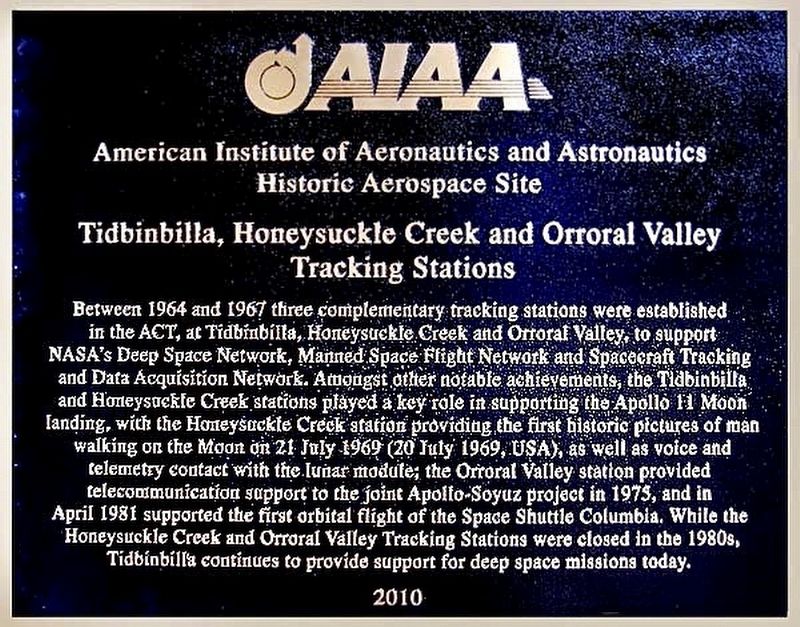
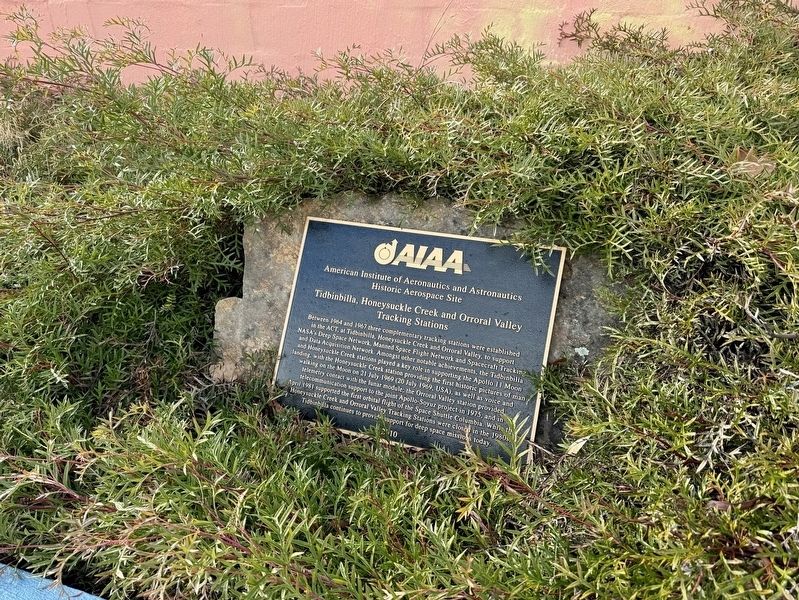
Tidbinbilla, Honeysuckle Creek and Orroral Valley Tracking Stations
AIAA Historic Aerospace Site
Photographed by Craig Baker
1. Tracking Stations Marker
Between 1964 and 1967 three complementary tracking stations were established in the ACT, at Tidbinbilla, Honeysuckle Creek and Orroral Valley, to support NASA's Deep Space Network, Manned Space Flight Network and Spacecraft Tracking and Data Acquisition Network. Amongst other notable achievements, the Tidbinbilla and Honeysuckle Creek stations played a key role in supporting the Apollo 11 Moon landing, with the Honeysuckle Creck station providing the first historic pictures of man walking on the Moon on 21 July 1969 (20 July 1969, USA), as well as voice and telemetry contact with the lunar module; the Orroral Valley station provided telecommunication support to the joint Apollo-Soyuz project in 1975, and in April 1981 supported the first orbital flight of the Space Shuttle Columbia. While the Honeysuckle Creek and Orroral Valley Tracking Stations were closed in the 1980s, Tidbinbilla continues to provide support for deep space missions today.
Erected 2010 by American Institute of Aeronautics and Astronautics.
Topics and series. This historical marker is listed in these topic lists: Air & Space • Communications.
this page online
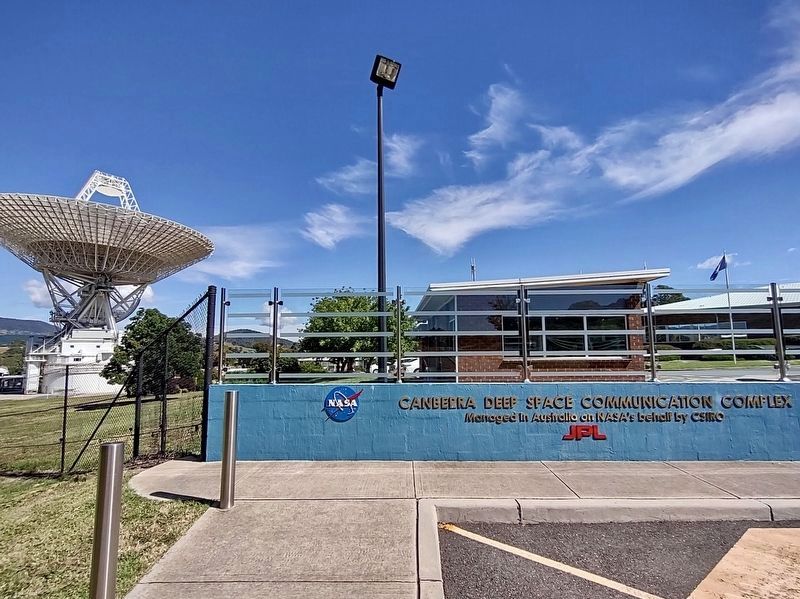
Location. 35° 24.183′ S, 148° 58.993′ E. Marker is near Kambah, Australian Capital Territory. It is in Paddys River. It can be reached from Discovery Drive 6.8 kilometers east of Paddys River Road. Located at the Canberra Deep Space Communication Complex building, in the plaque garden at the entrance. Touch for map. Marker is at or near this postal address: 421 Discovery Dr, Kambah ACT 2620, Australia. Touch for directions.

Regionally, it is in Oceania, in Australasia, in the Pacific Ocean, in South Pacific, on the Pacific Rim, in the Western World, and in the Anglosphere. Historically, it finds itself in what was once a British colony.
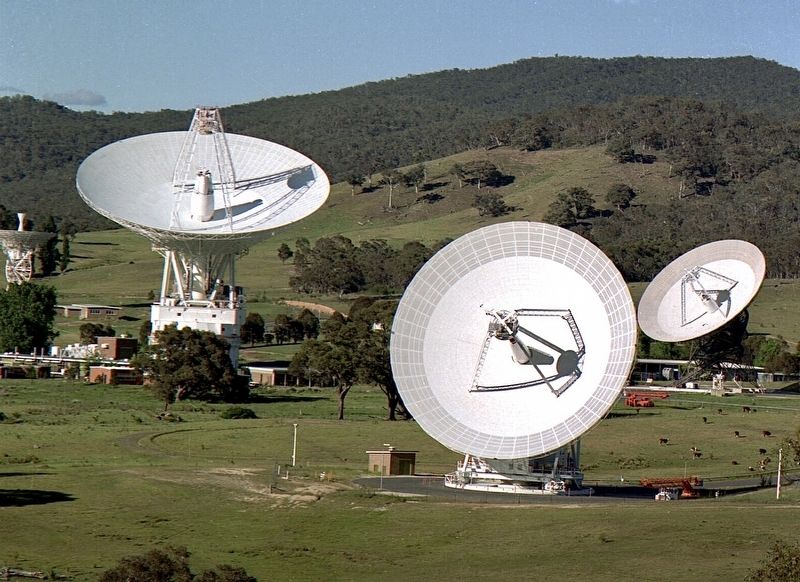
Regarding Tidbinbilla, Honeysuckle Creek and Orroral Valley Tracking Stations. Canberra’s DSS-43 antenna is the only antenna on Earth that can send commands to Voyager 2, which left our solar system in 2018. Its signals take over 18 hours to reach Earth.
Other NASA deep space antenna stations are at Goldstone, California; and Madrid, Spain.
Additional keywords. Canberra
courtesy NASA
2. Tracking Stations Marker

courtesy NASA
3. Tracking Stations Marker
The marker is at the center of the photo, in the landscaping
Photographed by Craig Baker
4. Canberra Deep Space Communication Complex
courtesy NASA
5. Canberra Deep Space Communication Complex
Credits. This page was last revised on March 31, 2026. It was originally submitted on June 25, 2024, by Craig Baker of Sylmar, California. This page has been viewed 293 times since then and 59 times this year. Last updated on March 28, 2026, by Dean Barton-Ancliffe of Rowville, Victoria. Photos: 1, 2, 3, 4, 5. submitted on June 25, 2024, by Craig Baker of Sylmar, California. • Devry Becker Jones was the editor who published this page.
Editor’s want-list for this marker. Photos of other nearby plaques and interpretive signs, on their own marker pages. • Can you help?
