Merchants' National Bank

has been designated a
National Historic Landmark
This site possesses national significance in commemorating the history of the United States of America
1976
National Park Service
United States Department of the Interior
Topics and series. This historical marker is listed in these topic lists: Architecture • Industry & Commerce • Notable Buildings. In addition, it is included in the National Historic Landmarks, and the National Register of Historic Places (NRHP) series lists. A significant historical year for this entry is 1914.
Location. 41° 44.602′ N, 92° 43.459′ W. Marker is in Grinnell, Iowa, in Poweshiek County. It is at the intersection of Broad Street and 4th Avenue, on the right when traveling south on Broad Street. The marker is mounted at the southeast corner of the subject building, facing Broad Street. Touch for map. Marker is at or near this postal address: 833 4th Avenue, Grinnell IA 50112, United States of America. Touch for directions.

Regionally, this marker is in Eastern Iowa. It is also in the American Midwest and in the Corn Belt. Globally, it is in North America, the Western
this page online
Other nearby markers. At least 8 other markers are within walking distance of this marker: Historic Buildings (about 600 feet away, measured in a direct line); Notable Grinnellians (about 600 feet away); First Businesses (about 600 feet away); Grinnell College (about 600 feet away); a different marker also named Notable Grinnellians (about 600 feet away); a different marker also named Notable Grinnellians (about 600 feet away); J. B. Grinnell (about 600 feet away); Founding of Grinnell (about 600 feet away). Touch for a list and map of all markers in Grinnell.
Regarding Merchants' National Bank. National Register of Historic Places № 76000804. Also a contributing property in Grinnell Historic Commercial District, NRHP № 91000384.
From the National Register Nomination prepared by Carolyn Pitts, 7/1975:
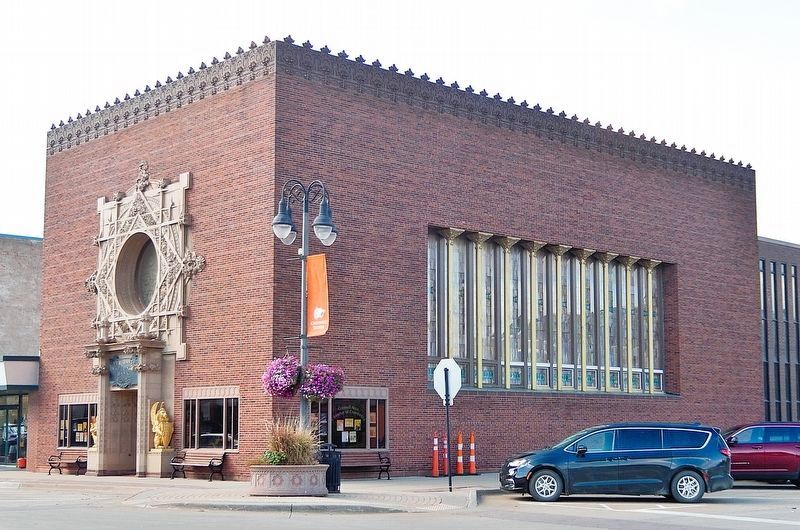
This Iowa bank retains most of its original ornament and glass and in particular, its exterior remains as Sullivan designed it. Small in scale,it is monumental in effect — the exterior is bold and solid — the interior is aglow with light and color. A simple cubic plan, the walls present two elevations both quite different in treatment — the front and side walls vary in fenestration, rhythm and ornament.Photographed by Cosmos Mariner, September 19, 20252. Merchants' National Bank MarkerThe marker is mounted at eye level on the southeast corner of the building, facing Broad Street.
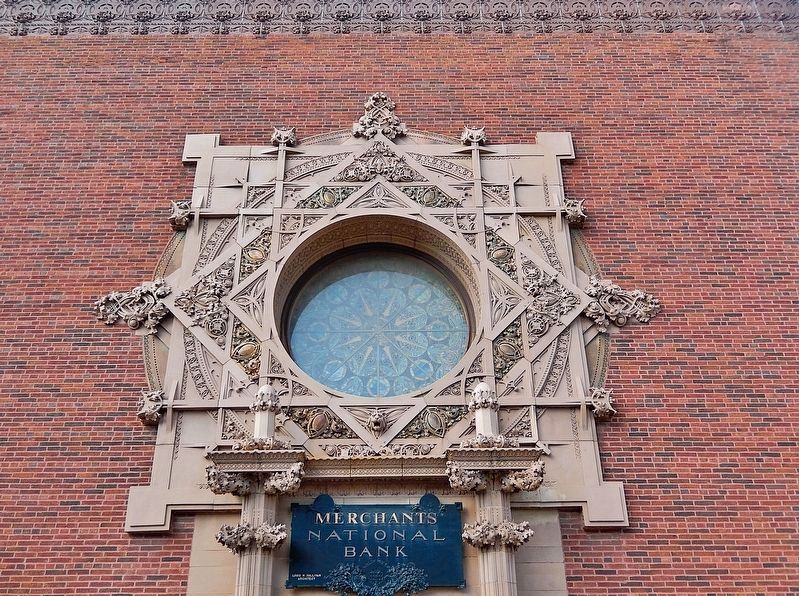
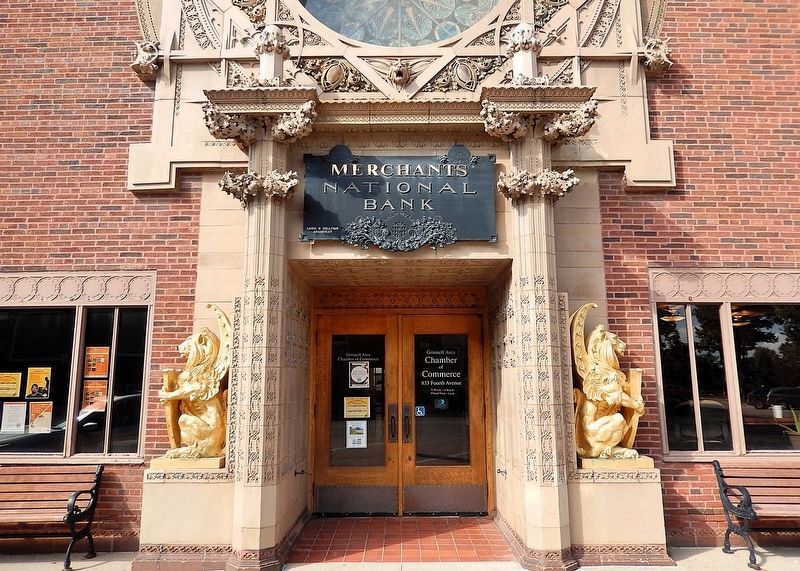
The most interesting exterior feature is the entrance door with a huge sunburst of ornament above. Morrison describes it: "All of this detail is executed in gray terra cotta, except the heraldic lions and certain portions of the ornament which are gilded. The sunburst above the door centers about a kind of 'rose-window' in stained glass, and is a remarkable fantasy in superimposed circles, squares and diamonds, with both naturalistic and geometric details. As a study in decorative design per se it is of great interest. It must be ascribed to Sullivan's innate tendency to burst out at times into overwrought lyricism."
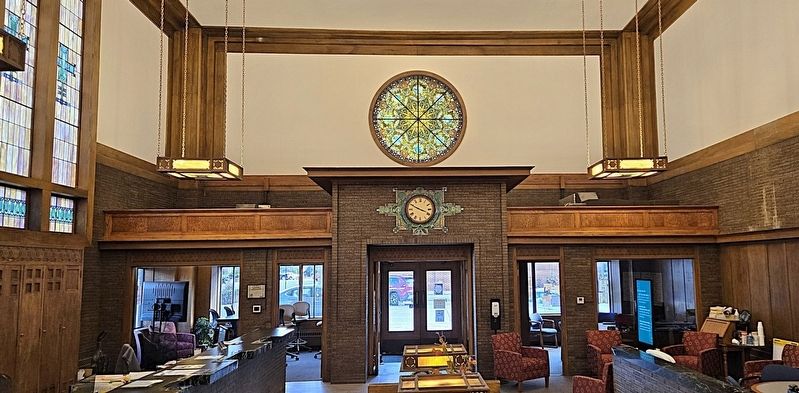
The interior is detailed in brick and tile with the same ornament. A decorative gold frieze at the rear of the main corridor repeats the same pattern that appears in the exterior cornice. The oak frames of the hanging lights repeat the motifs of the door lintels.The walls have a high brick dado topped by a finishing strip of dark-stained oak. Above this they are of light plaster. The brick wall at the back, over the vault and the safe deposit room, has a rich band of fire-gilt terra cotta ornament. Gold terra cotta trim also occurs on the tellers' cage at the back, and on the capitals of the square piers carrying large flower-bowls.Photographed by Cosmos Mariner, September 19, 20253. Merchants' National Bank (southeast elevation)Ten massive stained-glass windows span the east facade.
The large window of the east wall is of leaded glass, with a ground of marbled yellow and lavender, with central insets in peacock blue and bright green colors. The skylight colors are cream and turquoise blue. The clock over the entrance is set in a glass mosaic field. The suspended lighting fixtures are oak and frosted glass and the circular window of the facade is set in brilliant colors.

Related marker. Click here for another marker that is related to this marker.
Also see . . .
1. Merchants' National Bank (Wikipedia).
Excerpt: Built in 1914, it is one of a series of small banks designed by Louis Sullivan in the Midwest between 1909 and 1919. All of the banks are built of brick and for this structure he employed various shades of brick,(Submitted on January 5, 2026, by Cosmos Mariner of Cape Canaveral, Florida.)ranging in color from blue-black to golden brown, giving it an overall reddish-brown appearance. It was declared a National Historic Landmark in 1976 for its architecture. In 1991, it was listed as a contributing property to the Grinnell Historic Commercial District.Photographed by Cosmos Mariner, September 19, 20254. Merchants' National Bank (south/front elevation)The unveiling of this Louis Sullivan building was given national coverage in the architectural press of the day. The Merchants' Bank was featured in an eleven-page spread in The Western Architect's February 1916 edition. As he did in his banks in Cedar Rapids and Sidney, Ohio, Sullivan used lions, or at least a grotesque, winged version of a lion, as figurative decoration. Some of the plans and even the designs of the ornament were done by Sullivan's draftsman Parker N. Berry, who was shortly thereafter to fall victim to the 1918 Spanish flu epidemic.

2. Step Inside a Jewel Box (Grinnell Chamber of Commerce).
Excerpt: The Merchants National Bank building in Grinnell, Iowa, is one of the eight Midwestern “jewel-box” banks designed by Louis Sullivan, legendary American architect and(Submitted on January 6, 2026, by Cosmos Mariner of Cape Canaveral, Florida.)mentor of Frank Lloyd Wright. The phrase “jewel-box” was coined by Sullivan himself to convey the simplicity of the brick structure, which created the impression of a jewelry box while underscoring the security of those items stored inside. But it is not the simplicity of this building that draws visitors from around the world. It is Sullivan’s unparalleled ornamentation – from the awe-inspiring stained-glass windows to the majestic griffins standing guard at the entrance to the geometric/organic explosion of terra-cotta that dominates the façade – that has made the building an international attraction.Photographed by Cosmos Mariner, September 19, 20255. Merchants' National Bank Cartouche & Rose WindowThe Gems in the Jewel Box:
• Terra-cotta portal, the most recognizable feature of the building
• Spectacular rose window with its maze of geometric and organic shapes
• Monumental stained-glass east windows, 15 feet high by 40 feet wide
• Elaborate glass mosaic around clock, designed by renowned artist Louis Millet
• Organic terra-cotta interior ornament
• Hand-carved wooden check desk
• Pink Tennessee marble floors
3. Jewel Box Bank/Merchants National Bank Historic Tour (YouTube).
Excerpt: Completed in 1914, this bank was Louis Sullivan's third major "Jewel Box" bank created in the final decade of his life. The building, nearly cubical, suggests security and stability needed in a bank, but the stonework and terra cotta ornamentation modify the austerity of the structure. The center of visual interest is the circular stained-glass window over the entrance. The interior decoration continues the themes of the building's exterior. Additional information is available in the bank, which is now occupied by the Grinnell Visitor Center and Chamber of Commerce.(Submitted on January 6, 2026, by Cosmos Mariner of Cape Canaveral, Florida.)


Credits. This page was last revised on February 19, 2026. It was originally submitted on January 5, 2026, by Cosmos Mariner of Cape Canaveral, Florida. This page has been viewed 70 times since then. Photos: 1, 2, 3, 4. submitted on January 5, 2026, by Cosmos Mariner of Cape Canaveral, Florida. 5. submitted on January 6, 2026, by Cosmos Mariner of Cape Canaveral, Florida. 6, 7. submitted on January 5, 2026, by Cosmos Mariner of Cape Canaveral, Florida. 8, 9. submitted on January 6, 2026, by Cosmos Mariner of Cape Canaveral, Florida.
