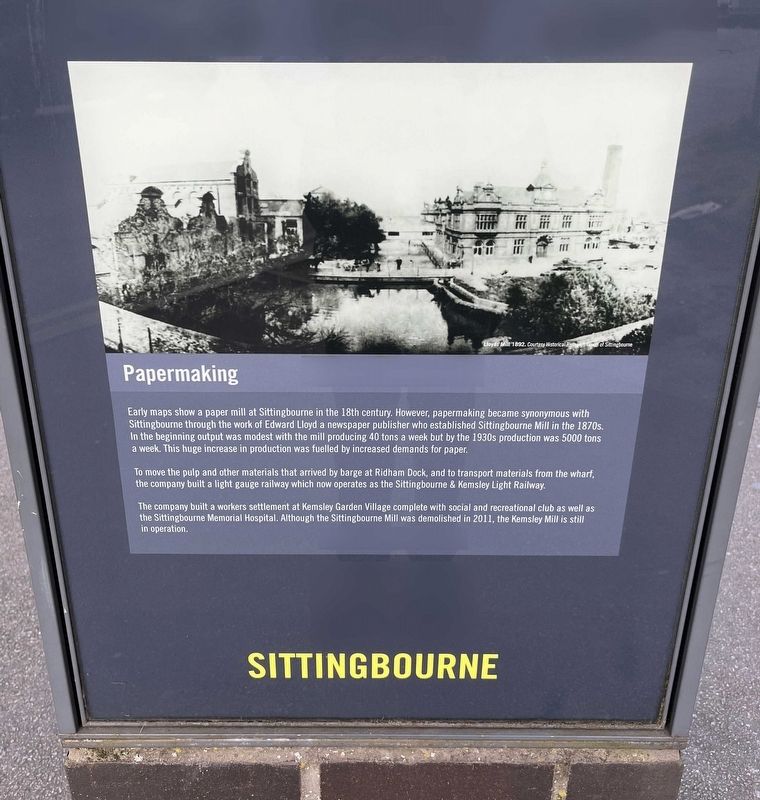
Early maps show a paper mill at Sittingbourne in the 18th century. However, papermaking became synonymous with Sittingbourne through the work of Edward Lloyd a newspaper publisher who established Sittingbourne Mill in the 1870s. In the beginning . . . — — Map (db m272147) HM
Sittingbourne is surrounded by agricultural villages, the produce from which was for many centuries brought to the town to be sold or transported to London. Auctions of apples, pears, cherries and other fruits were being held from the 17th century. . . . — — Map (db m272923) HM
A known ancient trackway passed near Sittingbourne along the route of the current A2. The Romans paved the track and it became Watling Street, the main route from Dover to London and on to St Albans. The route became popular with pilgrims travelling . . . — — Map (db m272148) HM
The oldest part of this ancient inn dates back to the early 15th Century. Tradition has it that Henry V was entertained here on his victorious return after the Battle of Agincourt in 1415. — — Map (db m272926) HM
At its peak, in the 1870's, Sittingbourne had the largest brickworks in the world. There were many brickworks on both sides of Milton Creek, the largest manufacturer being Smeed Dean, which in 1877 was selling 60 million bricks a year. Smeed Dean . . . — — Map (db m272924) HM
This building was erected in 1708 and is an early example of the use of stock bricks. It became the Rose, one of the most prestigious coaching Inns on the London to Dover road. — — Map (db m272925) HM