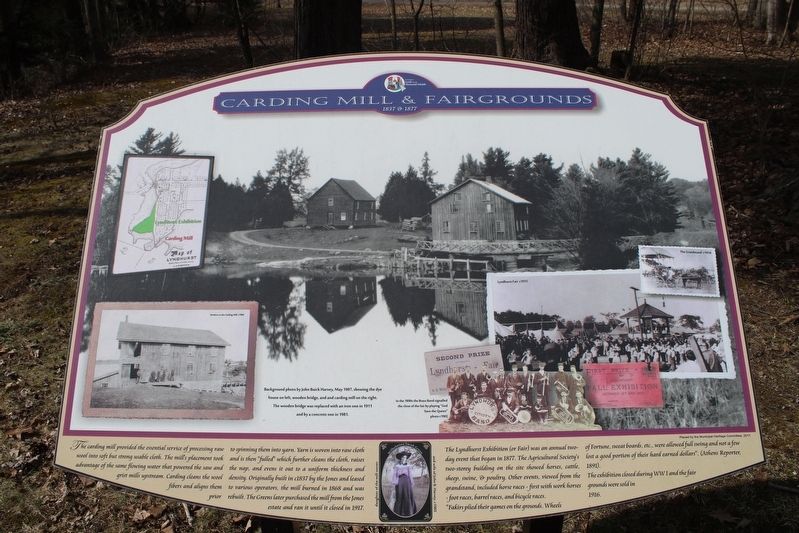
On Jonas Street, on the right when traveling south.
The carding mill provided the essential service of processing raw wool into soft but strong usable cloth. The mill's placement took advantage of the same flowing water that powered the saw and grist mills upstream. Carding cleans the wool fibers . . . — — Map (db m255004) HM
On Lyndhurst Road, on the left when traveling south.
Development of this community began after the construction of the province's first successful iron smelter and a sawmill in 1801. On the west bank of the river a grist-mill was built in 1827 and a village plot laid out by Charles and Jonas Jones of . . . — — Map (db m244317) HM
On Lyndhurst Road, on the right when traveling south.
This was the site of the first iron smelter in Canada west of Quebec. Furnace Falls took its name from the blast furnace. The iron works were built in remote wilderness conditions in 1801 by Wallis Sunderlin an ironmaster from Vermont. By 1803, . . . — — Map (db m244348) HM
On Cook Street at Lyndhurst Road, on the right when traveling south on Cook Street.
While the existence of local ore was well known and various petitions
had been made for the right to erect a foundry, it was not until
1801 that Wallis Sunderlin, a Vermont founderer, established the first
iron works in Upper Canada . . . — — Map (db m244304) HM
On Lyndhurst Road, on the right when traveling south.
The Lyndhurst Bridge
Reputedly the oldest bridge in existence in Ontario, this structure was built in 1856-57. It was designed by John
Roddick, then an employee of a prominent local mill owner, and erected by contractors Miles . . . — — Map (db m244449) HM