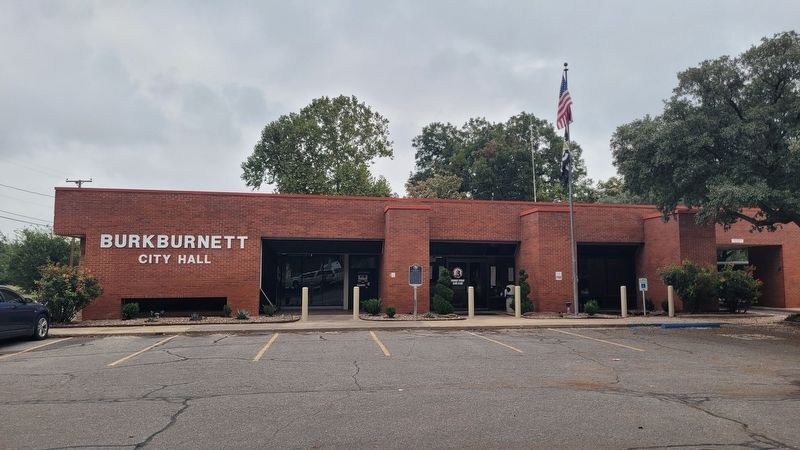
A native of Missouri, Samuel Burk Burnett came to Texas with his family soon after the Civil War. He married Ruth Loyd of Fort Worth in 1870, and in partnership with her father, Martin B. Loyd, established the famous Four Sixes (6666) Ranch in 1875. . . . — — Map (db m287403) HM
The Four Sixes barn was built by Burk Burnett, an influential and prosperous Texas rancher. It housed expensive horses admired by some of the wealthiest men and women in the West. Appearing much as it did when in use at Burnett’s King County ranch, . . . — — Map (db m136052) HM
Home was wherever a cowboy hung his hat. At ranch headquarters, the bunkhouse was his home until he moved on again. This structure from King County, Texas, probably began as a half-dug-out on the site of a buffalo hunter's camp. Its walls and . . . — — Map (db m231260) HM
Created in 1876, King County organized in 1891. Its first courthouse, a two-story frame structure, was destroyed in 1905 by a tornado. The next house of justice, built of sandstone, burned in 1914. That same year, the county hired Fort Worth . . . — — Map (db m105089) HM
The son of noted rancher Burk Burnett for whom the nearby town of Burkburnett (18 Mi.NE) was named Tom L. Burnett (b. 1871) became one of the leading area cattlemen. Trained on his father's 6666 (Four Sixes) Ranch, Tom later owned the local Triangle . . . — — Map (db m288878) HM
Prominent cattleman and civic leader Tom Lloyd Burnet (b. 1871) had this house built in 1924. The Colonial Revival residence was designed by the Wichita Falls architectural firm of Voelcker and Dixon. After Burnett's death in 1938, the house . . . — — Map (db m303641) HM
Settled primarily by settlers from Texas and the southern states, Corn Hill was one of the earliest communities in Williamson County. John E. King, county judge from 1858 to 1860, named it for the home he built on a hill and nearby cornfield in . . . — — Map (db m304400) HM
Thin black lines indicate changes in relevance. Between each pair of lines entries are ordered geographically but all have the same relevance.
* Inflectional forms of words are their plurals, singulars, and possessives as well as gramatical tenses and similar variations.